
One of the first things you’ll want to do after moving into a home in Spain is make it feel like yours. You start hanging things on walls. Some art. Put up a mirror. Mount a shelf.
Simple enough — you’ve done it a hundred times in the US. You grab your drill, pick a spot on the wall, press the bit in and… nothing. The drill whines, the bit spins and the wall laughs at you.
Welcome to the land of concrete walls.
Drywall vs Concrete — The Fundamental Difference
In the US, almost every home is built with wood-frame construction and covered in drywall. Drywall is, as the name suggests, just dried plaster on paper. A standard drill bit goes through it like a warm knife through butter. A plastic anchor and a screw and you’re done in thirty seconds. We’d done it so many times we didn’t even think of it as a skill.
Spain is different. The vast majority of homes — old and new — are built from concrete block or brick. Solid, quiet, incredibly durable and almost completely impervious to a standard drill. If you’ve ever pressed a drill bit against concrete and watched it spin in place while generating heat and a faint smell of burning, you know exactly what we mean.
What You Actually Need
Hanging anything heavier than a picture frame on a Spanish wall requires a few things your US toolkit probably doesn’t include:
A hammer drill (taladro percutor) — this is the non-negotiable one. A hammer drill doesn’t just spin the bit, it also hammers it rapidly into the surface while rotating. That combination is what actually cuts through concrete and masonry. A standard cordless drill does not do this, regardless of how powerful it is or how much you want it to. If you’re going to DIY anything in Spain, a hammer drill is your first purchase.
Masonry bits (brocas para hormigón) — standard drill bits won’t cut concrete either. You need masonry bits, tipped with tungsten carbide. They’re easy to find at any Spanish hardware store (ferretería) and inexpensive. Buy a set in multiple sizes.
Concrete anchors (tacos de plástico) — these replace the drywall anchors you’re used to. They’re plastic plugs that expand inside the drilled hole when a screw is driven into them. Same concept as a drywall anchor but sized for the larger holes that concrete requires. The most common ones in Spain are Fischer brand — ask for tacos Fischer at any hardware store and you’ll be understood immediately.
The process itself is straightforward once you have the right tools: mark your spot, drill with the hammer drill and masonry bit, blow out the dust, insert the taco, drive the screw. It takes longer than drywall but it’s solid — things hung on concrete walls in Spain are not coming down.
A Few Things Worth Knowing
Tiles are a different challenge entirely. Bathrooms and kitchens in Spanish homes are often tiled floor to ceiling. Drilling through tile without cracking it requires a tile bit (broca para azulejos) and a very light touch — start slow, no hammer function until you’re through the tile and into the wall behind it. If in doubt, find a spot where you can avoid tile altogether.
If you hit something hard unexpectedly — a different sound, more resistance, the drill suddenly stops cutting — stop immediately. You may have hit rebar (reinforcing steel) inside the concrete. Drilling through rebar is a job for a professional, not a DIY afternoon.
For lighter items — small frames, hooks, cable management — adhesive strips like Command strips actually work well on painted concrete surfaces and avoid the drilling process entirely. Spain’s painted walls tend to be smoother than the textured finishes common in the US, which helps adhesion. That said, they have limits and anything with real weight still needs a proper anchor.
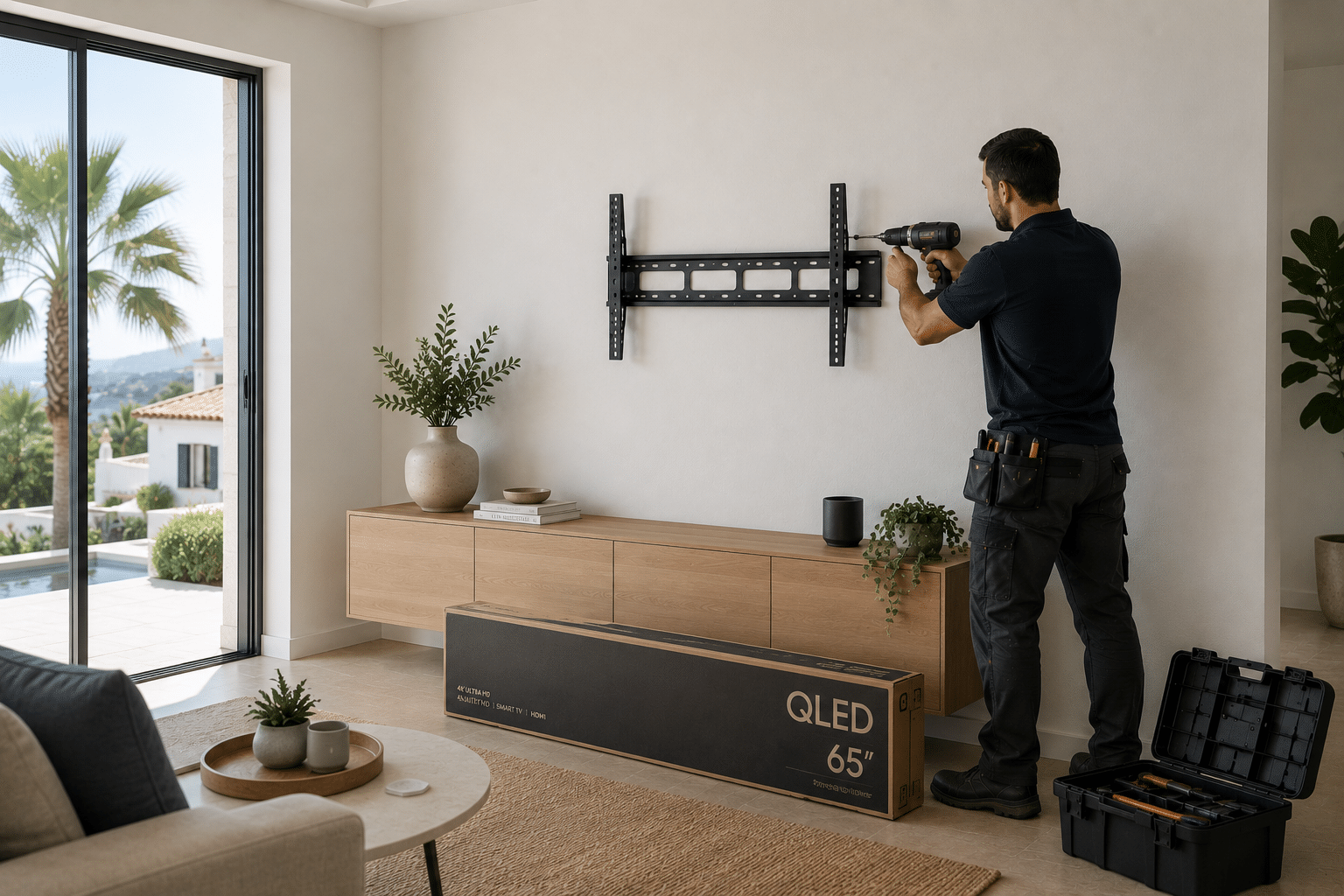
For anything structural — mounting a TV, a heavy mirror, shelving that will carry load — hire a professional. Spanish handymen (known as manitas, literally “little hands”) are easy to find, reasonably priced and will do in an hour what might take you a frustrated afternoon and a cracked tile to accomplish.
When You Change Your Mind — Patching Concrete
In the US, patching a hole in drywall is straightforward — a little spackle, a light sand and you’d never know it was there. Concrete is a bit more involved but still very manageable.
For small screw holes, a ready-mixed filler (masilla or pasta de relleno) works well. It goes on like spackle, dries hard and sands smooth. For larger holes or anything that goes deeper into the wall, a cement-based filler (mortero de reparación) is the better option — it’s more durable and bonds properly to the masonry behind it. Both are available at any ferretería or large hardware store like Leroy Merlin.
The process: fill the hole, let it dry completely — longer than you think, especially in humid weather — sand smooth and touch up with paint. That last step is where it gets interesting. Matching the exact shade of the paint on the wall after the fact can be genuinely difficult, especially if the wall has aged or faded. The practical solution is to keep a small amount of leftover paint from when you first move in. Even a small jar is enough for touch-ups and will save you a frustrating afternoon trying to match a color at the paint counter.