
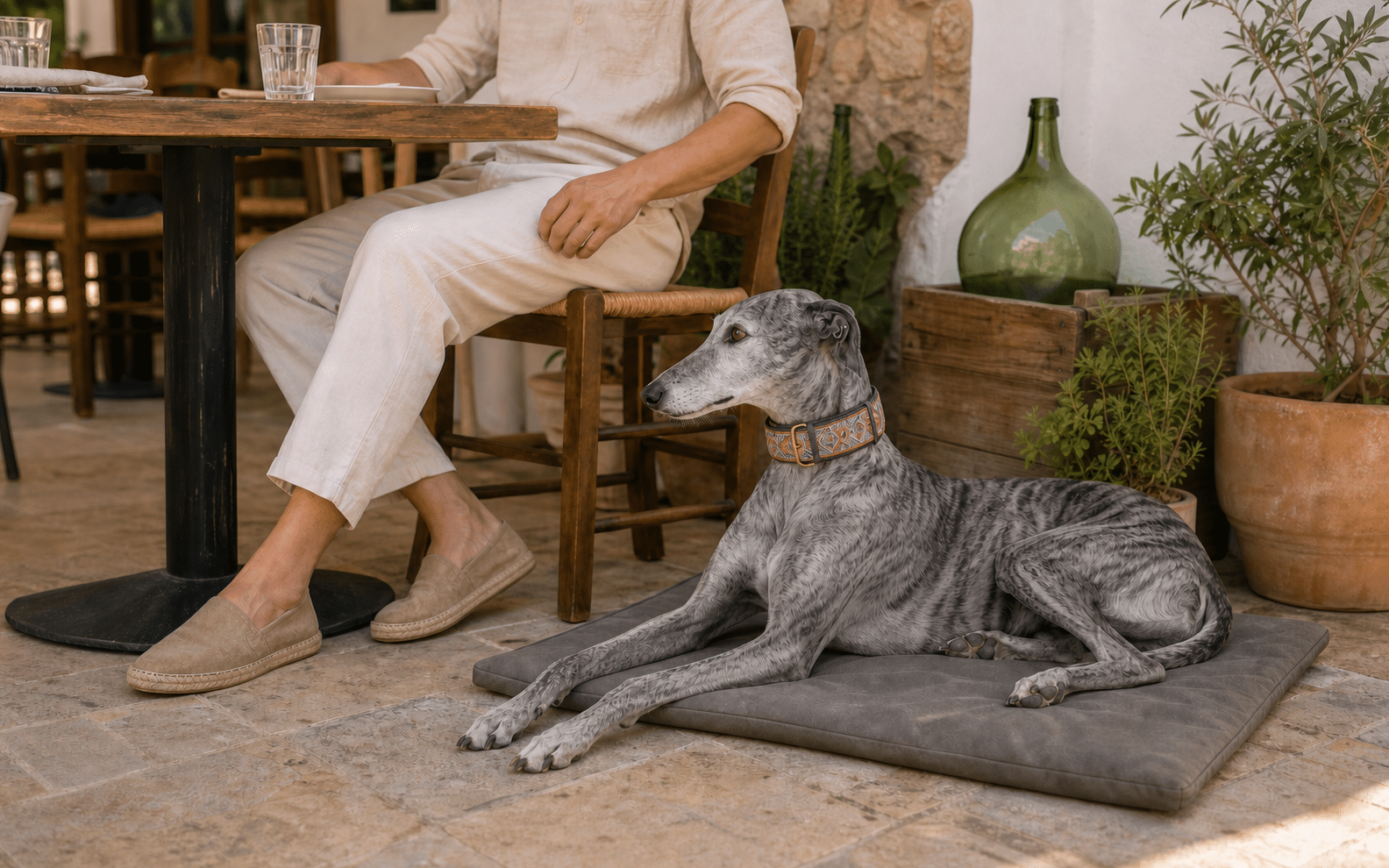
Watch two restaurant terraces on the same village street for an afternoon and you’ll see it. One server greets a dog with a water bowl already in hand, the next points at a non-existent sign and shrugs. Both reactions are common and both come from the same source. A law that changed the rules in 2023 without notifying the businesses affected by it. That inconsistency is the whole story of dogs in shops, restaurants and beaches in Spain. This post will save you an awkward moment or two once you’re settled in Spain.
The Law Changed In 2023, But No One Told Businesses
Spain’s national Animal Welfare Law (Ley 7/2023) came into force in September 2023 and flipped the norm.
Before the new law it was up to the owner of the business to decide whether a dog could come inside. Now, dogs are allowed into most public and private establishments by default. That includes bars, restaurants, hotels, shops and public transport, as long as they don’t pose a risk to people or other animals.
If a business wants to keep dogs out, the law requires them to post a visible sign at the entrance saying so. No sign technically means your dog is welcome. In practice, plenty of business owners still don’t know this and enforcement is inconsistent. It’s still worth a quick glance for a sign or a friendly check with staff before you sit down, especially outside the bigger cities where the rule has had less airtime.
So what do you actually do if there’s no sign and staff still say no? Technically you’re in the right, but there’s no useful way to enforce that in the moment. Nobody is going to call an inspector to your table and pushing the point rarely gets you anywhere except an uncomfortable meal. The businesses who are genuinely breaking the rule are the ones who face a complaint or a fine later, not something you can compel table-side. Our advice is the unsatisfying but practical one: say thanks, take your dog somewhere else and save the mental energy. It happens rarely enough that it isn’t worth the friction.
The one hard line the law draws is hygiene: animals cannot go into food preparation or kitchen areas, so a restaurant can seat your dog at the table and still legally keep it out of the kitchen.
The Comunidad Valenciana Has Its Own Version Of The Law
On top of the national law, the Comunidad Valenciana passed its own regional animal welfare law (Ley 2/2023), which layers on similar language for the area specifically. It applies the same way across the region, whether you’re in Jávea and Dénia or the bigger cities (Valencia, Alicante, Castellón). The practical effect is the same as the national rule: dogs can enter a venue unless there’s a specific rule or posted notice against it and the business itself can still choose to say no.
What the regional law also did was extend mandatory civil liability insurance to all dog owners, not just owners of breeds classified as potentially dangerous (PPP). This is a different thing from pet health insurance, which is optional and covered separately on our Moving With Pets To Spain page. Civil liability insurance isn’t something the government provides or bundles in automatically either; it’s a private policy you buy yourself from an insurer, the same way you’d shop for home or car insurance.
For a standard dog, a basic policy typically runs somewhere in the €20-50 a year range. PPP dogs face a higher legal minimum of coverage and cost more to insure accordingly. If your dog injures someone or damages property, that policy is what responds, and going without one can draw the same 500-10,000 euro fine range as the other welfare law violations.
What This Looks Like In Day-to-Day Life
Restaurants and bars. Terraces and patios are the easy case; almost nobody blinks. Indoor seating varies more by establishment than by any rule and asking first is normal practice, not an imposition. Larger dogs sometimes get a more cautious welcome than small ones, purely as a matter of the owner’s comfort with the space.
Shops and shopping centres. Independent shops tend to follow the owner’s personal preference. Larger shopping centres increasingly market themselves as pet-friendly in common areas, though individual stores inside can still set their own policy. A sign on the mall entrance doesn’t guarantee every shop inside follows suit.
Public transport. Trains, buses and the metro generally allow pets with size or carrier requirements that vary by operator. Small dogs in a carrier are rarely an issue; larger dogs on a leash are usually fine but worth confirming with the specific operator if you’re planning a longer trip.
Hotels. Increasingly pet-friendly, but this is one area where individual property policy still rules. It’s worth confirming directly when booking rather than assuming.
One small comfort we’d recommend either way is bringing a small mat or blanket for your dog to lie on. There’s no rule requiring it, but it’s a common and welcomed habit. It keeps your dog off the tile or terrace stone and staff generally appreciate that you thought of it.
Beaches Are An Exception, Not The Rule
Unlike restaurants and shops, beach access for dogs isn’t governed by the same welcoming default. It’s set locally, beach by beach and most main beaches in our area prohibit dogs during the main summer season, usually April to September.
Jávea, where we’ll be living, doesn’t currently have a dedicated dog beach. The nearest one is Playa Escollera Norte in Dénia which is officially designated for dogs. If you’re travelling further afield in the region, Valencia city has one at Playa de Pinedo and Alicante city has its own near Cabo de Santa Pola. Most of the larger coastal cities in the Comunidad Valenciana have set aside at least one. Some beaches along the coast also relax their rules outside high season (October through March), though this varies by municipality and isn’t guaranteed everywhere. It’s worth checking locally each year rather than assuming last year’s rule still applies.
Where there’s no dog beach and no seasonal exception the ban is still enforceable. It’s one of the few places we’d say the “no sign, no problem” logic from restaurants doesn’t hold. Beach bans are usually posted, but don’t count on a sign either way. Check before you go.
Parks, Streets And Everyday Etiquette
Dogs need to be on a leash in public spaces and leaving a dog tied up unsupervised outside a shop is a specific offence under the national law. It’s punishable by a fine that can run from €500 up to €10,000 for the more serious end of that category. It’s a bigger deal than it sounds since it’s an easy habit to fall into if you’re used to a quick unsupervised tie-up outside a US shop.
Protected natural parks are a separate case from an ordinary municipal park or urban green space. It’s worth knowing the difference given how many of them there are here. The Parc Natural del Montgó, spanning Jávea, Dénia and neighbouring towns, generally allows dogs on the hiking trails, but on a leash at all times. National welfare law specifically calls out protected natural spaces as places where a loose or uncontrolled dog can draw enforcement, on top of whatever the park’s own visitor rules say.
Full national parks (parques nacionales), a stricter category that doesn’t include Montgó, can be far more restrictive, sometimes banning dogs outright in central zones. It’s worth checking a park’s own visitor information before a hike rather than assuming the same rules apply everywhere you go.
If your dog falls under the potentially dangerous breed classification (perro potencialmente peligroso or PPP), expect additional requirements in public: a muzzle at all times, a leash no longer than two metres, and an administrative license from your local ayuntamiento that has to be renewed periodically. This applies regardless of how the individual dog actually behaves. The classification is breed and characteristic-based, not behavioral. We cover the national breed list and the registration process on our Moving With Pets To Spain page.
Regardless of size or breed, don’t count on finding a poop bag dispenser or trash bin along beach walkways and paseos to deal with pet waste. Coverage is inconsistent even in built-up areas and beachfront paths are often the least reliable spot for either. Carry your own bags every time and pack out what you can’t throw away nearby. It’s the one habit that will never get you in trouble.
Dogs In Your Car In Spain
This one catches US arrivals off guard more than almost anything else on this list, since a dog riding loose or sitting on a lap is common practice back home and clearly against the rules here.
Spanish traffic regulations require that a dog not interfere with the driver and be properly restrained. In practice that means a secured crate or carrier on the floor behind the front seats, a cargo barrier if the dog rides in the back seat or a crash-tested harness clipped into a seatbelt. A dog riding loose, in your lap, or with its head out the window can draw a fine anywhere from around €80 up to €500 euros depending on how much it’s judged to be a driving distraction. It also can include a possible loss of points off your license if it’s treated as a serious infraction. It’s a bigger adjustment than it sounds if you’re used to a dog just hopping in the back seat unrestrained. It’s worth sorting out a crate or harness before your first real road trip rather than after a stop by the Guardia Civil.
A List Of Things To Remember About Your Pet In Public In Spain
A short mental checklist saves you the occasional awkward encounter. A few of these are genuinely different from what’s normal back in the US:
None of this requires much extra planning once it’s routine. It just means your first few outings are a bit more “ask first” and after that it mostly takes care of itself.