
Before Moving To Spain
Spanish Taxes
For Expats

Spanish taxes for expats are one of the more complex parts of moving to Spain, especially coming from the US where the system works very differently. Once you’re living in Spain, you’re dealing with two tax systems at the same time and understanding how they interact is key to avoiding surprises.
The goal of this guide isn’t to cover every rule or calculation, but to give you a clear picture of how the system works so you know what to expect and where to focus your planning.

Planning Ahead Before You Move Matters
Taxes between the US and Spain aren’t just about filing returns each year. They influence how you structure your finances over time. Decisions around where to hold investments, how to move money and when to recognize income can all have tax implications in both countries. Getting advice from professionals who understand both systems can be extremely valuable. It can reduce the risk of costly mistakes later on.
If you haven’t already mapped out what your monthly finances will look like on the Spain side, the US vs Spain Monthly Budget Workbook is a useful starting point before the tax picture becomes more concrete.
Knowing Spanish Tax Residency Requirements Is Key
The most important concept to understand when moving to Spain is tax residency. It determines how and where you’ll be taxed.
In Spain, you’re generally considered a tax resident if you spend more than 183 days in the country during a calendar year, or if your primary economic or family ties are in Spain. Once you meet that threshold, Spain considers you a tax resident for the full year and taxes you on your worldwide income not just income earned in Spain.
To minimize this, it helps to coordinate your move carefully with the Spanish tax calendar which runs from January 1 to December 31. Many expats move after July 2nd, so they spend fewer than 183 days in Spain that year. That makes the following January the start of their first official tax year in Spain.
If you anticipate that you may be close to the 183 day limit, it’s a good idea to keep a simple record of your travel days. Flight confirmations, receipts or a basic log of when you enter and leave Spain can suffice. In the event of a question about your tax residency status, having documentation can help support or clarify how many days you’ve actually spent in the country.
It’s important to note that simply buying a home in Spain or obtaining a visa does not automatically make you a tax resident. Residency for tax purposes is primarily based on the 183 days you are physically present in the country.
The Beckham Law: A Special Tax Regime For Qualifying New Residents
Spain offers a special tax regime commonly known as the Beckham Law (officially the Régimen Especial de Trabajadores Desplazados) that allows qualifying new residents to pay a flat 24% tax rate on Spanish-sourced income for up to six years rather than being taxed at the standard progressive IRPF rates. For higher earners this can represent a significant difference.
The regime was originally designed for executives relocating to Spain for work but has been expanded over time. As of 2023, it was broadened to include digital nomads, certain self-employed individuals and entrepreneurs under what is sometimes called the Startups Law. However it is not available to everyone. You must not have been a Spanish tax resident in the five years prior to your move and you must apply within six months of registering with Spanish social security.
There are tradeoffs worth understanding. Under the Beckham Law you are only taxed on Spanish-sourced income rather than your worldwide income. For some expats this is advantageous. For others whose income structure is primarily US-based it may be less so. The Foreign Tax Credit and other standard expat tools work differently under this regime so the math isn’t always straightforward.
If you think you might qualify, it’s worth discussing with a tax advisor who understands both the Spanish and US sides before you arrive in Spain. Once you’ve established tax residency under the standard regime the window to “opt in” closes quickly.
Managing Spanish And US Taxes As An Expat
Moving to Spain doesn’t eliminate your US tax obligations.
US tax obligations are based on citizenship not residency. You’re still required to file a US tax return each year and report your worldwide income even if you live in Spain full time. For many expats, this is one of the more surprising aspects of the move. While this sounds like it could result in double taxation there are systems in place to prevent that, but it does mean you’re dealing with two parallel filing requirements.
The US–Spain Tax Treaty helps determine which country has the primary right to tax different types of income, while tools like the Foreign Tax Credit and the Foreign Earned Income Exclusion help offset taxes paid in one country against obligations in the other. In practice, this means most expats don’t pay tax twice on the same income, but you still need to file in both countries and structure things correctly. Planning ahead can make a meaningful difference in how efficiently this works.
Note that the Foreign Tax Credit is applied against your Spanish taxes due — it does not reduce your taxable income. The credit cannot exceed your Spanish tax liability.
A Key Difference In The Spanish Tax System
The Spanish tax system is designed around the individual not the household. If you’re married, each person files their own tax return and reports only their own income and their share of deductions in Spain. If you file jointly in the US, you’ll take your US joint return, separate each spouse’s earnings, investment income and deductions then report the appropriate portions on each of your individual Spanish tax returns.
For any jointly owned assets in Spain that have income or deductions, Spain assumes 50/50 ownership unless legally specified otherwise. That means each person reports 50% of the total of income or deductions applicable to those assets when calculating their Spanish taxes.

Spanish Personal Income Tax (IRPF)
Spain’s Personal Income Tax known as the IRPF is progressive. The rate increases as income rises. Depending on your income level and the region you live in rates can range from around 19% to over 45%. For many people, this is another adjustment, as the structure and rates can feel quite different from what they’re used to in the US.
There are two components to Spain’s personal income tax:
- General Worldwide Income (Renta General)
- Savings Worldwide Income (Renta del Ahorro)
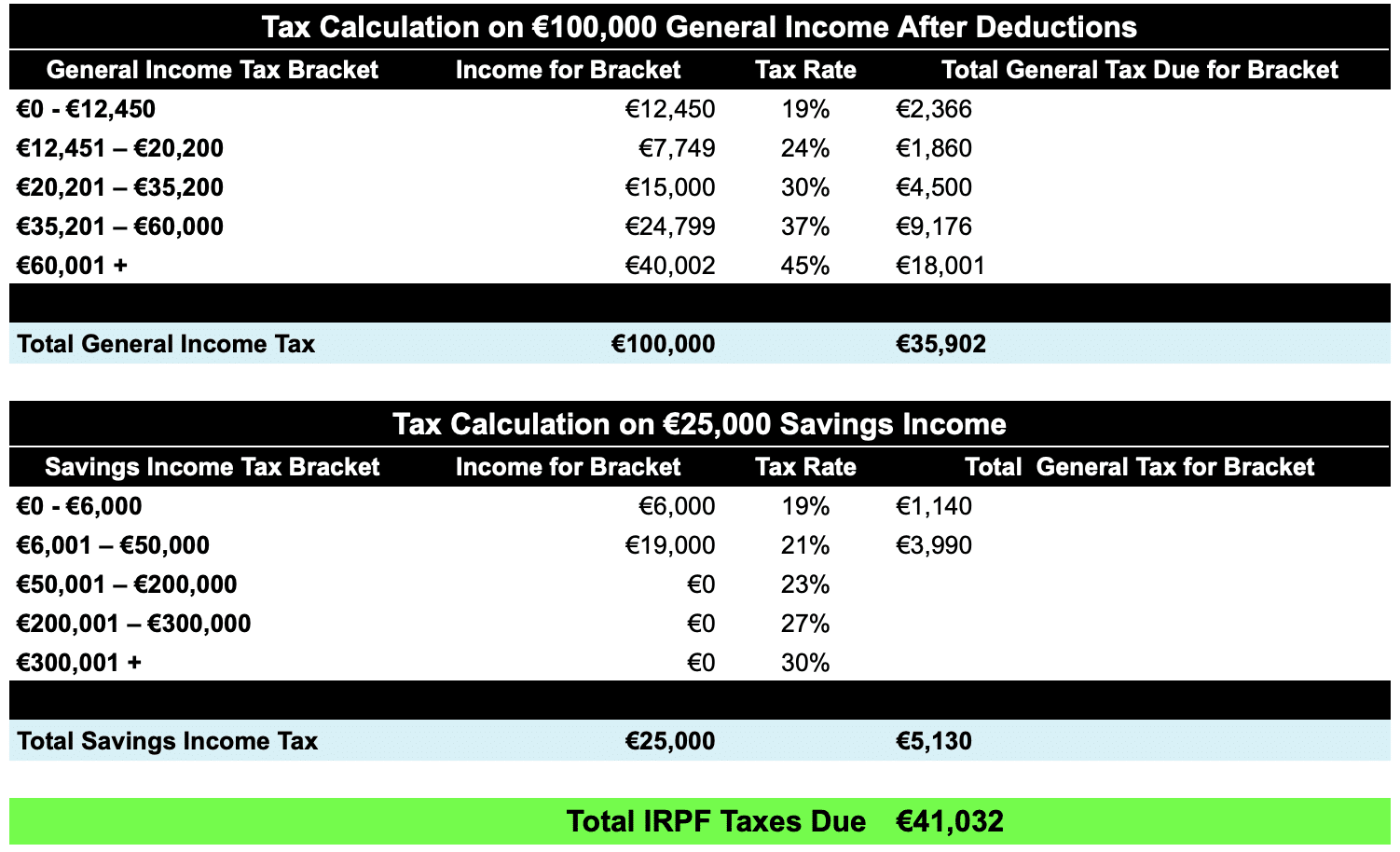
Each component has its own progressive rate scale. Each base is taxed independently so you calculate the tax on your general income then calculate the tax on your savings income. Add the two taxes together and that determines your total IRPF owed.
1. General Worldwide Income (Renta General)
General Income (“Renta General”) is defined as income from these sources:
Deductions for General Income include :
All exemptions listed above to income, personal allowances and wealth exemptions are per person)
The General Income rate can vary between regions (much like state taxes in the US vary by state). The total tax rate includes both federal and regional taxes. In Spain it’s all on one return compared to the US where you file a Federal and State return.
2. Savings Worldwide Income (Renta del Ahorro)
Savings Income (Renta del Ahorro) the second component of the IRPF is defined as income from these sources:
3. Calculating Your Total IRPF Tax
The general rates below are 2025 published rates. As of early 2026, there aren’t any planned changes for the 2026 Tax Year.
Click the tabs below to see the differing rates between general income and on savings income.
| Income - Deductions | Tax Rate | Tax Rate Applied To |
|---|---|---|
| €0 - €12,450 | 19% | On first €12450 of income |
| €12,451 – €20,200 | 24% | On next €7749 of income |
| €20,201 – €35,200 | 30% | On next €15000 of income |
| €35,201 – €60,000 | 37% | On next €24799 of income |
| €60,001 + | 45% | On any income over €60,000 |
| Income | Tax Rate | Tax Rate Applied To |
|---|---|---|
| €0 - €6,000 | 19% | On first €6000 of income |
| €6,001 – €50,000 | 21% | On next €43999 of income |
| €50,001 – €200,000 | 23% | On next €149999 of income |
| €200,001 – €300,000 | 27% | On next €99999 of income |
| €300,001 + | 30% | On any income over €300000 |
Spanish Wealth Tax
In addition to the IRPF, there is a Spanish Wealth Tax, known as the IP. It applies to Spanish residents that have net assets above certain thresholds. While not everyone will be affected, it’s something to be aware of, especially for those with significant assets.
The IP is a regional tax. It is set by each region in Spain and applies every year to the total value of your worldwide assets (property, savings, and investments, after subtracting debts) Most people don’t pay it unless their net wealth is high. If married, each spouse benefits from separate exemptions. Jointly owned assets are divided proportionally (50/50 unless you have another legal arrangement). Structuring ownership of assets and choosing your region of tax residency in Spain can make a major difference in how much (if any) you pay.
Many regions offer high exemptions to the wealth tax (100% for Madrid or €1.3M for a single individual in Valencia for example) but check with the region where you are planning to live for specific information on the IP Tax that may apply in that area.
The Solidarity Tax (ISGF)
The Solidarity Tax is a national tax that only applies to Spanish residents if your worldwide net wealth is above €3 million. It ensures that wealthy individuals in regions with low or no Wealth Tax obligation still pay something.
The Solidarity Tax (like Spain’s Wealth Tax) is assessed per person, not per household or couple. If your personally owned assets are structured correctly and each person in a married couple have less than €3,000,000 in assets each, they owe nothing toward the Solidarity Tax.
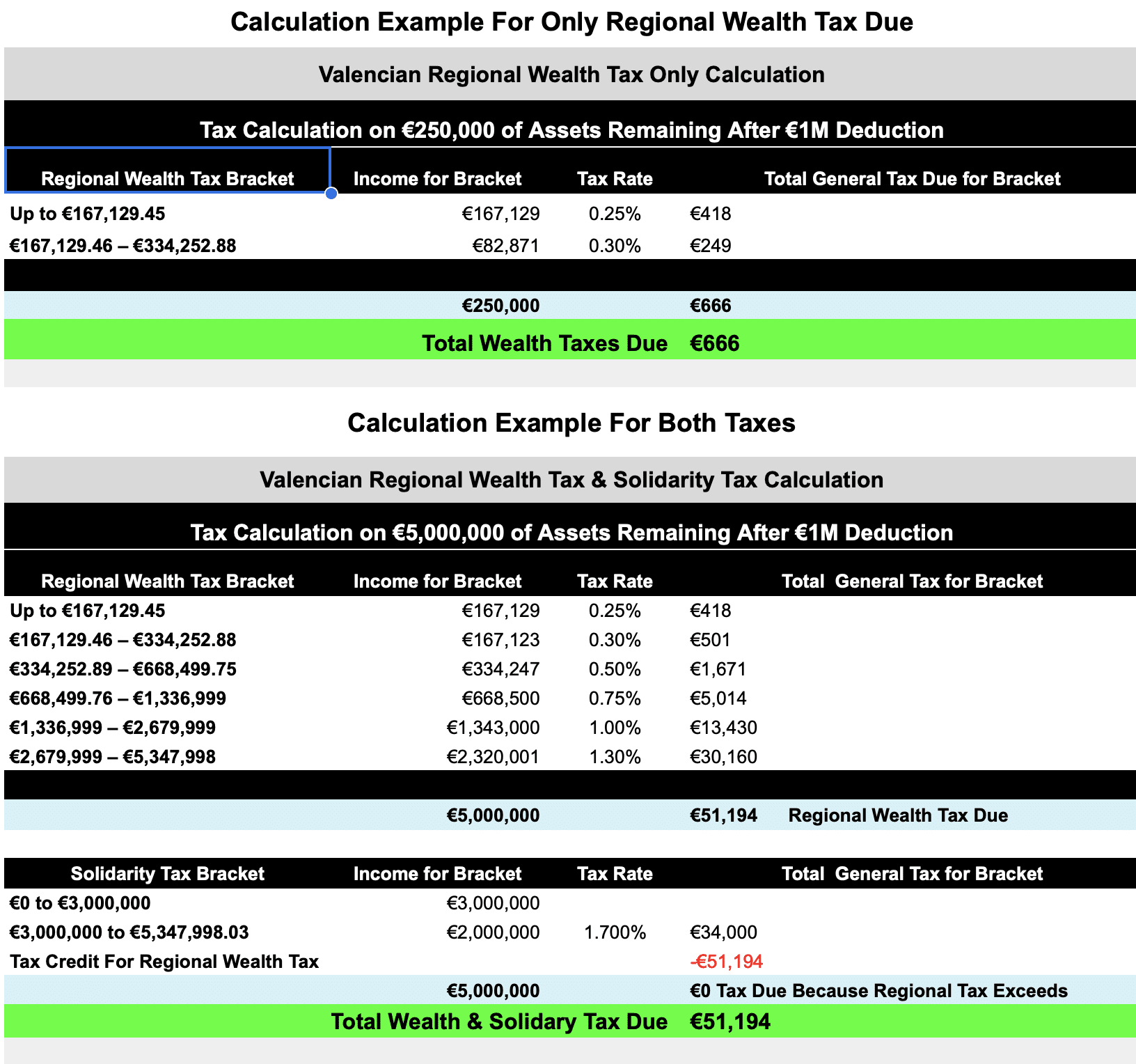
If you qualify to pay BOTH the Wealth Tax (IP) and the Solidarity Tax (ISGF), then you pay your full Wealth Tax to the region and then you pay your Solidarity Tax minus what you paid the region for the Wealth Tax. That ensures that you’re not “double taxed” on your wealth.
Click the tabs below to see the differing rates for the Wealth Tax (Valencia Region shown here) and the Solidarity Tax:
| Value After Std Deductions | Tax Rate |
|---|---|
| Up to €167,129.45 | 0.25 % |
| €167,129.46 – €334,252.88 | 0.30 % |
| €334,252.89 – €668,499.75 | 0.50 % |
| €668,499.76 – €1,336,999 | 0.75 % |
| €1,336,999 – €2,679,999 | 1.00 % |
| €2,679,999 – €5,347,998 | 1.30 % |
| €5,347,998 – €10,695,996 | 1.70 % |
| €10,695,996 – €53,479,998 | 2.10 % |
| More than €53,479,998 | 0.30 % |
| Base liquidable (net wealth after exemptions/deductions) | Rate % |
|---|---|
| Up to €3,000,000 | 0 % |
| From €3,000,000 to €5,347,998.03 | 1.7 % |
| From €5,347,998.03 to €10,695,996.06 | 2.1 % |
| Over €10,695,996.06 | 3.5 % |
Other Non-Income Based Taxes In Spain
The IVA Tax
The Spanish IVA tax is a non-income based tax. It is similar to sales taxes in the US.
Contrary to the US where you see the tax added at the end of your purchase, it’s already included in most prices you see on the shelf, on-line and on the menu in restaurants. In Spain, the rate is consistent across the country. For services it’s usually NOT included in the fee and is added as a line item on your invoice after the fee. The rates are:
Capital Gains On Property And Investments
The savings income section above touches on capital gains briefly, but property sales have a few specifics worth calling out separately.
Gains from selling Spanish property are taxed under the savings income scale rather than the general income scale. The rate brackets for savings income are typically lower than the general IRPF brackets shown earlier — worth confirming the current year’s exact thresholds with your advisor since these get adjusted periodically.
Two exemptions are worth knowing about specifically.
If you’re a Spanish tax resident over 65 selling your primary residence, the gain is generally exempt from capital gains tax entirely. And if you reinvest the proceeds from selling your primary residence into a new primary residence within two years, that gain can also be exempt regardless of age. Neither exemption applies automatically — both require meeting specific conditions, so confirm eligibility before counting on either one.
One more detail that catches people off guard: if you sell Spanish property as a non-resident, the buyer is required to withhold 3% of the purchase price and remit it directly to the Spanish tax authorities on your behalf, as an advance against whatever capital gains tax you actually owe. It’s not an extra tax, just a prepayment mechanism, but it affects how much cash you actually receive at closing.
Inheritance And Gift Tax (Impuesto de Sucesiones y Donaciones)
This is one of the areas where Spain works very differently from the US, and it’s worth understanding well before it becomes relevant.
The US taxes the estate itself, with a high exemption threshold and tax-free receipt for heirs. Spain does the opposite — it taxes the person receiving the inheritance or gift, based on what they personally receive, their relationship to the person who passed, and which region they live in.
Like the Wealth Tax, this is administered regionally and the variation is significant. Many regions offer steep reductions — sometimes 99% — for spouses and children, which can make the effective tax minimal for close family. Other regions are considerably less generous. Where you (or your heirs) are a tax resident at the time, can matter as much as how much is being inherited.
Rates and allowances are also based on how closely related the recipient is to the deceased, with spouses and children treated most favorably and more distant relatives or unrelated recipients taxed more heavily.
For Americans specifically, there’s an important gap worth flagging: unlike income tax, there’s no broad US-Spain treaty mechanism offsetting inheritance tax the way the Foreign Tax Credit offsets income tax.
That means it’s possible to owe Spanish inheritance tax on an inheritance without an automatic credit against any US tax treatment. It’s also worth knowing that non-residents can owe Spanish inheritance tax too, if what they’re inheriting is Spanish-situated property — relevant if family back in the US might someday inherit a home you bought here.
Given how much this varies by region and personal circumstance, this is genuinely one of those areas where getting advice from a Spain-based advisor before it’s relevant, rather than after, makes a real difference.
Also another non-income based tax that may come into play depending on your situation are property taxes.
US Reporting Obligations: FBAR And Foreign Asset Disclosure
Moving to Spain doesn’t reduce your US reporting obligations. In some ways it adds to them.
Two requirements catch many expats off guard. If you hold funds in a Spanish bank account that exceed $10,000 at any point during the calendar year you are required to file an FBAR (FinCEN Form 114) with the US Treasury. This is separate from your tax return and filed independently through the Financial Crimes Enforcement Network. The deadline is April 15 with an automatic extension to October 15. The penalties for non-filing are significant even when no tax is actually owed.
Separately, if your total foreign financial assets exceed certain thresholds ($200,000 for single filers living abroad or $400,000 for married couples filing jointly at year end) you are also required to file Form 8938 as part of your federal tax return. This threshold is lower for those living in the US, so confirm which applies to your situation.
Both requirements apply regardless of whether you owe any US tax. They are reporting obligations not tax obligations, but the IRS treats non-compliance seriously. A US tax advisor familiar with expat finances should review your situation annually to confirm you’re meeting both requirements correctly.
FAQs
Do I need to keep records of my income and transactions from before moving to Spain?
Yes, it’s a good idea to keep clear records from before and after your move. This can help establish timing for tax residency, support income reporting and make it easier to handle questions from tax authorities, if they arise.
Is it difficult to stay compliant with both tax systems?
It can be complex at first, but with the right setup and guidance most expats find it becomes manageable over time.
Are there penalties for not filing required tax forms in Spain?
Yes. Spain takes reporting seriously and penalties for missing filings or incorrect reporting can be significant, even if no tax is ultimately owed.
How are exchange rates handled when reporting income?
Income earned in foreign currencies is typically converted to Euros using official exchange rates. The method used can vary depending on the type of income and reporting requirements.
Do I need to file taxes in Spain if I don’t have Spanish income?
If you’re considered a Spanish tax resident, you still need to file and report your worldwide income even if none of it was earned in Spain.

Before Moving
Everything you need to sort before you leave — visas, NIEs, finances and the hundred other things on your pre-move list.

After The Move
What you need to get sorted once you arrive — utilities, healthcare, paperwork and all the practicalities of your new life in Spain.

Property Guide
Here’s what to know about buying property in Spain as an American — from your first search to signing at the notary.

Resources
Checklists, glossaries and vetted websites to help you plan, prepare and hit the ground running in Spain.

Our Journey
Follow along as we document our move from Portland, Oregon to Jávea, Spain — the highs, the headaches and everything in between.
This page last updated: