
A lot of everyday things are what they are, and you never really think about them twice. Moving to another country upends that. With all of the things that are different, suddenly you’re researching things that never crossed your mind before.
The safety of money in Spanish banks was one of those. Here in the US you see banks display the FDIC emblem. Our first thought was, does Spain have anything like that? Is our money actually safe there?
It turns out the answer is yes, and the details work differently enough from the US system that they’re worth understanding before you move real money across the Atlantic.
The biggest difference is with accounts at brokerage firms. The EU only sets €20,000 or protection and each country decides whether to offer more. Spain goes well above that amount, which matters if you ever end up comparing a Spanish brokerage to one elsewhere in Europe.
What If Your Bank Fails?
In the US, FDIC insurance covers $250,000 per depositor per bank per ownership category. The categories do a lot of work here. Single accounts, joint accounts, retirement accounts and trust accounts each get their own separate $250,000 limit at the same bank, so a couple can often shelter well over a million dollars at one institution just by structuring accounts across categories. A bank failure typically pays out within a few business days.
In Spain (and everywhere else in the EU), the Deposit Guarantee Schemes Directive sets a harmonized €100,000 per depositor per bank, administered in Spain through the Fondo de Garantía de Depósitos (FGD).
It’s simpler and flatter than the US system: no separate categories to stack, though a joint account with two named holders doubles to €200,000, and the limit applies independently at each bank if you split funds across institutions.
One important detail worth knowing if you’re timing a property sale: the directive requires a temporary exception for certain lump sums, including proceeds from selling a home, raising coverage to €500,000 for three months from the date the funds land in the account.
If you’re wiring proceeds from a US property sale into a Spanish account, or receiving a large payout tied to a divorce, retirement or inheritance, this temporary bump is worth knowing about and worth timing account structure around if the amount is significant.
Repayment in case of a bank failure is required within seven business days.
What If Your Brokerage Firm Fails?
In the US, SIPC protects brokerage customers up to $500,000 total per customer, with a $250,000 sub-limit specifically for uninvested cash sitting in the account.
Like FDIC coverage, this only protects against the brokerage itself failing or mishandling custody of your assets. It does not protect against market losses, a stock or fund declining in value, or an issuer going bankrupt.
In Spain, FOGAIN plays the equivalent role for clients of investment firms, brokers and portfolio managers, covering up to €100,000 per investor if the firm becomes insolvent and can’t return your cash or securities.
Just like the SIPC, FOGAIN doesn’t cover market losses or fraud committed by an outside party, only the firm’s own failure to return what it was holding for you.
This is the one area that isn’t uniform across the EU. The underlying directive only requires a €20,000 minimum and Spain opted to guarantee €100,000 instead, five times the floor. A brokerage account held in a different EU country could carry meaningfully less protection depending on what that country chose.
Payout in Spain is required within three months of the insolvency being declared, slower than the FGD’s seven days for straightforward bank failures.
What About Wise and Revolut?
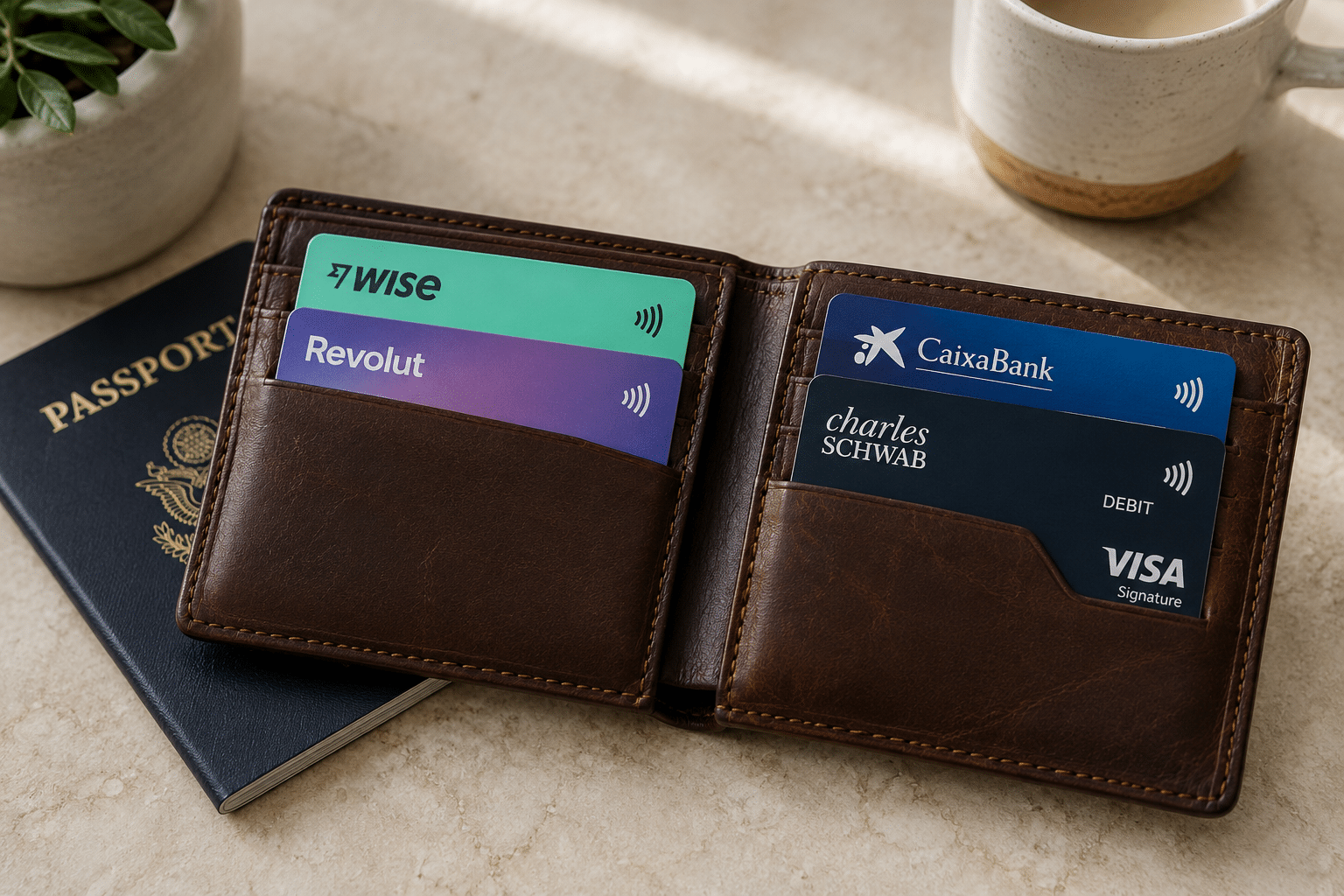
Both come up constantly in expat information websites and both are commonly misunderstood as “basically a bank.” Neither necessarily is and which protection applies depends entirely on which specific legal entity is holding your money, not the name on the app.
Wise operates as an Electronic Money Institution (EMI) everywhere it does business, including its EU entity (Wise Europe SA, based in Belgium). An EMI is legally required to safeguard customer funds, typically by holding them in segregated accounts at real banks, but safeguarding is not the same thing as deposit insurance.
If Wise itself failed, safeguarded funds should still come back to customers, but there’s no FGD or FDIC-style guarantee sitting behind a Wise balance, in Spain or anywhere else. For a Wise account opened in the US, that account is held by Wise’s US entity under US money transmitter regulations, safeguarded per US rules, not by Wise’s EU entity.
Moving to Spain and using the Wise app there doesn’t change which entity holds your existing US account or what protection applies to it. If you want an EU-regulated Wise account, that’s a separate account with the EU entity not an upgrade of the US one.
Revolut is more of a mixed case, because it actually holds a real banking license in parts of Europe. EUR balances held with Revolut Bank UAB, its Lithuanian banking entity, are genuinely covered by the EU deposit guarantee scheme up to €100,000, the same protection as a euro balance at a traditional Spanish bank.
Not every Revolut product or every customer is necessarily on that banking entity. Some balances and account types can still sit under a separate e-money entity without deposit insurance behind them.
The practical move, for either Wise or Revolut, is to check which specific entity your account agreement names rather than assuming coverage based on general reputation.
Unauthorized Card Transactions
In the US, protection depends on which type of card was used.
Debit cards and other electronic transfers fall under Regulation E, which uses a tiered system: your liability is capped at $50 if you report within two business days of noticing the loss, jumps to $500 if you report within 60 days, and becomes unlimited if you report after 60 days from your statement date.
Credit cards fall under a different rule, Regulation Z, which caps liability at $50 regardless of timing.
In practice, the major card networks (Visa, Mastercard, Amex, Discover) voluntarily extend that to zero through their own fraud policies, but that zero-liability protection is a network policy choice, not a legal requirement the way the $50 cap is.
In Spain and the rest of the EU, PSD2 applies one standard regardless of card type.
Maximum liability for an unauthorized transaction is €50 and drops to zero if the loss wasn’t something you could reasonably have detected, or if the bank failed to require strong customer authentication on the transaction. The bank must refund you by the next business day after you report it.
There’s no tiered escalation toward unlimited liability the way US debit cards work under Reg E, and no dependence on a voluntary network policy the way US credit cards work under Reg Z.
Remember that protection follows the card issuer’s home regulator not the country you happen to be standing in when you use it.
Keep a US-issued credit card after moving to Spain and swipe it at a Madrid grocery store and Reg Z still governs that card, because the issuing bank is regulated in the US. The same logic from the Wise and Revolut section applies here too.
A Spanish-issued card gets PSD2 protection; a US-issued card keeps US rules no matter where in the world you use it.
The Risk None of This Covers: Wire Fraud
Everything above protects against unauthorized use, someone else using your card or account without your permission. None of it touches a different and much costlier category: being deceived into wiring money yourself. This is often called authorized push payment fraud and it’s the single biggest financial risk in an international property purchase specifically, not a rare edge case.
The pattern is consistent. Scammers monitor a property transaction, often by compromising a lawyer’s, notary’s or agent’s email account and wait until right before closing. Then they send “updated” wiring instructions from what looks like a completely legitimate, familiar email thread, sometimes with correct names, dates and amounts pulled straight from the real correspondence they’ve been quietly reading. The buyer wires the closing funds exactly as instructed, and the money is gone within hours, typically broken up and moved through multiple accounts before anyone notices.
One widely cited industry survey found just over half of consumers were unaware or only somewhat aware this even happens.
No deposit guarantee, card regulation or bank protection applies here, because you authorized the transfer yourself. Once the money leaves your account to wherever you told the bank to send it, it’s genuinely gone unless it can be clawed back within a very narrow window before the receiving bank moves it again.
Never wire money based solely on emailed instructions, and always independently verify account details by phone, using a number you already had on file before the transaction started, not a number pulled from the email itself.
When working through a property purchase with a real estate agent and a law firm, it’s worth explicitly asking both how they handle wiring instruction changes and agreeing in advance that any change to account details will only ever be confirmed by phone and never trusted from an email alone.
Recap
| United States | Spain (EU-wide unless noted) | |
|---|---|---|
| Bank deposit insurance | $250,000 per depositor, per bank, per ownership category (FDIC) | €100,000 per depositor, per bank (FGD); €200,000 for a joint account |
| Temporary high-balance exception | Not applicable | €500,000 for 3 months, for specific lump sums (home sale, inheritance, divorce, retirement) |
| Bank failure payout timeline | A few business days | 7 business days |
| Brokerage/investment protection | $500,000 total, $250,000 cash sub-limit (SIPC) | €100,000 per investor (FOGAIN) — Spain-specific, EU floor is only €20,000 |
| Brokerage failure payout timeline | Varies by case | 3 months |
| Wise balances | Safeguarded, not deposit-insured | Safeguarded, not deposit-insured (EMI in both jurisdictions) |
| Revolut EUR balances | N/A | €100,000 FGD-equivalent, if held with Revolut Bank UAB (Lithuania) |
| Debit card unauthorized use | $50 / $500 / unlimited, tiered by reporting speed (Reg E) | €50 max, drops to €0 in more cases (PSD2) |
| Credit card unauthorized use | $50 legal cap, $0 in practice via network policy (Reg Z) | €50 max, drops to €0 in more cases (PSD2), same rule as debit |
To Help Protect Yourself And Your Money
Check out these areas of our site for more information on Banking and Managing Finances in Spain.