
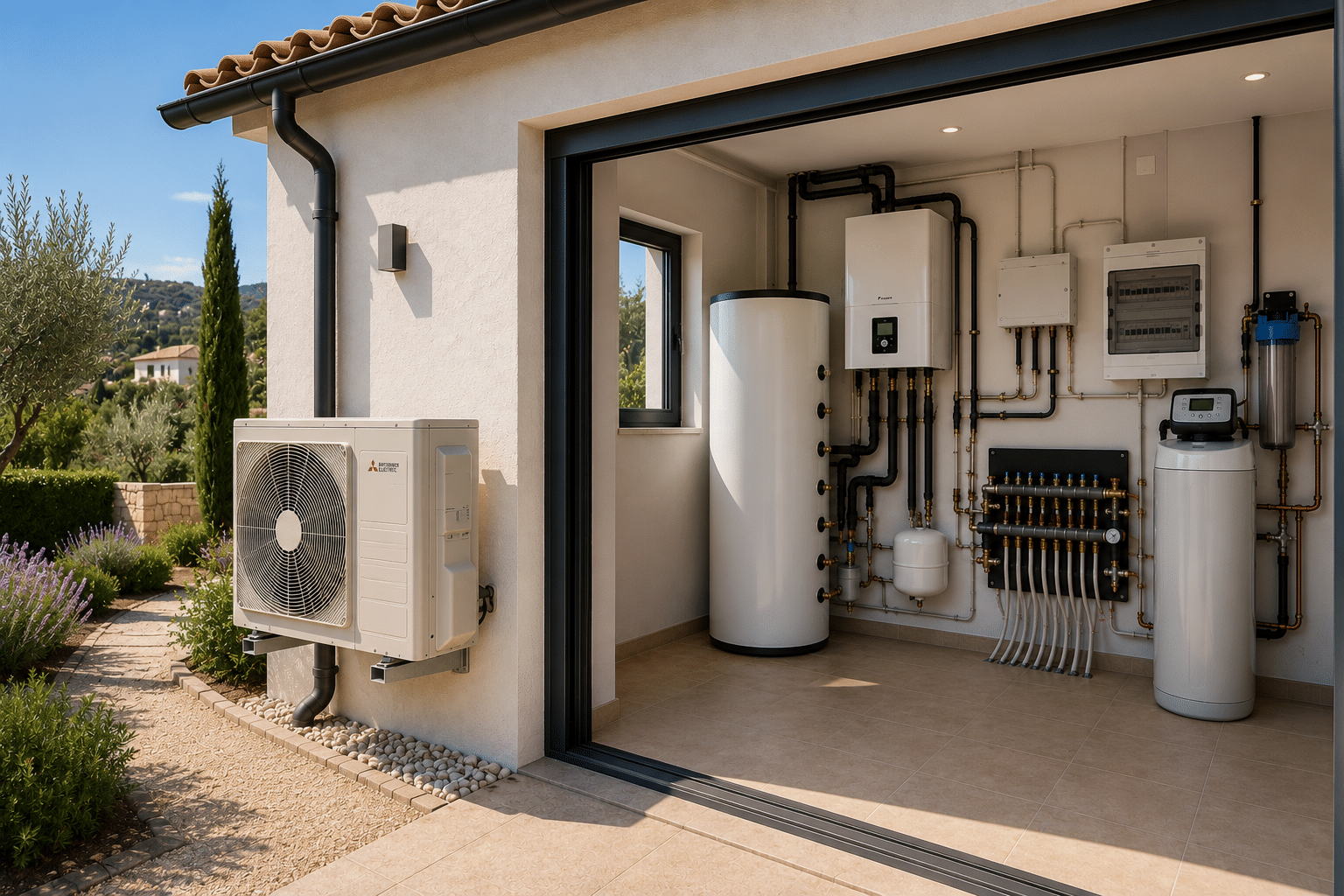
Heating and cooling systems, as well as hot water all work differently in a Spanish home than they do in the US. It’s worth understanding how, before you’re standing in a property trying to figure out what you’re actually looking at.
There’s usually no central furnace and ductwork. Air conditioning often does double duty as the heating system. Hot water frequently comes from a small unit that heats on demand rather than a tank quietly keeping 50 gallons warm in the garage. None of it is worse, it’s just different. Each one affects how you’ll budget for and evaluate a property.
New Build vs. Existing Homes
New builds typically come standard with underfloor heating, central air conditioning and a tankless water heater built in from the start, usually run off an aerothermal heat pump system. Building codes in Spain have required this level of efficiency for a while now, so a new build rarely leaves you guessing.
Existing homes, especially anything built before the 2000s, are a different story. Older properties were built to stay cool in summer not warm in winter and a lot of them were never fitted with ductwork or central systems at all. If you’re looking at resale property, everything below is worth understanding before you go on your home search.
Split Air Conditioning
The system that ends up doing double duty as both AC and heat in most existing homes is the split air conditioner.
A split unit has two parts: an indoor unit mounted on a wall and an outdoor compressor, connected by refrigerant lines. Most modern split units include heat pump technology, so the same unit blows cold air in summer and warm air in winter.
There are three configurations:
Coverage varies a lot from property to property. Some existing homes have a split unit in every bedroom plus the main living area, others have just one unit in the living area and nothing in the bedrooms. This is worth checking room by room when viewing properties rather than assuming a whole-house system is in place.
Installation costs run roughly €500–€1,500 for a single split unit, €1,000–€2,800 for a multi-split covering a few rooms and €2,500–€5,500+ for a fully ducted system. Running costs depend on efficiency rating, but ten hours a day of summer use is roughly €50–€60 a month per unit, less if it’s an A+++ inverter model.
One more thing worth checking before adding units to an older property: every Spanish home has a contracted power limit (potencia contratada), capping how much electricity can run at once. Stacking several split units onto a system sized for an older home’s more modest needs can trip that limit. Increasing that limit may mean needing an updated electrical certificate or minor upgrades.
See our Utilities in Spain guide for more on how this works.
Underfloor Heating in Older Homes
Underfloor heating shows up occasionally in renovated properties, but it’s not something to expect by default outside new construction.
There are two types: electric mats under the tile, cheaper to install but pricier to run and water-based systems connected to a boiler or heat pump which is more expensive upfront but cheaper long-term. In an older home this is generally a renovation add rather than something already there.
Pellet Stoves and Fireplaces
It’s common to see a pellet stove or an open fireplace in older inland or rural properties. Sometimes it’s the sole winter heat source or sometimes as a backup to a split unit.
Running costs are generally low, roughly €60–€100 a month for regular daily use through the coldest months, but they need a bag of pellets stored somewhere and an annual professional cleaning. They’re not something to plan around as a primary system, but worth noting if a listing mentions one.
A Note on “Gas” in Spain
When a Spanish home is described as having gas, it usually doesn’t mean piped natural gas the way it does in most of the US. Piped natural gas is mostly confined to larger inland cities — Madrid, Valencia, Barcelona and similar.
Coastal and rural areas mostly run on bottled gas instead: an 11kg blue butane bottle for indoor use like cooking and hot water, or a 12.5kg propane bottle for outdoor or higher-demand setups. A replacement bottle runs around €15.50–€15.60 exchanged, price-regulated by the government and reviewed every two months.
Homes with heavier gas demand, including some heating setups, often run 6–8 bottles grouped into two switchable sets so you’re never caught empty mid-shower. For the full breakdown of bottle types, pricing and how long a bottle typically lasts depending on what it’s powering, see our Utilities in Spain guide.
The short version for heating purposes: if a listing mentions a gas water heater, ask whether that means a bombona setup or an actual piped connection, since the two work very differently day to day.
Hot Water: Tank vs. Tankless
Spain leans heavily toward the instant, tankless water heater — a calentador if it runs on gas, a termo if it’s electric — especially in apartments and older homes where space is tight.
A gas calentador heats water on demand with no tank and no standby heat loss. It heats roughly twice as fast as an electric version, though output is tied to flow rate. An electric termo usually does store water in a small tank, similar to a US setup, just often smaller than expected.
Water quality matters. Most areas along the Spanish Mediterranean coast — Costa Blanca, Costa del Sol, Catalonia (Barcelona and Tarragona notably) — plus the Balearic Islands are often cited as having notably hard water, which shortens the life of both tank and tankless heaters through limescale buildup — see our Utilities in Spain guide for the full picture on water quality in the area.
One thing worth flagging: the internal anode in an electric tank is supposed to be checked yearly to prevent early failure from hard water, a step most owners admit they skip. A water softener protects your water heater along with the rest of your plumbing fixtures and appliances.
Running costs vary a lot by household size and usage.
An electric termo left running continuously tends to be the most expensive option, since it’s reheating a standing tank around the clock rather than only on demand.
A gas calentador only fires when the tap is open, which keeps the day-to-day bill lower. They do, however, require a periodic gas safety inspection plus the cost of refilling or maintaining the gas supply. It’s worth asking a current owner or your gestor for a recent utility bill during a viewing rather than relying on general estimates. Especially since Spanish electricity tariffs and gas bottle pricing shift fairly often.
Aerothermal Systems
Aerotermia is an air-source heat pump providing heating, cooling and hot water from a single outdoor unit. It’s the system built standard into most new construction and increasingly offered as a retrofit option in renovations. Adding one to an older home is a larger project than swapping in a split unit or a new water heater.
What to Check When Viewing Homes
For new construction, confirm that an aerothermal system, underfloor heating and tankless water heater are actually included in the price rather than an upgrade option.
For existing homes, ask how many split units are installed and where, whether they’re heat-pump capable, what’s producing hot water and its age plus whether there’s any underfloor heating or supplemental heat source like a pellet stove. None are deal breakers but it’s exactly the kind of detail that’s invisible in listing photos.