
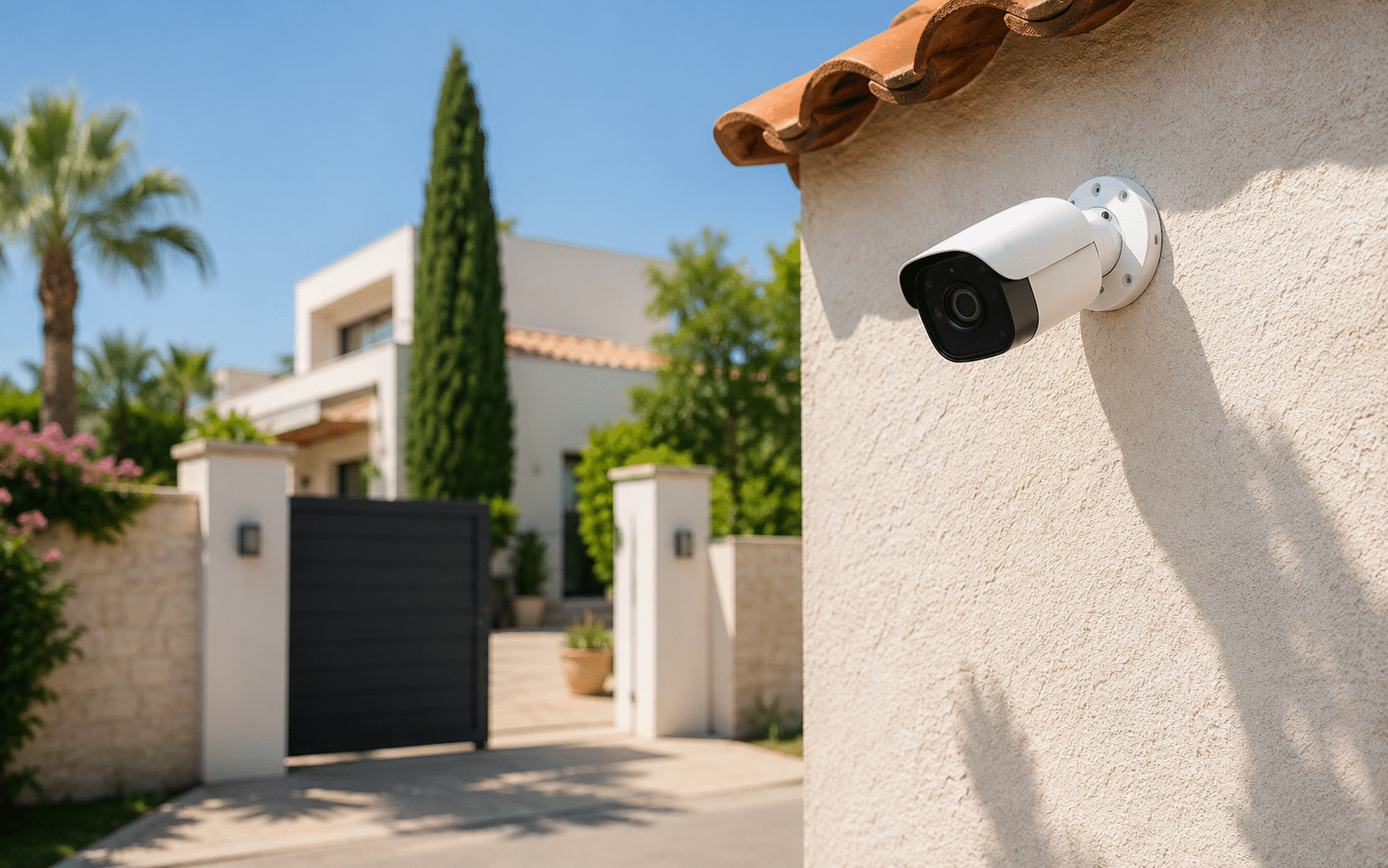
There’s a lot more to consider with home security systems in Spain than in the US. Home security systems in Spain are common in new home construction. Expats who buy an existing home usually install a system if it doesn’t already have one.
There are many professional firms that you can purchase systems from, but if you’re thinking about doing it yourself, it’s not as simple as just ordering some cameras or a video doorbell, installing them wherever you want, and forgetting about it. Real planning is required to make sure you don’t run afoul of Spain’s privacy laws.
Spain treats video and audio recordings on your property, especially footage of anyone else, as personal data. There’s a real legal framework behind where you point your cameras, who needs to know about it, and how long you’re allowed to keep recorded footage. Get it wrong and it’s not just a neighbor being annoyed, the Spanish data protection authority can and does fine people over this.
EU And Spanish Privacy Laws
The first thing is to know what those privacy protections are, so you can set up your home security system correctly. Here’s a brief overview.
GDPR
GDPR is the EU’s General Data Protection Regulation that covers all countries in the EU.
GDPR regulates how anyone’s personal data, which legally includes video footage and audio recordings of an identifiable person, gets collected, used and stored.
LOPDGDD
LOPDGDD (Ley Orgánica de Protección de Datos y Garantía de los Derechos Digitales) is Spain’s own data protection law.
It covers the same core ground as GDPR, but also fills in Spain-specific details that GDPR leaves up to individual countries to decide. These include things like how consent works for minors, rules around workplace monitoring and enforcement specifics.
AEPD
The AEPD (Agencia Española de Protección de Datos) is Spain’s government body responsible for enforcing GDPR and LOPDGDD within Spain.
It investigates complaints and issues guidance like the camera and audio rules covered in this post. It has the authority to levy fines against individuals or businesses that violate data protection law, with penalties for camera and signage violations typically ranging from roughly €1,500 to €20,000 depending on the violation.
Core Rules About Security Cameras
For home security cameras the AEPD publishes its own practical guidance. The core rules are more specific than general GDPR advice would suggest. Here’s a recap of each rule and what it actually looks like in practice.
Stay on your own property. Footage has to stay limited to the home you own. You’re allowed a minimal strip of public road or path outside your home if it’s genuinely necessary to cover your property’s entry point, but you can’t record a neighbor’s property, windows or their front door.
What Is Allowed
An interior camera that only sees your own family and guests, a baby monitor or pet camera pointed entirely within your own home. These stay fully outside data protection rules since they never leave the interior of your home.
A camera on your porch capturing a small strip of your own driveway or the public path right at your entry, or a camera covering your own garden or pool area. These are technically exterior by AEPD’s definition, even though they only capture your own property, so the sign and retention rules below apply. In practice the compliance burden here is light, a sign near the access point and deleting footage after a month covers it.
What Is Not Allowed
A camera angled to capture a neighbor’s garden, pool, windows or front door, or a camera that records an entire street or public area rather than the minimal strip needed to see your own property’s entry point.
Post a sign. Any camera that can see outside your property needs a visible sign at the monitored area. The AEPD publishes an official template design (the standard yellow sign with a camera icon), and using that template automatically satisfies the content requirements without you having to word it yourself.
The signage requirement applies any time a camera can capture images of people outside your home, live view or not, since even briefly viewing someone’s image counts as processing their data.
Limit who can see the footage and how long you keep it. Only the person responsible for the system should have access to footage. Any remote viewing capability over the internet needs to be password protected. Footage can only be kept for one month before it has to be deleted. The only exception is if you need it to report a crime, in which case you’d hand the relevant footage over to police rather than keeping it indefinitely yourself.
Go easy on audio. If your cameras or video doorbell record sound, know that Spanish authorities treat audio as more invasive than video, capturing someone’s actual conversation is a bigger privacy intrusion than capturing their image. Unless you have a specific reason to need it, it’s worth leaving audio recording off on security devices by default.
Hidden cameras are the exception, not the norm. A hidden camera installed specifically to monitor someone without their knowledge is only justified in narrow circumstances, such as a real suspicion of wrongdoing with no other way to confirm it.
Live View Vs Recording: It Matters
There’s a real difference between a camera that streams a live view where nothing is recorded and a camera that actually records and stores footage. Recorded footage requires attention to how long it’s stored and how securely it’s stored.
A live-view-only camera has nothing to retain, nothing to secure beyond the live feed itself and nothing that could later surface in a dispute. If you mainly want the reassurance of checking in on your property, a system set to live view without continuous recording is easier to stay compliant with and carries lower risk.
Rules On Placement Of Cameras
Here are a few practical camera placement rules:
Entrances and driveways: angle the camera inward toward your own property and door, not outward down the street or toward a neighbor’s gate.
Rooftops: a roof-mounted camera should point downward and inward onto your own property, not out across the neighborhood or toward a neighbor’s roof terrace or windows.
Shared walls and boundaries: if your property borders a neighbor’s home closely, as is common with adosados and some villa developments, pan-tilt-zoom cameras need privacy masking set up over any part of the frame that includes the neighbor’s side, to permanently black out that area of the recording.
Gardens and pools: keep these angled to stay within your own boundary walls or fencing, since a camera catching a neighbor’s garden over a shared wall is one of the more common sources of complaints.
Pan-tilt-zoom cameras: these are the riskiest type from a compliance standpoint because they can be repositioned to see more than a fixed installation angle, so masking off restricted areas isn’t optional.
AEPD draws the line at your home’s walls, not your property boundary. Interior cameras are anything inside your home’s walls. Exterior cameras are considered anything outside of your home’s walls, even if it only covers your own property.
Video Doorbells and Smart Locks
Video doorbells sit in an interesting middle ground. The AEPD generally exempts these from the stricter data protection requirements as long as they’re used for exactly what they’re marketed for: checking who’s at the door and letting them in.
Where doorbells get people into trouble is when they go further than that. Those include continuously recording rather than only activating when someone’s at the door, enabling facial recognition features or capturing a shared entry, a neighbor’s entrance or a portion of the street. If your villa has a doorbell that faces a shared street, shared entry or is close to a neighbor’s front door, it’s worth checking the field of view and adjusting it to only cover your entry.
This is one of the more common sources of neighbor disputes in Spain. Someone installs a doorbell camera, a neighbor feels watched every time they come and go and it ends up as a complaint to the AEPD. Spanish courts have ruled that convenience alone, such as wanting to see if a package was left, doesn’t justify a camera that captures a shared entry or a neighbor’s door.
If a doorbell camera records or saves clips and a non-family visitor shows up, do they need to be told?
Legally, yes. Simply seeing the camera on the wall isn’t enough to satisfy that requirement. The information duty specifically requires the camera owner’s identity and how to exercise data rights and a visible camera alone doesn’t convey that. A small compliant sign near the entry door handles it automatically for every visitor without you needing to say anything.
If your doorbell is genuinely just a live view showing you who’s there and doesn’t record anything, it’s basically the same as checking a peephole and no sign is needed.
The practical fix in most cases is simple. Narrow the angle of the camera view to your own entrance, turn off continuous recording and skip the facial recognition feature. It solves the vast majority of disputes before they start.
What About People Who Work In Your Home?
This is the part that catches people off guard. It’s directly relevant if you’re planning to hire regularly scheduled house cleaners, caregivers, gardeners, pool technicians or any other household help.
The AEPD is explicit about this. Once a household employee works in your home and your cameras could reasonably capture them, the whole setup stops being purely domestic in the eyes of the law and becomes subject to full data protection obligations.
In practice that means:
The simplest fix is to turn or schedule cameras off when they are there. That directly satisfies the “no continuous monitoring of work” requirement since there’s nothing being recorded while they’re present. Most modern camera systems’ apps can use schedules to make this easy to set up as a recurring time block rather than you having to remember to do this manually.
Does a worker need to sign something?
Legally, no. A signed document isn’t required. Verbal notice or a visible sign satisfies the basic information duty. Documenting that you informed someone is worth doing, not for their protection, but for your own.
Spanish courts have thrown out camera evidence specifically because an employer couldn’t prove a domestic worker had been informed, even when the footage clearly showed wrongdoing. In one case, hidden footage caught a household employee accessing a family’s safe. Because the cameras were covert and the worker had never been told about them, the recording was ruled inadmissible and couldn’t be used to justify terminating them.
A simple written note, even just a couple of lines added to a work agreement or a text message confirming the conversation happened, is enough to remove any ambiguity later if it’s ever needed. It costs nothing and takes two minutes.
What about people who visit for one-off repairs?
A one-off repair visit, for example a plumber or electrician fixing something once, doesn’t trigger the same obligations. If they’re briefly caught on an interior camera, that stays under the same domestic exemption as any other incidental visitor. If they’re caught on an exterior camera at your door, an existing sign already covers them the same way it covers anyone else.
Do Authorities Have Any Right to Interior Footage?
If cameras only cover the interior of your home and aren’t recording while visitors or workers are there, do Spanish authorities have any automatic right to view or take the footage?
No. This is actually a case where the domestic exemption works in your favor rather than being a loophole.
The Spanish Constitution protects the inviolability of the home under Article 18. Spanish legal interpretation is explicit that this protection isn’t just about physically entering your house, it also covers technological intrusion, meaning police can not install cameras or microphones inside your home or otherwise observe your home’s interior without your consent or a judge’s authorization.
The same underlying principle applies to footage you’ve already recorded yourself. Because your home is constitutionally protected space, authorities generally need your voluntary consent or a judicial warrant to compel you to hand over any stored interior video footage. It’s the same standard that applies to physically searching your home with narrow exceptions like a crime actively in progress.
If you’re ever a crime victim and want to voluntarily hand over your own footage to police, that’s entirely your call to make. But nobody, police included, has an automatic right to walk in and take it without your consent or a court order.
What If Your Security Company Accesses Your Footage?
If you’re using a professionally monitored security system, here’s a scenario worth thinking through: your house gets broken into while you’re away, the alarm triggers, the security company’s monitoring center pulls up your camera feed to see what’s happening and decides whether to dispatch police. That footage was recorded and someone at the security company just looked at it. Whose responsibility is that data at that point, yours or theirs?
It’s more your responsibility than you might expect. It’s less clearly regulated than you might expect, too. For a private home, your camera system generally stays under the same domestic exemption. What actually governs how the security company handles your footage, whether they retain a copy, for how long, and what else they might do with it, is whatever’s written in your service contract and privacy policy with that specific service provider.
It’s worth actually reading the service contract rather than assuming. It’s a question to ask an installer directly before signing up: does their monitoring center retain footage after an alarm event, for how long and is it used for anything beyond verifying that specific incident. Established providers with a lot to lose reputationally tend to have clear answers to this built into their terms, but it’s not something to take for granted, especially with smaller or newer providers.
Choosing A Home Security System In Spain: Full-Service vs DIY
Two established Spanish companies dominate the full-service home security market. Verisure (formerly Securitas Direct in Spain) and Movistar Prosegur. Both handle professional installation, offer 24/7 monitored response and notably, both address the domestic privacy issue directly in their equipment.
Verisure’s motion sensors with built-in cameras can be fitted with a physical privacy mask that fully covers the camera lens when not needed. Movistar Prosegur offers the option to install motion sensors without cameras for households uncomfortable with the idea. Since these are large, established Spanish providers, their installers are generally well versed in local placement and signage requirements as a matter of routine, which takes some of the compliance thinking off your plate.
If you’d rather go DIY, the simplest way to sidestep the data-hosting question entirely is local storage. Consumer brands like Reolink, TP-Link Tapo and Eufy can record to a local microSD card or home hub rather than the cloud, keeping everything on your property. It’s usually cheaper long-term since cloud plans on these platforms typically come with a monthly subscription.
If you do want cloud access for remote viewing, where that cloud data is hosted matters. Plenty of popular doorbell and camera brands, including full smart home ecosystems are run by US companies storing footage on US servers. In the EU, your footage is governed end to end by GDPR with the AEPD enforcing it.
Once a US company stores that footage, the US CLOUD Act lets US law enforcement compel it to hand data over through US legal process, even if the servers themselves sit in Europe. A transatlantic transfer agreement, the EU-US Data Privacy Framework, is meant to make this legal under GDPR, but it’s worth knowing it’s the third such framework in six years, the previous two were both struck down by EU courts and this one is under active litigation now with a possible ruling in 2026 or 2027.
Realistically, the odds anyone actually comes looking for your home security footage are extremely low. But it’s a real difference: European-hosted footage stays inside one clear legal system while US-hosted footage adds a second layer of law on top that can reach it differently. It’s worth checking a system’s privacy policy for where data lives and whether an EU storage option exists. You’ll want to take that into consideration when shopping, especially for spaces where household staff or regular visitors might appear.
What This Looks Like In Practice
Compared to having a security system in your US home, home security systems in Spain come with a lot more to consider. You shouldn’t skip cameras altogether as home security is a completely reasonable thing to have in your Spanish home. It means setting things up with a bit more intention than plugging in whatever arrives from Amazon and pointing it wherever’s convenient.
You need to ensure that cameras are pointed inward toward your own property, post a sign if any camera faces outward, have the two-minute conversation with anyone who works in your home regularly and review your doorbell’s settings for live view versus recording rather than assuming it’s fine as shipped.