

Going back and forth to the EU to plan for a move is a significant part of relocation costs. We’ve tried to plan our move related trips to coincide with vacation trips to save money on airfare. While airfare to Europe has never been cheap, prices keep rising due to all of the current things going on in the world.
One day while getting ready to book a flight, I accidentally reversed the airport codes on the website, going from Spain to the US and back to Spain. The surprise? The exact same transatlantic flight can cost noticeably less if the round trip starts in Europe instead of the US. Same route, same plane, even the same airline — different price depending on which end of the ocean the ticket originates.
It was a big wake up call and is changing the way we think about booking future flights both before and after the move.
Identical Flights Are Priced Differently Depending On Where It Starts
Airlines don’t price a route once and sell it everywhere at that price. They price by market.
A US-to-Europe round trip sold to someone starting in San Francisco and a Europe-to-US round trip sold to someone starting in Barcelona are technically the same flights in reverse, but airlines treat them as separate products aimed at separate customers and set the price based on what each market will bear.
A few things drive that gap:
None of this is a loophole or a trick. It’s just how airline revenue management works. It consistently favors the traveler whose itinerary starts on the European side.
The Biggest Difference: What Happens When Something Goes Wrong
This is the part that matters even more than the cost of airfare. Europe and the US have completely different rules for what an airline owes you when a flight is delayed or cancelled and which rules apply depends on where your flight departs from and who operates it.
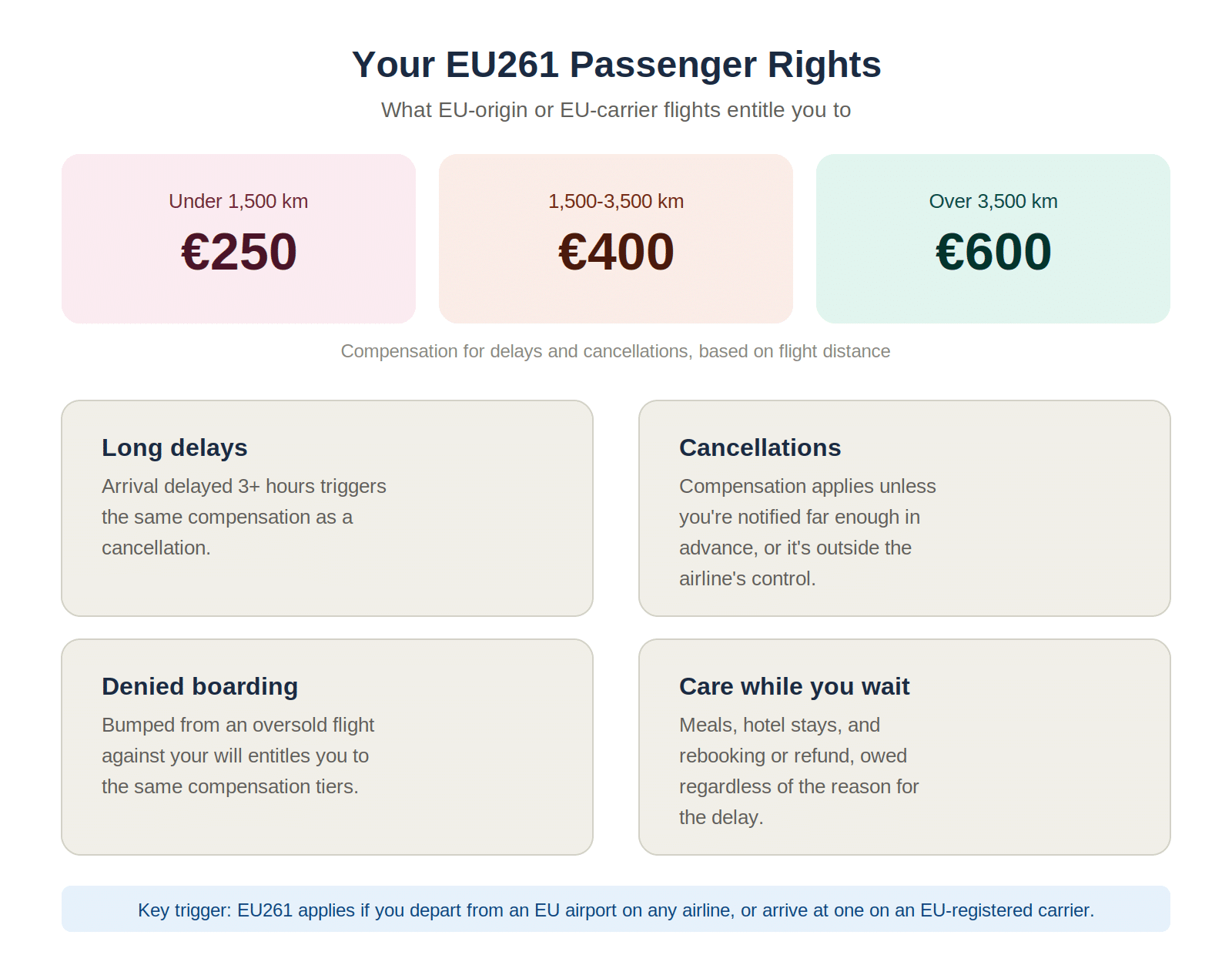
Under EU261, coverage applies as follows:
If you book a codeshare — say the ticket is issued by American but the flight is actually operated by Iberia or Lufthansa — it’s the operating airline that determines EU261 coverage, not the airline whose name is on your confirmation.
For a round trip, the strongest coverage comes from flying an EU-based carrier in both directions: the outbound leg is covered because it departs the EU and the return leg is covered because an EU airline operates it, regardless of where it departs from.
The US Department of Transportation Has Nothing Like EU261
If you fly a US carrier for the return leg instead, that leg falls outside EU261 and you’re back to US DOT refund-only protection for that segment.
Since late 2024, the Department of Transportation requires airlines to automatically refund your ticket if your flight is cancelled or significantly delayed and you choose not to travel. That’s it — you get your money back. There’s no equivalent to the EU’s compensation payment for the inconvenience itself and no requirement for meals or a hotel during a long delay.
EU261 Is Changing But Not The Way Airlines Wanted
The delay threshold was the center of the real fight in Brussels. The Council of the EU, backed by the airline lobby, pushed to raise it from three hours to four hours on shorter routes and six hours on long-haul, which would have stripped compensation rights from a large share of currently eligible passengers. The European Parliament held firm on the other side and on July 7, 2026, MEPs formally approved the reform by a vote of 646 to 12, keeping the three-hour threshold and the existing compensation amounts intact — €250 for flights under 1,500 km, €400 for the middle tier, and €600 for anything longer.
The reform does add a few passenger-friendly changes beyond preserving the status quo:
There’s also a move toward a single, unified claim deadline across the EU instead of the current patchwork of national rules.
Formal publication and entry into force are still pending as of this writing, expected sometime in late 2026 or 2027 after a transition period, so it’s worth checking back if you’re reading this well after publication. But for now, and very likely going forward, the rule that matters most for your wallet — three hours, up to €600 — isn’t going anywhere.
Cutting Travel Costs Between The US, EU And Beyond
While we’re still splitting time between Oregon and Spain, we’ll start booking future relocation related trips starting in the EU. To get that pattern set we’ll need to buy a one-way (US to EU) ticket for our next trip, so that all future trips can be EU-US-EU. The key will be knowing when the next trip after that will be as the EU-US portion will be the return from this next trip and the US-EU part of that round trip ticket will be the following trip after that.
Another upside is that once we’re based in Spain, the rest of the world gets a lot cheaper to reach. Long-haul fares out of European hub airports to places like Southeast Asia, the Middle East and East Africa are routinely a fraction of what the same trip costs from the US thanks to denser route competition and carriers fighting harder for European travelers.
We travel often and this is one of the quieter ways the move pays for itself. A flight from Madrid or Barcelona to Bangkok can run less than half what we’d pay flying out of the US West Coast. Destinations across North Africa and the Middle East that felt like a splurge before are now a short, inexpensive hop.
If travel is part of your life the way it is for us, that’s a real line item worth factoring into your ongoing budget when comparing the true cost of life in Spain versus staying put.
A Couple Of Things To Be Aware Of
Booking sites sometimes localize prices based on your browser location or currency setting, so it’s worth checking fares while actually connected from Europe via VPN using an incognito window rather than assuming a US-based search shows you the EU-side price.
To avoid issues, do not intentionally mis-book itineraries or skip flight segments to game the system. Stick to booking the trip you’re actually going to take.