
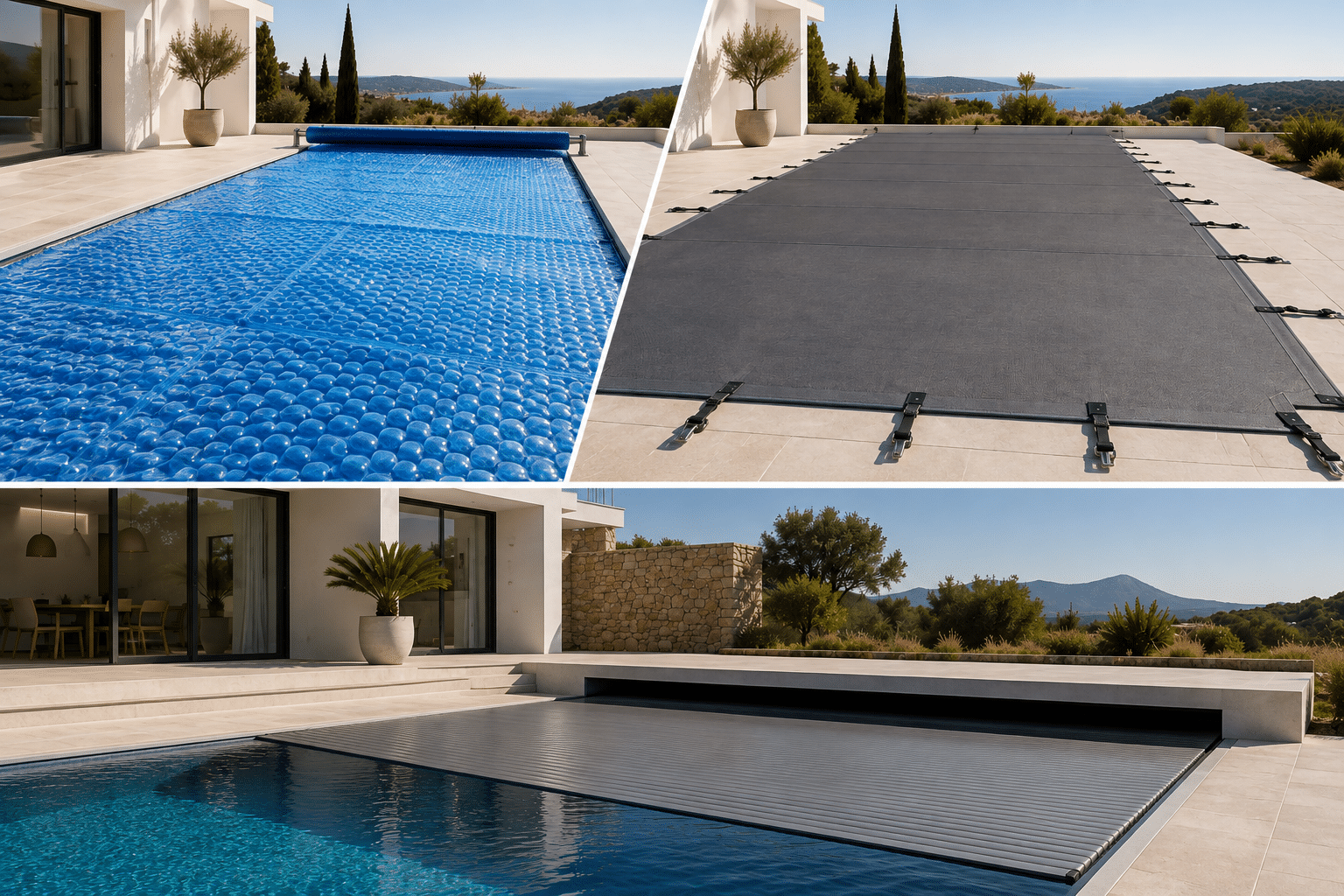
There are roughly 38,000 pools in the Marina Alta area alone (that area includes Jávea, Dénia and the small nearby towns around them). It works out to close to one pool for every five residents. That’s a lot of water sitting outside in the sun all summer. It’s also a lot of water quietly evaporating every day.
Pool covers in Spain are one of the cheapest, most overlooked upgrades you can make. Getting the wrong type of pool cover is a common mistake and one that costs owners far more than the cover itself.
Not Every Pool Cover Does The Same Job
“Pool cover” gets used as a catch-all term. But the three common types solve different problems, and only one of them is actually built to stop a child or pet from falling in.
Solar Pool Covers
These are the lightweight, bubble-wrap style blankets that float on the surface of the pool. They trap heat and cut evaporation significantly. They’re also the cheapest option by far, typically somewhere in the €150-600 range depending on pool size and thickness.
What they don’t do is hold any weight. A solar cover will not stop a child or a dog from going straight through it. It should never be marketed or treated as a safety device.
Safety Pool Covers
These are a different category entirely. They’re made of reinforced mesh or solid material, anchored into the deck around the pool and rated to hold real weight. A proper safety cover genuinely does double duty. It keeps debris and heat loss under control and they’re actually built to stop someone from falling in. Expect somewhere in the €1,000-3,000 range installed.
They cost more than a solar cover and take more effort to remove and refit. That’s why most owners use them for longer stretches such as overnight, a week away or the off-season rather than every day.
Automatic Pool Covers
These roll out and retract along a track with the push of a button. Most are usually motorized though manual crank versions exist too if you’d rather skip the electrical work. They combine the benefits of a safety cover with real day-to-day convenience. That makes them popular for anyone actually using the pool throughout the season rather than closing it up. They’re also by far the most expensive option, generally landing somewhere from €8,000 up to €20,000 or more installed and they need a professional to fit the track system.
One thing worth checking before you commit to a brand is who locally installs and services that system. A proprietary motor or track from a smaller manufacturer can be hard to get repaired if the original installer isn’t around anymore or doesn’t cover your area.
What Spanish Law Requires For Pools
There’s no blanket national law requiring every private, single-family pool in Spain to be fenced or covered. The rules get real for communal pools, urbanisation pools and pools attached to short-term rental properties. Those are typically required to have a lockable barrier or safety cover in place whenever the pool isn’t supervised.
If you’re renting your place out even occasionally or your pool is shared within a community, confirm what your ayuntamiento or community bylaws actually require. Don’t assume a solar blanket satisfies it, since it won’t.
Even without a legal requirement for a private pool, treat a true safety cover the same way you’d treat a fence: it’s a layer of protection not a substitute for watching kids or pets around the water.
Permits For Pool Covers
Permits are a separate question from safety requirements. The answer depends on what kind of cover you’re installing.
A flat safety or automatic cover that tracks along the deck generally falls under routine minor works. Most municipalities don’t require a formal permit for it though some do want a simple obra menor declaration on file, especially if anchors are being drilled into an existing deck.
Where permits become a real requirement is a tall pool enclosure, the kind of structure that rises well above the water rather than lying flat, typically anything over about 1.8 metres in height. Those are generally treated as a construction project and need a building permit from your ayuntamiento before installation.
Since the exact threshold and paperwork vary by municipality, it’s worth a quick check with your local ayuntamiento before you install anything more than a basic flat cover.
Water And Heat Efficiency
Costa Blanca summers are hot and dry. Water stress here is a real, growing problem. Alicante province has already lived through a serious drought in recent years. Entire towns banned pool filling and in a few cases, tap water turned too salty to drink.
As of this year (2026) the region isn’t under an active restriction, but the underlying rule allowing one has stayed on the books. Reservoir levels here can turn quickly. Cutting evaporation with a cover isn’t just about your water bill. It’s a habit worth building before it becomes mandatory, not after.
A cover, even a basic solar one, cuts evaporation dramatically. It also cuts how often you’re topping off the pool or running the heater to make up for a cold night. For a property you’re not swimming in every day, this alone can be worth more than the cover cost within a season or two.
If you’re heating your pool year round rather than just in the shoulder seasons, the case for a cover gets stronger. Most of the heat a pool loses overnight or on a cool winter day, escapes straight off the open water surface. A cover sitting on top overnight can cut that heat loss substantially. That results in your heater, whether it’s electric, gas or solar-assisted, working less to hold the same temperature. That adds up to a real, ongoing drop in either your energy bill or the solar load your system has to carry.
What Is The Best Type Of Pool Cover For You?
Aesthetics matter more to some owners than others. If you’d rather not look at a bulky roller sitting poolside, it’s worth knowing the installation options before you buy.
Track systems for safety and automatic covers generally come in two styles.
A top-mount track sits visibly above the border of the pool; it’s the cheaper and more common option.
A flush or under-deck track is built into the pool edge itself and disappears almost entirely when the cover is open.
The flush option costs more to install, especially as a retrofit on an existing pool, but it’s the cleanest look by a wide margin if a minimalist poolside is the goal. Solar covers are the trickier one to hide, since they need a roller to be practical. A slim, low-profile roller stored against a wall or under a bench seat is a reasonable compromise.
Should you get a manual or electric cover? Solar covers and most safety covers are manual by nature. You roll or unroll them by hand or with a reel. Automatic covers are usually motorized and push-button, but manual crank versions exist if you’d rather avoid running electrical wiring near the pool. Motorized is the more convenient day-to-day choice. Manual is simpler, cheaper to maintain and has nothing to fail electrically.
Pool Cover Lifespan And Maintainance
Lifespan of a pool cover varies a lot by type. It’s worth factoring into the cost comparison, not just the sticker price.
Solar covers hold up for roughly 3 to 5 years under the Costa Blanca sun, less if they’re cheap or left unrolled in direct sunlight when not in use.
Mesh safety covers are the longest-lived option, typically 10 to 15 years. Solid safety covers land in between at 7 to 11. Automatic covers depend heavily on upkeep of the moving parts. The fabric and motor are usually warrantied for 3 to 7 years, but the ropes, tracks and fabric can be serviced or replaced individually well beyond that rather than replacing the whole system.
General upkeep of a pool cover is fairly light. A few habits apply no matter which type you choose.
A quick visual check of your cover every month or two, plus a proper clean two to four times a season, is really all it takes to keep it working as it should. Skipping it is the main reason people replace covers years earlier than they needed to.
If you already have a pool service technician coming by for regular maintenance, ask them to check the cover while they’re there.
First, have them check the tension and condition of the anchor straps on a mesh or solid safety cover. A strap that’s stretched or corroded is the difference between a cover that actually holds weight and one that just looks like it does.
Second, on an automatic cover, they should check the alignment of the track and the condition of the ropes or cables that pull it. Those wear gradually and tend to fail without much warning.
How To Pick The Right Pool Cover
If the pool is mostly decorative or if you’re only using the property part of the year, a solar cover plus a proper safety cover for whenever you’re away is a reasonable, affordable combination.
If you’re living in the villa full time, have kids or grandkids visiting regularly or you’re renting the property out the case for an automatic cover gets a lot stronger. It’s the only option people will actually use every single day without it becoming a chore.
Whatever you land on don’t let a solar blanket do a safety cover’s job. They’re not built for it. Treating them as interchangeable is the mistake that actually matters.