
We’ve covered the basics of Spanish driving schools (autoescuelas) and how they work on our Spanish driver’s license page. This post goes further into the actual process: what it costs, how long it takes, and a few details that catch Americans off guard.
Plenty of countries let you swap your foreign license for a local one with no test at all. Spain does this for close to 35 countries. The bad news, the US isn’t one of them. As of 2026 no individual US state has an agreement with Spain either. If someone tells you their state has a deal with Spain, verify it directly with the DGT as there is a lot of false information on the web on this topic.
You Have Six Months To Pass Driving School
Once you become a legal resident of Spain your US license is valid for 6 months. After that, it’s simply not valid to drive on anymore. Driving on an expired foreign license can bring a fine of up to €500. If you’re in an accident while driving on it, your insurance can refuse to cover the claim. To keep driving after six months you have to get a full Spanish license.
This means passing the same theory and practical exams as someone who’s never driven before in their life. Years of US driving experience don’t shorten the process or exempt you from any part of it. There’s no partial credit, no administrative workaround and no way around actually enrolling in an autoescuela, (Spanish driving school) and going through the whole thing.
Here’s The Process, Step By Step
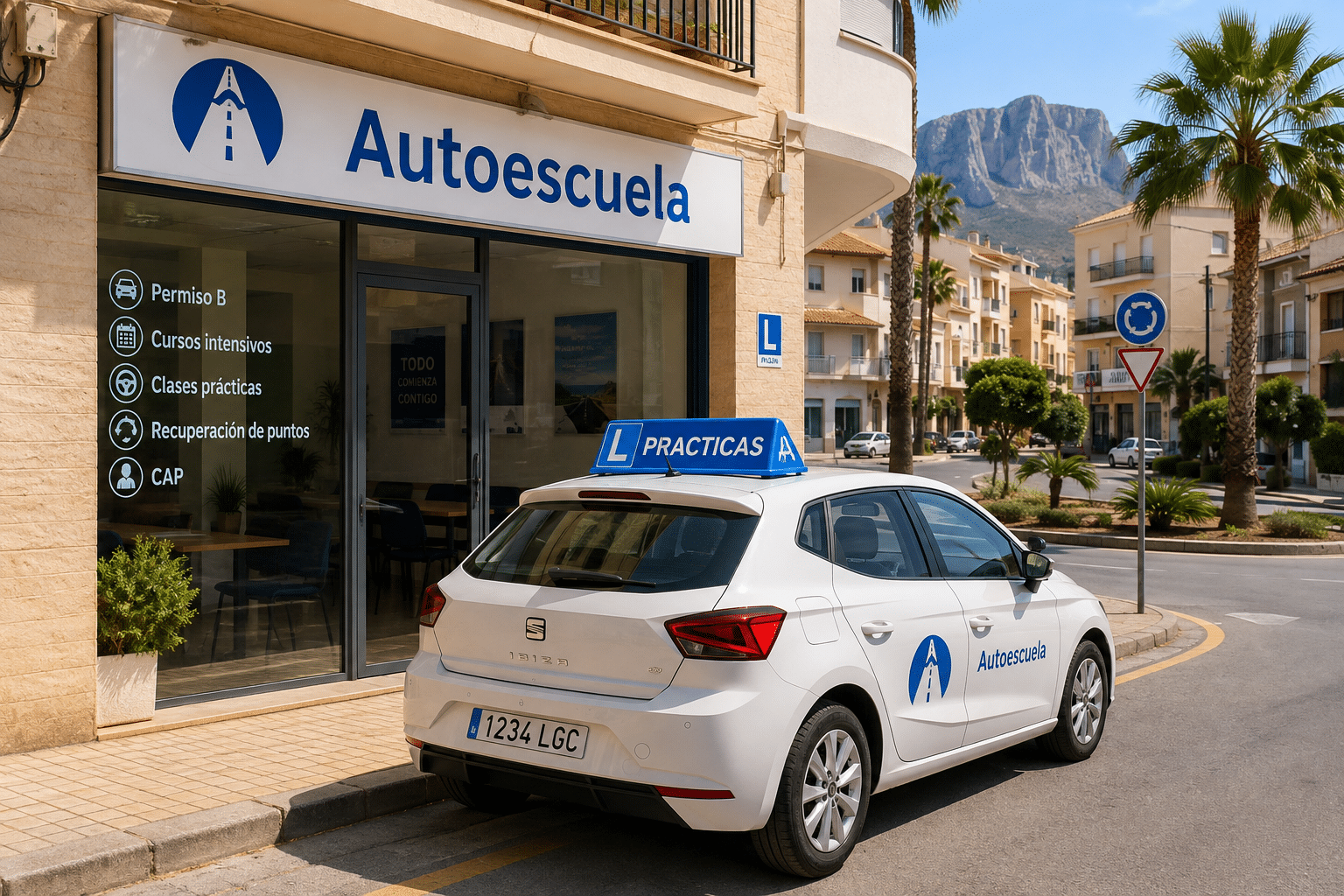
The first step is enrolling with an autoescuela, a Spanish driving school.
They’ll handle scheduling your exams with the DGT and provide the car and instructor for your practical lessons and test. Once you’re enrolled, you’ll need to get a few documents in order before you can actually book a test date:
Without a valid NIE, the DGT won’t let you schedule an exam, so it’s worth confirming that’s settled before you enroll.
From there, the process runs in two parts.
The theory exam covers 30 questions on traffic law and signage, and you’re allowed up to 3 wrong answers to pass. As mentioned on our driving schools overview, you can take the theory exam in English, French or German, not just Spanish.
The practical driving exam is Spanish-only, no exceptions, and the examiner may ask basic questions about the car itself, checking your oil, for example, as part of it. Most driving schools recommend doing at least your practical lessons in Spanish too, even if you tested through on the English theory exam, simply so you’re not caught off guard by instructions during the actual test.
Your instructor does sit in the car during the practical exam, in the front passenger seat, with the examiner directly behind them in the back. Since they’re right there, it’s plausible (but not guaranteed) they could step in and clarify something informally if you’re genuinely confused about an instruction. There is no official accommodation and no guarantee an examiner allows it or that your instructor offers it.
The exam is meant to assess your own understanding and independent driving, not a translated relay, so it’s safer to treat any in-car help as a lucky break rather than something to plan around. Preparing your practical lessons in Spanish ahead of time is still the more reliable move.
If you already speak Spanish from elsewhere, Spain’s traffic code uses its own specific vocabulary, arcén for shoulder, calzada for roadway, isleta for a traffic island. That doesn’t always match the terms used in Latin American Spanish.
Brush Up On Driving A Manual Transmission Vehicle
If you take your practical exam in an automatic car your Spanish license comes with a restriction limiting you to automatic vehicles only. That might sound like a non-issue if you’ve only ever driven automatics. Manual transmission cars are still far more common in Spain, in the used car market and in rental fleets. An automatic-restricted license can genuinely limit your options down the road.
If there’s any chance you’ll want to drive a manual car in Spain, whether it’s a rental on a road trip or a used car you pick up locally, it’s worth training and testing on manual from the start, even though it usually takes more practice hours to feel confident. Testing in a manual car gives you the unrestricted license that covers both.
What Does An Autoescuela Cost?
Total cost varies more than most people expect. It depends heavily on how many practical lessons you personally need before you’re ready for the test.
The fixed costs are fairly predictable:
On top of that, you’re paying per practical driving lesson and that’s the part that impacts the total. Most people land somewhere between €700 and €1,500 by the time they’re licensed.
How Long Does It Take?
Plan on 3 to 6 months from enrollment to license in hand, depending on where you live, how quickly you can book lessons and exam dates and whether you pass both exams on the first attempt. It’s not something to leave until month 5 of your 6-month grace period. Start the process early enough that a failed attempt or a scheduling delay doesn’t push you past the deadline.
What Is The Experience Like?
Don’t show up to your exam without having actually driven in an autoescuela car first.
Every car handles a little differently and local examiners tend to have specific routes and habits that instructors know well and first-timers don’t. Beyond English-language support it’s worth asking a school directly about their pass rate before enrolling. That’s a better signal of how well they actually prepare foreign students than the language of instruction alone.
Once you’ve got the license, the rules of the road themselves are a separate adjustment. We cover the habits most likely to catch a US driver off guard in our post on driving in Spain, worth a read once you’re actually on the road here.