
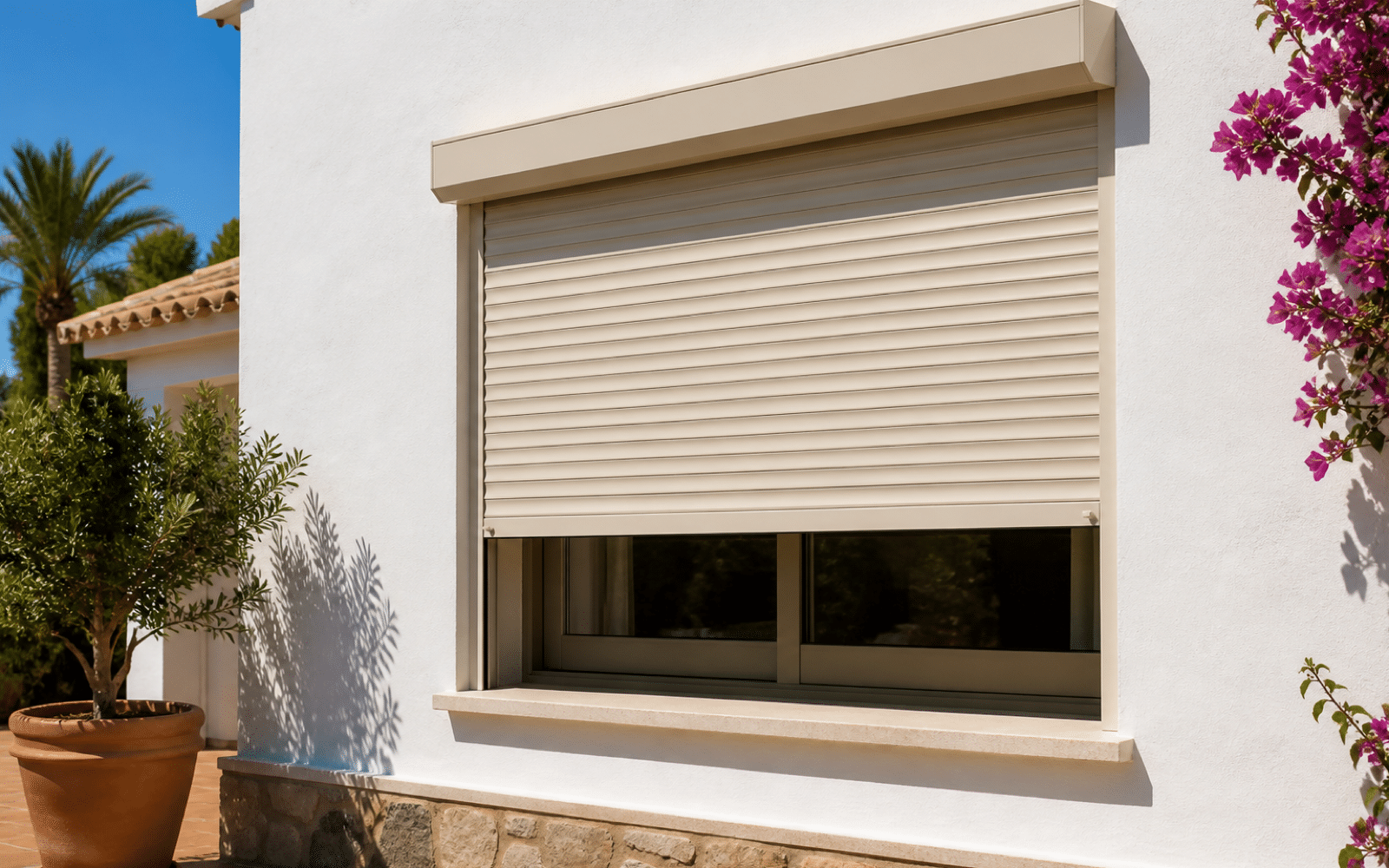
If you’ve traveled to Europe, you’ve probably noticed persianas on a lot of apartment and home windows. In the US, there’s really nothing similar on residential homes. A persiana is a roller shutter that lives in a box above the window frame. It rolls down to fully cover the glass. Spaniards use them every day, and once you understand why, you’ll wonder how you ever lived without them.
What Exactly Is A Persiana?
A Persian differs from the interior blinds most Americans are familiar with. It sits on the outside of the glass. That means it blocks heat before it reaches your window, not just after the sun has already turned your glass into a radiator. It’s an external solid shutter made of interlocking horizontal slats, usually aluminum or PVC. It stores in a box (cajón) mounted above the window. You raise and lower it with a strap or a crank that’s inside the room or with a motor if it’s equipped with one. When it’s fully closed, it blocks nearly all outside light and adds a real layer of insulation and security to your home.
Why Are They So Popular In Spain?
Climate control. Costa Blanca summers push well past 35°C (95°F) for weeks at a time. A closed persiana during the hottest afternoon hours keeps direct sun off the glass. That measurably cuts how hard your AC has to work. If you’ve read our post on heating and cooling, you already know Spanish homes lean on passive strategies like this before turning on the AC.
Security. A closed persiana is a solid barrier, not a pane of glass. Ground-floor units and street-facing bedrooms lean on this heavily. Especially when a home sits empty for stretches, whether that’s a summer trip back to the US, a normal workday or traveling often once you’ve moved.
A dark, empty-looking window signals that nobody’s home. A row of closed persianas doesn’t send that same signal, since Spaniards close them for heat and privacy just as often as they do for an empty house. Persianas also block anyone’s ability to see into the property from outside, which is worth something on its own whether or not you’re away.
Privacy. Closing a persiana fully blocks sightlines completely. This matters more in Spain than in the US, given how much closer buildings sit to the street and to each other.
Noise. A closed persiana adds a real buffer against street noise. This matters if you’re near a bar-lined street, shopping area or roadway.
Light Blocking. Many Spaniards close their persianas fully every night not just during heat waves. A fully closed persiana blocks essentially all light, more than a blackout shade or curtain does.
It also pairs with a slightly later daily rhythm in Spain. Evenings run later and mornings start a bit slower than a typical US schedule. A dark room until you’re ready to get up fits that rhythm well.
None of this is a design trend. It’s a functional response to a hotter, denser, more security-conscious way of living than most Americans are used to. That’s why you’ll find persianas on nearly every window in the country, old villa or new build alike.
Types Of Persianas You’ll Run Into
Enrollables (roller shutters). The standard type, and what most people mean when they say persiana. Horizontal slats roll up into a box above the window.
Mallorquinas. Fixed wooden slat shutters, angled to let air and diffused light through even when closed. More common on older or traditional-style properties, particularly in villages and less common in modern builds.
Alicantinas. A regional variant common on the Costa Blanca. It’s similar in concept to mallorquinas but with a distinct slat style. If you’re house-hunting around Jávea or Dénia, you’ll see the term used locally.
For a new install or retrofit, aluminum enrollables are the default choice. They’re the most weatherproof, the easiest to motorize and the easiest to source parts for down the road.
Manual Or Motorized Persianas?
Manual persianas use a strap (cinta) or a crank to raise and lower the shutter by hand. They’re cheaper, simpler and have nothing to break beyond the strap itself. That said, straps do wear out over years of daily use. Replacing one is a small, routine repair, not a sign anything is seriously wrong.
Motorized persianas raise and lower at the push of a button. They usually connect to an app or a home automation system, letting you set a schedule so shutters close automatically during the hottest part of the day even when you’re not home. If you’re already planning a broader smart home setup, it’s worth checking out our home automation post.
Retrofitting an existing manual persiana to be motorized isn’t always a full replacement. Motor kits exist that fit inside an existing box, generally running an extra €100 to €300 per window depending on the box type and whether it needs a wired connection or works off a battery and remote.
What Do Persianas Cost?
Costs vary by material, size, and how much of the existing structure you can reuse. As a rough guide:
A whole-home retrofit adds up fast if you’re doing every window in an older resale property. Budget persianas as part of your broader move-in costs rather than treating them as a minor line item, especially if the property you’re buying doesn’t have them already or has old, deteriorating units that need replacing.
Some Spanish home insurance providers offer a small premium discount for security features, including persianas. It’s not a huge saving on its own, but worth asking about when you set up your policy.
Installing In An Existing Home vs A New Build
New builds almost always come with persianas already installed. They’re standard in Spanish residential construction. But don’t assume that means every window.
If you’re building a new home from the ground up, your main decisions are which windows get them, manual vs motorized and whether to integrate them into a broader home automation package at the build stage. Doing this at the build stage is far cheaper than retrofitting later.
Existing homes are more variable. Older properties, especially those built decades ago, often have a cajón de obra (a box built directly into the wall structure with mortar and brick rather than a modern prefabricated unit). Replacing one of these isn’t as simple as swapping a part. It can mean opening up the wall around the window, which adds cost, mess and time compared to a modern retrofit.
The good news is there are PVC replacement box kits exist specifically for this situation. They fit inside the existing cajón de obra opening without demolition, sealing up the old box and installing a new, better-insulated unit inside it.
Old, worn cajones are a real source of heat and air loss, similar to the effect of single-pane windows. If a home has its original 1980s or 1990s wooden persianas and boxes, factor a retrofit into your renovation budget rather than assuming they’ll be fine as-is.