
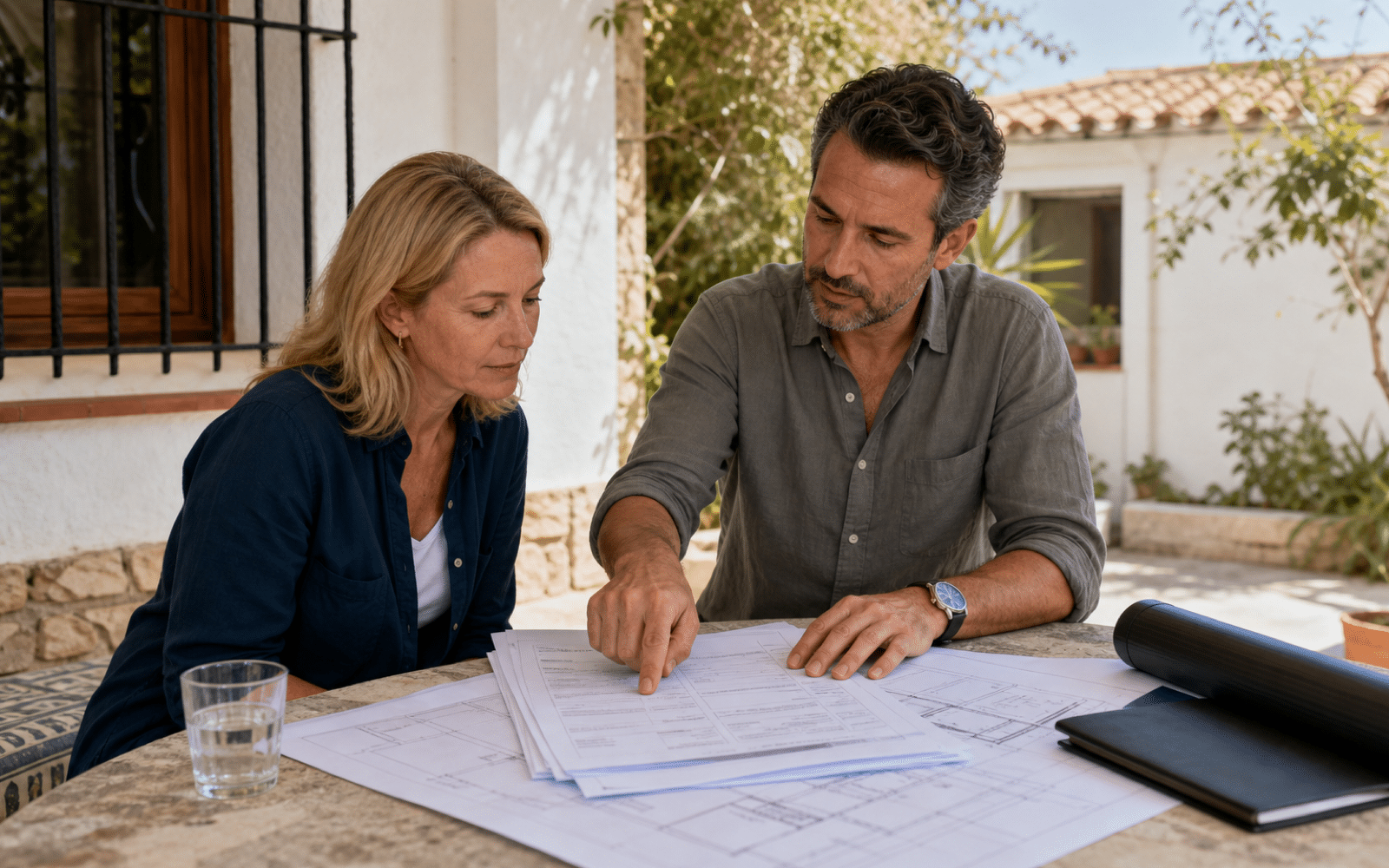
As we’re looking for a place to live, in addition to new construction we also thought about renovating a home in Spain. One of our first thoughts was: what are we actually allowed to do without a permit? The answer isn’t as simple as “big projects need permits, small ones don’t.” Spain runs on a three-tier system, the rules vary by municipality, and getting it wrong can mean fines, a stopped project or a home you can’t legally sell until you fix it.
Renovating A Home In Spain Can Involve Three Types Of Permits
Spain doesn’t have one single “renovation permit.” Depending on what you’re doing, you’ll fall into one of three categories.
Licencia De Obra Mayor
This is a major works permit that’s required for anything touching the structure, the facade, the roofline, or the building’s official use. Think knocking down a load-bearing wall, adding a floor, changing a garage into living space, or altering the exterior. This is the most involved permit type.
This permit requires a technical project drafted and signed by an architect (aparejador). You need approval before you start work, not just before you finish.
Costs break into three pieces:
A decision on the permit generally takes one to three months and can stretch to six months in busier municipalities or during high season. Once work starts, expect a site visit from the ayuntamiento’s technical staff (técnico municipal) at key stages, not just at the end.
Licencia De Obra Menor
A light works permit that covers changes to installations or interior layout without touching structure. Retiling a bathroom, replacing plumbing or electrical runs, moving a non-structural interior wall.
This is a lighter process, but many towns still require review and approval before work begins.
The ICIO construction tax still applies. The municipal administrative fee is smaller, often in the €30 to €150 range for a typical project.
A decision usually takes one to four weeks. Inspection here is generally reactive rather than scheduled, meaning the municipality can request proof of your permit at any point rather than sending someone out during the work.
Declaración Responsable
The lightest of the three permits. This is used for surface-level cosmetic changes: repainting, replacing flooring, swapping out fixtures, general refresh work that doesn’t touch layout or systems.
In most municipalities, you can start work the same day you file, since you’re formally stating the work complies with regulations rather than waiting for approval.
It’s often free of the municipal administrative fee, though the ICIO construction tax can still apply depending on the work.
The trade-off for the speed is that you can be on the hook if it turns out you needed a higher tier of permit. The same reactive inspection risk applies here as with minor works so keep your filing on record indefinitely.
There’s no single national rule for exactly where minor work ends and major work begins. Each municipality sets its own threshold, sometimes based on cost (a common range is €15,000 to €30,000 in project cost as the cutoff), sometimes based purely on what the work touches, regardless of price.
A safe rule of thumb: if the work touches structure, the facade, the roof or changes how many separate units are in the building, assume it’s major. If it’s purely cosmetic with no new plumbing or electrical runs, it’s likely a declaración responsable. Anything in between needs a direct answer from your local ayuntamiento before you assume anything.
Renovating without the correct permit is a real legal violation in Spain not just a formality. Penalties can include a stop-work order, a fine that scales with the project’s value and in serious cases, a requirement to legalize the work retroactively or partially undo it. An unresolved permit issue can also block you from selling or mortgaging the property until it’s fixed.
Here’s the three tiers side by side as a quick reference:
Permit Type | Covers | Approval Before Starting? | Cost | Typical Timeline |
Licencia de obra mayor | Structure, facade, roofline, building use | Yes, required | ICIO (2-4%) + scaling municipal fee + architect oversight (4-8%) | 1-3 months, up to 6 in high season |
Licencia de obra menor | Interior layout, plumbing, electrical | Usually yes | ICIO + smaller municipal fee (€30-150 typical) | 1-4 weeks |
Declaración responsable | Cosmetic only (paint, flooring, fixtures) | No, same-day start | ICIO may apply, municipal fee often waived | Immediate |
How To Find Your Municipality’s Rules
Every Spanish municipality has its own PGOU (Plan General de Ordenación Urbana), the master planning document that governs what’s allowed on a given property, along with local building ordinances (normas urbanísticas) that set specific thresholds and requirements. You don’t need to read the whole document. Most ayuntamientos have an urbanismo (urban planning) department, and many offer a consulta previa, a formal or informal pre-inquiry where you describe your planned work and get a written answer on what permit tier applies before you file anything.
A local architect (aparejador) familiar with your specific municipality is worth involving early, even for a project you think is minor. They deal with your ayuntamiento’s interpretation of the rules regularly and can save you a wrong guess that costs time and money later. Some regions also have a Colegio Oficial de Arquitectos (professional architects’ association) with public tools for checking a property’s zoning and permitted use before you buy or renovate.
Watch For Lot Size And Buildable Area Rules
Beyond the permit type, many municipalities, Jávea included, cap how much you’re allowed to build relative to your lot size. This shows up as edificabilidad (a buildable floor area ratio: square meters of construction allowed per square meter of land) and ocupación de parcela (the percentage of your lot footprint the building can cover). These limits are set zone by zone within the local PGOU, so two similar lots on opposite sides of town can have different limits. Before planning any addition, check your specific zone’s numbers rather than assuming your lot has room.
This also means exterior additions that feel minor, a pergola, an outdoor kitchen, a covered terrace, can still require a permit and count against your buildable area, even though they don’t look like “construction” in the way a room addition does. Check with the ayuntamiento or your architect before you build it, not after.
What This Means If You’re Buying To Renovate
If you’re buying a property specifically to renovate it, get a read on the permit picture before you close, not after. A property’s zoning, historical protections, or existing violations from a previous owner can all affect what you’re allowed to do, and none of that shows up on a standard property listing. Ask your gestor or a local architect to check the property’s urbanismo status as part of your due diligence, alongside the other checks you’d normally run during a purchase.