
Before Moving To Spain
Spanish Visa
Documentation

Once you’ve chosen your visa type the next step is gathering your documentation. For most people, this ends up being the most time-consuming and detail-oriented part of the entire process. It’s also the stage where small mistakes or missing items can slow things down. Taking a thoughtful, organized approach to Spanish visa documentation from the beginning makes a big difference.
Note that Spain is also in the process of updating how visas are applied for and managed in 2026 — see our Spanish Visa Process guide for full details on what’s changing and how it may affect your application.
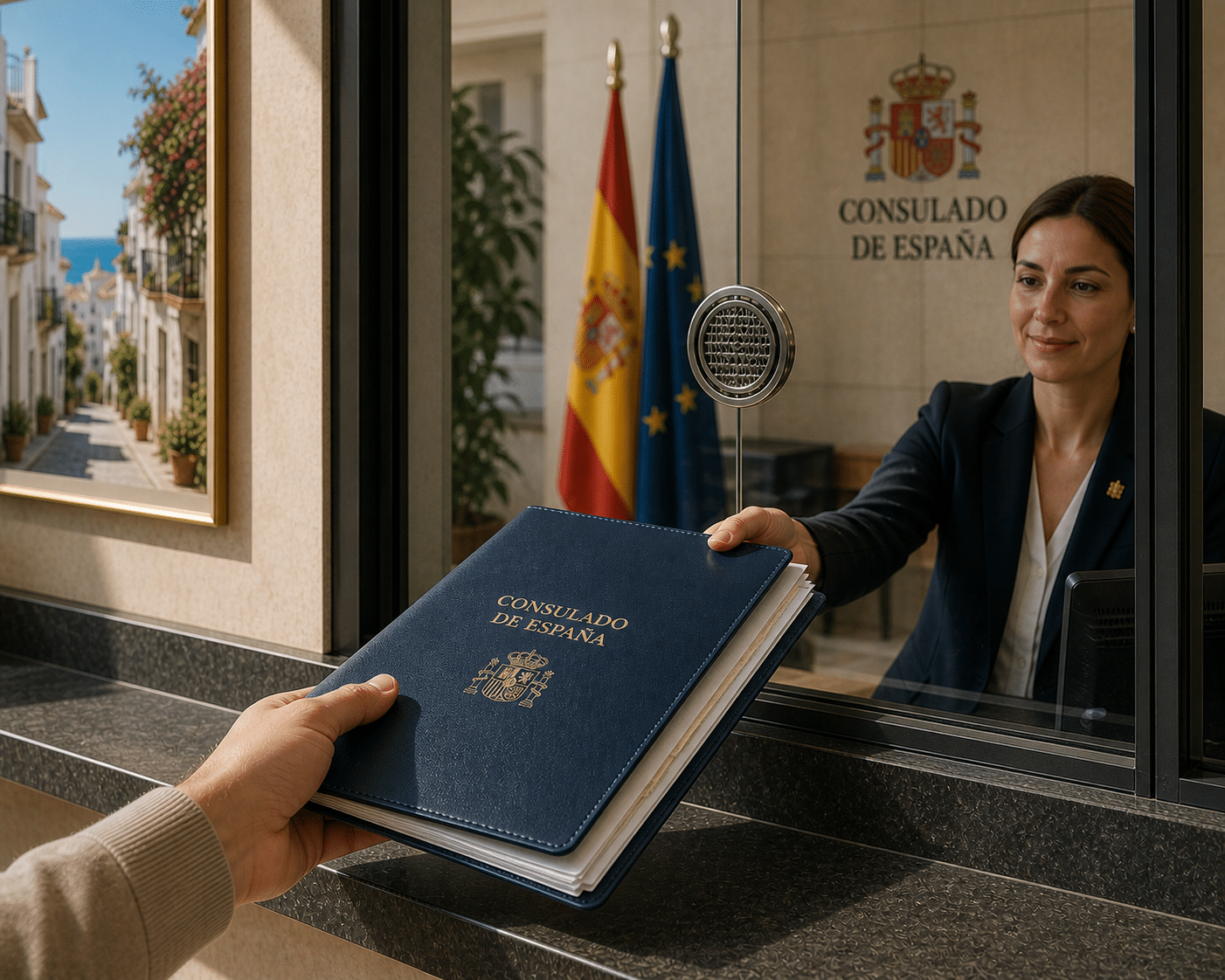
Spanish Visa Documentation: What You’ll Need
Getting your documents ready involves three stages: obtaining current copies, having them apostilled and then having them translated into Spanish. Each stage depends on the one before it, so the order matters. The sections below walk through each step. We also have a checklist that might be helpful.
Review the documentation requirements based upon whether you (or your lawyer) are applying in Spain or if you’re doing it via one of the consular offices in the US.
Timing And Expiration Of Your Documentation
Timing is another important factor that can easily be overlooked. Many documents must be issued within 90 days of your visa appointment date to be considered current — copies you’ve had sitting in a drawer for years won’t work. The 6-month guideline refers to when you should start the process, not when documents need to be in hand. Starting about 6 months out gives you enough runway to order documents, wait on apostilles and schedule sworn translations without everything becoming urgent at once.
For marriage and birth certificates that usually means the Vital Records office of the state(s) where you were born and/or married.
For criminal record verification, it’s important to check with the consular office where you’re applying. Some may want an FBI Identity History Summary, others may allow a State Issued Background check from your state police or Department of Public Safety.
For financial records the requirement varies by consular office, however you will usually need at minimum the last 3 months of bank statements (maybe 6 to 12 months). You may also need any investment, pension or income letters, as well as proof of ongoing income (retirement income, employment income, etc.)
Collecting everything too early can be just as problematic as collecting things too late. It’s usually best to think of the process as a sequence, gathering documents in stages so that everything is current when you submit your application.
In terms of overall timeline, most people find the documentation stage takes four to eight weeks from start to finish. Ordering documents, waiting on apostilles and scheduling sworn translations all take time and can’t always run in parallel. Starting earlier than you think you need to is consistently the advice from expats who’ve been through the process.
Consistency Across Documentation
Beyond simply gathering documents, it’s important that everything is consistent. Your name, address and personal details should match across all forms and supporting materials. Even small differences such as including a middle name in one document but not another can create confusion or require additional clarification. Taking the time to review everything carefully before your appointment can help avoid unnecessary back-and-forth.
Getting Your Documents Apostilled
After getting the current copies of your documents, all public documents (birth and marriage certificates, court documents, criminal records) need to be apostilled. An apostille is an official stamp under the Hague Apostille Convention that certifies the authenticity of a public document so it’s valid abroad. In the U.S., apostilles are issued by the Secretary of State in the state where the document was created.
Once you get your current copies of documents back, then you must have them apostilled by the same jurisdiction where they were originally issued. If you have an FBI Background Check document, that goes to the U.S. Department of State in Washington, DC for the apostille process. Bank statements and financial records do not need to be apostilled. However, they must be official (on bank letterhead, stamped or signed by the bank, not an online printout unless certified by the bank).
NOTE: Some states offer the ability to apostille your document when you order the current copy, saving you from sending them back to the jurisdiction again.
Translation Of Your Documentation
Any documents that are not already in Spanish will need to be translated. Spain requires all foreign documents to be in Spanish (Castellano) in order to be legally valid for administrative processes.
All translations must be done after apostille and by a “traductor jurado” (sworn translator) who is officially accredited by the Spanish Ministry of Foreign Affairs (Ministerio de Asuntos Exteriores, UE y Cooperación). You can also contact the appropriate Spanish consulate for your area, which may also have an additional list of accredited translators. Sworn translations carry the translator’s official seal and signature, making them legally valid in Spain.
Translations are required for civil documents, legal and financial documents and medical documents where applicable.
Submitting Your Visa Application
Once your documents are ready you’ll submit your application through the appropriate Spanish consulate, visa center or online. In some cases, this requires an in-person appointment where your documents are reviewed. During this stage, the focus is on completeness and accuracy. If something is missing or unclear, you may be asked to provide additional documentation. Being prepared and organized going into the appointment can make the process much smoother.
FAQs
Can I reuse documents if I apply again or renew my visa later?
Sometimes, but many documents must be recently issued, especially background checks and financial records. Even if you’ve applied before, you’ll often need updated versions for a new application or renewal.
Should I organize my documents in a specific way for submission?
Yes, and it can make a difference. Organizing documents in a logical order — often matching the consulate’s checklist — can make your appointment smoother and help avoid confusion during review.
Don’t have a consulate checklist? You can download our checklist. You should still ask your consulate for their checklist as the documentation required can vary by consulate.
Is it better to prepare documents myself or use a lawyer or service?
Many people successfully prepare documents on their own but others choose to work with an immigration lawyer or service to avoid mistakes. The right approach depends on your comfort level and how complex your situation is.
Do documents need to be notarized before being apostilled?
It depends on the document. Some documents, like official records (birth certificates, FBI background checks), do not require notarization before apostille. Others, such as affidavits or certain financial statements, may need to be notarized first. It’s important to confirm the requirements for each document type.
Can I speed up the process for obtaining documents or apostilles?
In many cases, yes. Some states and agencies offer expedited processing for document requests and apostilles, often for an additional fee. Planning ahead is still important, but expedited options can help if timelines become tight.

Before Moving
Everything you need to sort before you leave — visas, NIEs, finances and the hundred other things on your pre-move list.

After The Move
What you need to get sorted once you arrive — utilities, healthcare, paperwork and all the practicalities of your new life in Spain.

Property Guide
Here’s what to know about buying property in Spain as an American — from your first search to signing at the notary.

Resources
Checklists, glossaries and vetted websites to help you plan, prepare and hit the ground running in Spain.

Our Journey
Follow along as we document our move from Portland, Oregon to Jávea, Spain — the highs, the headaches and everything in between.
This page last updated: