
Property In Spain
Buying
Property In Spain

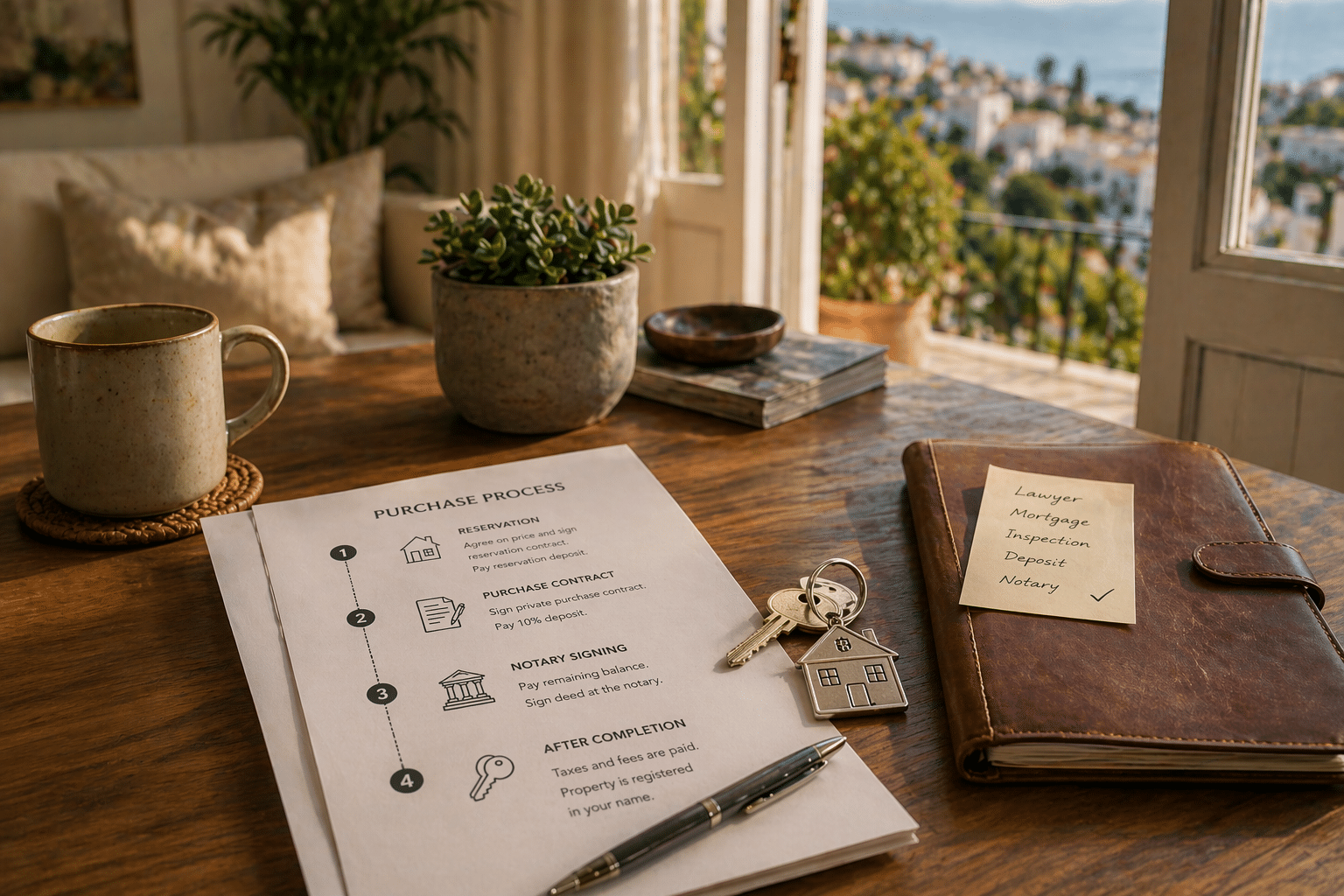
The property buying process in Spain is built around three main stages: reservation, deposit contract, and final signing at the notary. While the overall flow is straightforward, it differs in a few important ways from what many buyers are used to in the US, particularly in how deposits are handled, how legal checks are completed, and how the transaction is finalized.
Before You Make An Offer
Before making an offer on a property in Spain, you should ensure you have the following in place:
Before your viewings, the Quick Property Evaluation Checklist gives you a consistent framework for comparing properties while the details are still fresh.
Engaging A Lawyer
Hiring an independent lawyer (abogado) before you sign anything is one of the most important decisions you will make in this process. Your lawyer should be independent of the real estate agent and the seller and ideally experienced in Spanish property transactions involving foreign buyers.
Your lawyer handles due diligence, reviews all contracts, liaises with the notary, manages tax payments after completion and registers the property in your name. The cost is typically around 1% of the purchase price or less. It is money well spent.
Do not rely on the agent’s recommended lawyer without verifying their independence. In some cases, agents and lawyers have referral arrangements that may not serve your best interests.
Making An Offer And Negotiation
The property purchase process typically begins with making an offer through a real estate agent. There is often some room for negotiation, though how much depends on the property, local demand and how long it has been listed.
Well-priced properties in high-demand areas may see limited negotiation. Properties that have been on the market for a while or that appear inconsistently priced across websites may offer more flexibility. Conditions such as timing, financing or specific inclusions can sometimes be incorporated into the agreement. Any such terms should be reviewed by your lawyer before you commit to anything.
Reservation (Contrato de Reserva)
Once a price is agreed upon, the next step is signing a reservation contract (reserva), which takes the property off the market for a defined period while legal and financial checks are completed. At this stage you will typically pay a small deposit that’s usually between €3,000 and €6,000. This is commonly held by the real estate agent or placed in your lawyer’s client account, depending on how the transaction is structured.
The reservation period usually lasts between two and six weeks. During this time your lawyer begins due diligence: verifying ownership, checking for outstanding debts or liens, confirming planning permissions and ensuring the property is correctly registered with the Land Registry. Your lawyer will also confirm that the seller is current on community/HOA fees (comunidad) (if any) and the annual IBI property tax. Any arrears can transfer to the new owner if not cleared before completion.
Energy Performance Certificate
The seller is also legally required to provide a current energy performance certificate (certificado de eficiencia energética). This is a standard document but your lawyer should confirm it is in place.
Architectural Review/Inspection
Some buyers choose to bring in an architect or technical professional to assess the physical condition of the property, particularly for older homes or those with visible issues. It’s also worth using the inspection to assess the wider land and surroundings — particularly if the property has pine trees, borders agricultural land or has outbuildings that have sat unused. Our guide to wildlife and pests on the Northern Costa Blanca covers what to look for. While not always required, the inspection process provides an additional layer of confidence before committing further. Also check our property evaluation guide for more things that you may want to check.
If you want a structured framework to work from, the Detailed Property Evaluation Checklist covers systems, structure and legal compliance in depth — including the items your lawyer will be asking about anyway. A Spanish version is also available if you want to walk through questions directly with the listing agent or homeowner.
Download the PDF version (English) of the Detailed Property Evaluation Checklist
Download the Word version (English) of the Detailed Property Evaluation Checklist
Download the PDF version (Spanish) of the Detailed Property Evaluation Checklist
Whether the reservation deposit is refundable depends on the terms written into the agreement. In most cases it is refundable if a legal issue is discovered during due diligence, but not if the buyer simply decides to not complete the purchase.
Purchase Contract (Contrato de Arras)
Once due diligence is complete and both parties are ready to proceed, the next step is signing the Private Purchase Contract (contrato de arras). This formalizes the transaction and sets the final terms, including price, completion date and any agreed conditions.
Most residential transactions use what is known as arras penitenciales, which carry specific financial consequences for either party withdrawing. If the buyer pulls out after signing, the deposit is forfeited. If the seller withdraws, they are required to return double the deposit. This structure is standard in Spain and provides meaningful protection for both sides. This is the stage where the transaction becomes a binding financial commitment for both parties.
A less common variation, arras confirmatorias, does not carry the same automatic penalties and is treated more as a straightforward advance payment. If you encounter this type make sure you understand the difference before signing.
At this stage the buyer typically pays a deposit of around 10% of the purchase price which usually includes the initial reservation deposit already paid. You simply top it up to reach the full amount.
The period between signing the purchase contract and completion is usually four to six weeks, though this can vary depending on financing, documentation, and coordination between parties.
Payment Timeline
Funds are committed in stages across three points in the transaction. A typical payment flow looks like this:
- Reservation deposit: €3,000–€6,000
- Purchase contract deposit: ~10% (minus reservation amount)
- Final payment at closing: ~90% balance
In addition to the purchase price, taxes and fees add an additional 10% to 13%, depending on the property type and region. These should be factored into your budget from the outset. (See the Taxes and Fees section below).
Closing/Notary Signing (Escritura)
The final step takes place at the notary which serves a role broadly similar to closing in the US, but handled through a public official rather than an escrow company. Funds are not held centrally in escrow — the process relies on the notary, the Land Registry and your lawyer to ensure everything is in order before signing.
Both buyer and seller (or their legal representatives) attend the signing. The buyer pays the remaining balance of the purchase price at this point, typically by banker’s draft drawn on a Spanish bank. Wire fraud is becoming more and more common, so when transferring large amounts of money into your Spanish bank account or to a notary, you should use caution. We’ve provided more information in this post what to watch for, as well as a checklist to help you stay aware.
The notary verifies the identities of both parties, confirms the property is free of debts at the time of sale and ensures the transaction complies with Spanish law. Once the deed (escritura) is signed, ownership is officially transferred and the buyer receives the keys.
Before attending the signing, it is worth revisiting the property to confirm it is in the expected condition. There is no formal final walkthrough built into the Spanish process the way there sometimes is in the US. Arranging this independently in the days before completion is advisable.
If the property carries an existing mortgage, it must be cancelled at the notary before or during the sale. This is handled by your lawyer and the seller’s bank but it can add coordination and occasionally affect timing. Your lawyer should confirm the status of any existing mortgage during the due diligence period rather than at the closing stage.
After Completion
After the notary signing, your lawyer handles the remaining administrative steps: registering the property with the Land Registry (Registro de la Propiedad), paying the applicable taxes and transferring utilities and community accounts into your name. Confirm that the plusvalía tax, a municipal tax on the increase in land value, has been settled by the seller. Since 2021, this is the seller’s responsibility, but it is worth verifying before completion rather than after.
The fully registered deed is typically available within one to two months after closing.
One area US buyers often overlook is their reporting obligations back home. If you hold funds in a Spanish bank account that exceed $10,000 at any point during the year, you are required to file an FBAR (FinCEN Form 114) with the US Treasury. Separately, foreign assets above certain thresholds must be reported on Form 8938 as part of your federal tax return. These are US-side requirements that apply regardless of whether you owe any tax. A US tax advisor familiar with expat finances can walk you through what applies to your situation.
Taxes, Fees, and Closing Costs
Buyers should budget an additional 10% to 13% on top of the purchase price to cover taxes and fees. The exact amount depends on whether the property is a resale or new build and which region it is in.
- Resale Properties – The main tax is the Property Transfer Tax (Impuesto de Transmisiones Patrimoniales or ITP). Rates vary by comunidad autónoma. The Valencian Community has recently adjusted its rate to around 8% while other regions such as Catalonia remain closer to 10%.
- New Builds – Buyers pay VAT (IVA) at 10%, plus stamp duty (Actos Jurídicos Documentados) (AJD), which varies slightly by region.
Additional costs include notary fees, Land Registry fees, and legal fees. While smaller than the taxes themselves, they are a real part of the total budget.
To see what these costs look like in practice across a range of property prices — converted to US dollars at the current exchange rate — use the Spanish Property Price & Tax Calculator.
Compared to the US, closing costs in Spain are more heavily weighted toward taxes and less toward financing-related fees. There is also no title insurance system equivalent to what US buyers are used to. The combination of Land Registry records, notary verification and legal due diligence serves that function instead.
Summary: Typical Timeline
Most transactions move from reservation to completion in roughly six to twelve weeks.
A simplified view of the sequence:
- Obtain NIE and open Spanish bank account
- Engage an independent lawyer
- Agree price and sign reservation contract (pay €3,000–€6,000)
- Due diligence period (2–6 weeks)
- Sign contrato de arras and pay ~10% deposit
- Final preparations and pre-completion property visit
- Notary signing, final payment, keys received
- Post-completion: property registration, tax payments, utility transfers
FAQs
Can you make an offer on multiple properties at the same time in Spain?
Yes, but once you sign a reservation contract and pay a deposit, you are committing to that property. Unlike browsing listings, the process moves quickly into binding agreements so it’s important to be confident before reserving a home.
What happens if issues are found during due diligence?
If your lawyer identifies legal issues such as debts, registration problems, or missing permits, these can often be resolved before completion or used as grounds to withdraw. Whether you recover your deposit depends on how the reservation agreement is written, which is why legal review at this stage is critical.
Can a seller accept another offer after you’ve reserved a property?
No. Once a reservation contract is signed and the deposit is paid, the property is typically taken off the market. However, until that agreement is in place, sellers are free to consider other offers.
Do you need to be in Spain for the entire buying process?
No. Many buyers complete much of the process remotely. With a properly arranged power of attorney, your lawyer can handle most steps on your behalf, including signing documents and completing the purchase.
How do you know if the property is legally registered correctly?
Your lawyer verifies this through the Land Registry and other official records. They will confirm that the property boundaries, structures, and ownership details match what is being sold before you proceed to the purchase contract.

Before Moving
Everything you need to sort before you leave — visas, NIEs, finances and the hundred other things on your pre-move list.

After The Move
What you need to get sorted once you arrive — utilities, healthcare, paperwork and all the practicalities of your new life in Spain.

Property Guide
Here’s what to know about buying property in Spain as an American — from your first search to signing at the notary.

Resources
Checklists, glossaries and vetted websites to help you plan, prepare and hit the ground running in Spain.

Our Journey
Follow along as we document our move from Portland, Oregon to Jávea, Spain — the highs, the headaches and everything in between.
This page last updated: