After The Move
Learning
Spanish

Do You Need to Speak Spanish To Live In Spain?
The honest answer is no — but learning Spanish as an expat in Spain will make your experience significantly better. Most expats arrive knowing very little and improve over time simply by being immersed in the language. Waiting until you’re fluent before moving isn’t realistic and it isn’t necessary.
How Much Spanish Do You Really Need?
How much Spanish matters depends on where you live and how you want to live. In cities and expat-heavy coastal areas, English is widely spoken in restaurants, shops and many service businesses. In smaller towns and rural areas, it’s far less common.
Regardless of location, there are situations where learning Spanish becomes important: government offices, medical appointments, utilities, repairs and most administrative tasks. You don’t need perfect grammar, but being able to handle basic conversations, understand numbers and dates and explain simple problems goes a long way.
Focus On Practical Spanish First
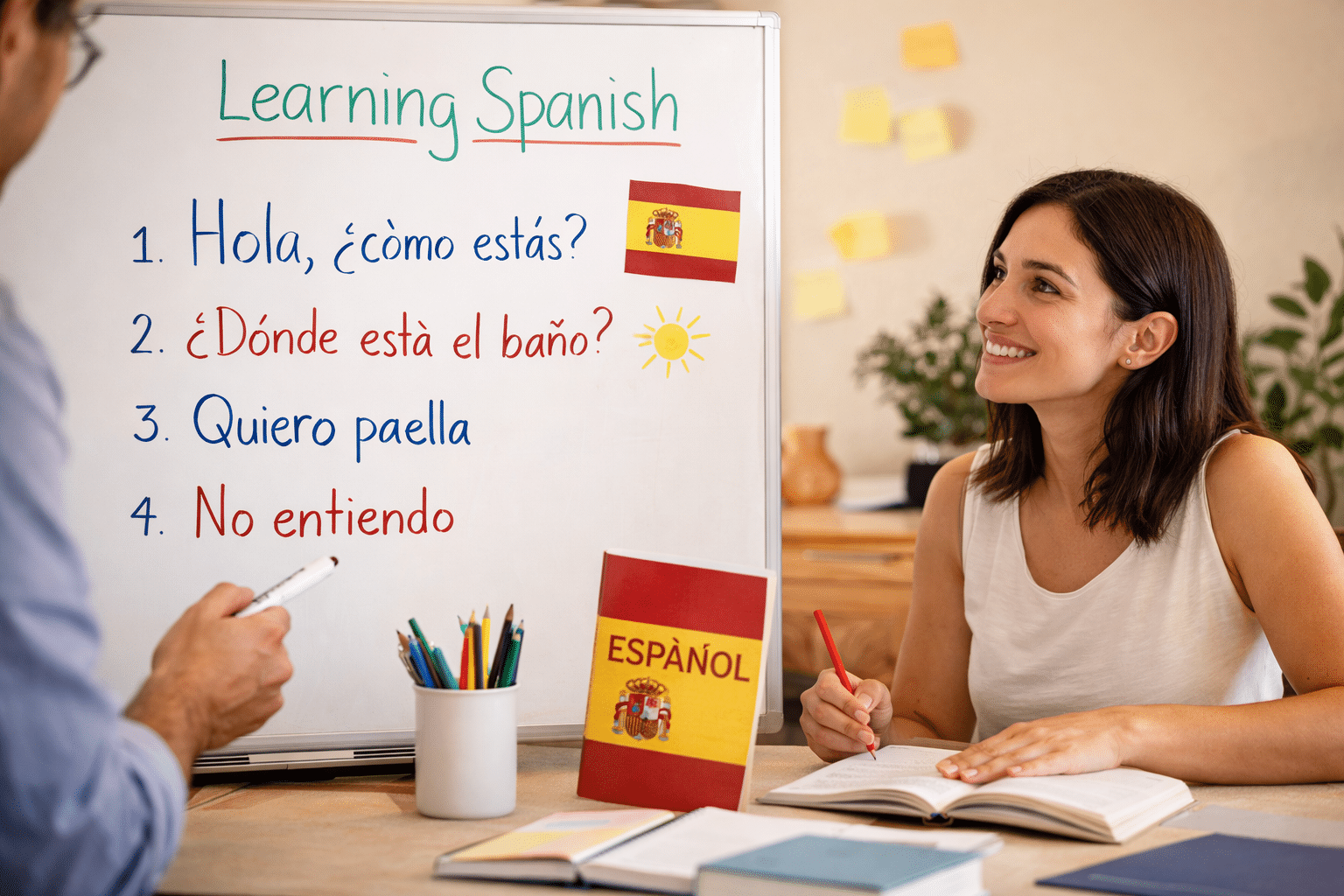
A common mistake is learning Spanish the way most of us learned a foreign language in school — heavy on grammar rules and light on actual use. For day-to-day life in Spain, practical vocabulary gets you further and faster.
Focus first on phrases like ordering food, making appointments, shopping, asking for directions and understanding prices and dates. Simple phrases like asking someone to repeat something, asking them to speak slower, asking where something is or saying you don’t speak much Spanish can go a long way. Confidence will build quickly once you can manage everyday situations and grammar knowledge follows naturally over time.
Ways Expats Learn Spanish In Spain
Most expats use a combination of methods rather than relying on just one:
Many towns, including those in the Jávea and Dénia area, have active intercambio groups which tend to be a low-pressure way to practice and a good way to meet people.
Language Schools In Spain For Expats
Most cities and many towns have Spanish language schools with courses designed for expats and foreigners. Classes typically come in a few formats: intensive courses (around 20 hours per week), part-time evening classes, private lessons and conversation-focused groups.
Schools accredited by the Instituto Cervantes follow national teaching standards and are recognized for official DELE exam preparation. Group classes in Spain are generally well-priced compared to equivalent courses in the US.
Many expats find that taking classes for the first few months after arriving helps them build a solid foundation, with Spanish continuing to develop naturally through everyday life after that.
Spanish Vs Regional Languages
Spain has several regional languages alongside Castilian Spanish: Catalan in Catalonia, Valenciano in the Valencia region, Basque in the Basque Country and Galician in Galicia.
If you’re moving to the Valencian community, you’ll occasionally encounter Valenciano on signs, in some official documents and sometimes in conversation. You don’t need to learn it as Castilian Spanish is understood everywhere, but it’s worth knowing it exists. Locals generally appreciate any effort to engage with the regional language, even just a word or two.
Standard Castilian Spanish will serve you well anywhere in Spain.
The Biggest Mistake Expats Make
It’s easy to settle into an expat community where most of your daily interactions are in English. In areas with large expat populations, including parts of the Costa Blanca, this is a genuine possibility. It’s not a problem in the short term, but expats who never push past it tend to feel more like visitors than people who’ve made Spain their home.
Learning Spanish, even imperfectly, changes that relationship with neighbors, local businesses, healthcare and everyday life.
Measuring Language Competency
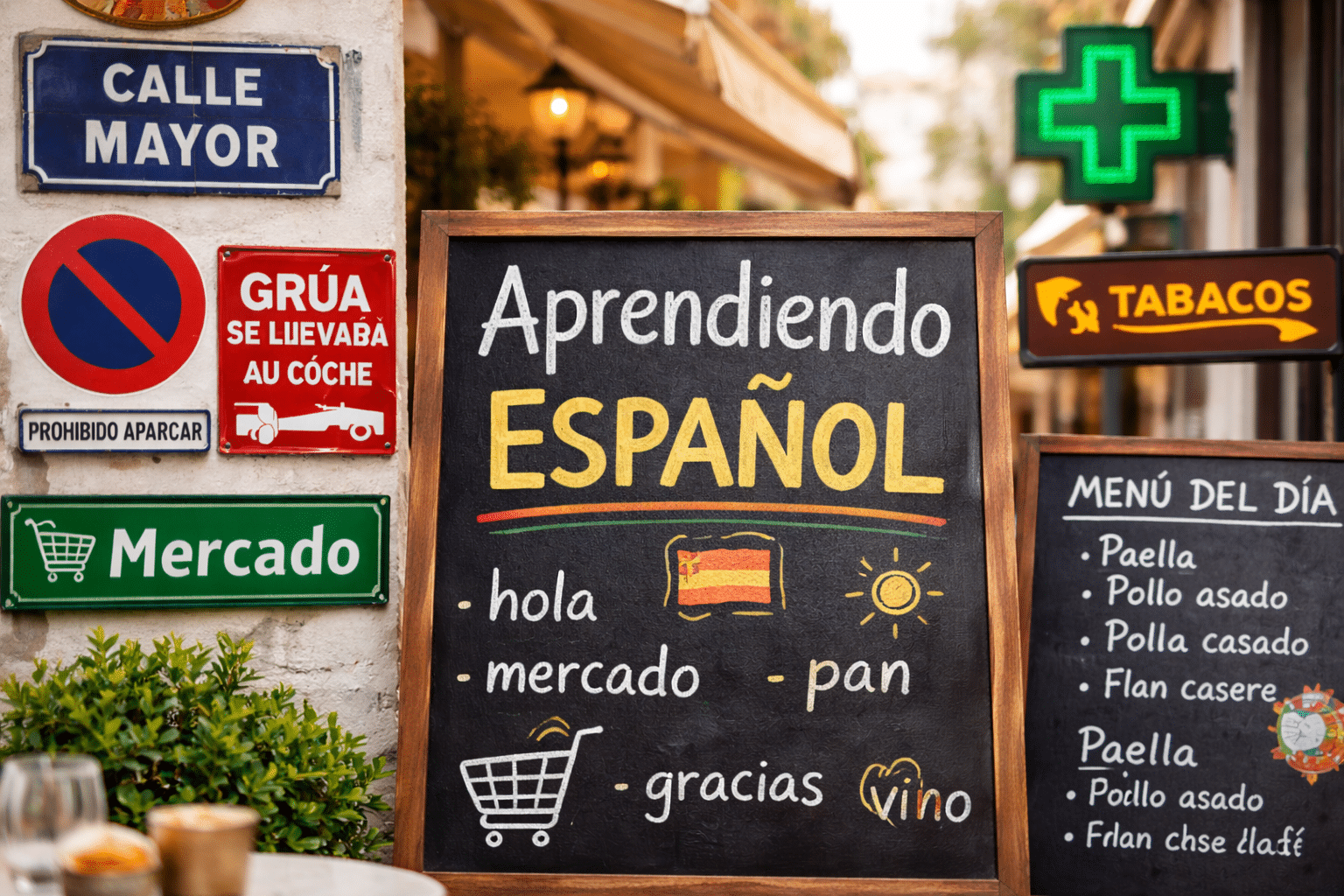
Spanish language schools and courses in Spain use the CEFR (Common European Framework of Reference for Languages) to describe language ability. These levels range from beginner to fluent. They are based on what you can actually do in the language in real-life situations.
If you plan to eventually seek Spanish citizenship (which you can do after living in Spain for 10 years), Spain does require proof that you know the language and local culture. You’ll need to pass two short exams specifically the DELE A2 Spanish exam (A2 detail listed in the table below) and the CCSE test, a quick multiple-choice quiz about Spanish life, history, and customs.
The CEFR system has six levels, grouped into three main categories: Beginner (A), Intermediate (B), and Advanced (C) with two levels in each. Here are more details about learning spanish at each level:
You can understand and use simple words and phrases. You can introduce yourself, order food, and handle basic daily needs like shopping or directions. Allows you to survive daily interactions politely, but rely on English for anything complex.
Takes about 2–4 months of regular study.
You can talk about familiar topics like your family, hobbies, work, and travel. You can handle simple conversations and read basic notices or forms. It gets you to a point of managing everyday life fairly easily.
Takes about 2–4 months of regular study.
You can deal with most situations that might arise while living in Spain — at the doctor, bank, or town hall. You can explain your experiences, plans, and opinions with reasonable confidence.
Takes about 6–12 months of regular use and study.
You can follow complex conversations and your grammar and listening skills improve a lot. It’s ideal for long-term residents or people who want to connect deeply with locals.
Takes about 1–2 years of steady use after reaching B1.
You can use Spanish fluently and effectively for social, academic, or professional purposes. Subtle idioms and cultural nuances start to make sense. Gives you an almost native-like comfort and is excellent for expats working or studying in Spanish environments.
Takes several years of consistent immersion and practice.
You understand virtually everything you read or hear. You can express yourself precisely, even in complex discussions. Equivalent to a native speaker — rare and not necessary for most expats.
Like C1, it takes several years of consistent immersion and practice.
FAQs
How long does it take to become conversational in Spanish?
Most people reach basic conversational ability within six to twelve months of consistent study combined with daily immersion. The timeline varies depending on how much time you dedicate to study, how often you use Spanish in everyday situations and whether you take formal classes. Living in Spain accelerates the process considerably compared to studying from home.
Is Spanish spoken in Spain different from Latin American Spanish?
Yes, there are differences in pronunciation, some vocabulary and regional expressions. The most noticeable difference for most people is the pronunciation of the letters c and z, which in Spain sounds like the English “th” rather than an “s.” For everyday communication it’s not a barrier — Spanish speakers from different regions understand each other well and you’ll adapt quickly.
Can I get by in Spain without speaking any Spanish?
In tourist-heavy coastal areas and larger cities, yes — many people manage with English alone. But relying entirely on English limits your independence, makes administrative tasks harder and can leave you feeling like a permanent visitor rather than someone who has made Spain home. Even basic Spanish makes a meaningful difference.
Should I learn Spanish before I move or wait until I arrive?
Both approaches work, but starting before you arrive gives you a head start on practical vocabulary and builds confidence for early interactions. Even a few months of basic study means you arrive able to handle simple transactions, read signs and follow basic conversations. That said, most people find their Spanish improves fastest once they’re actually living in Spain and using it every day.
Are there free resources for learning Spanish before I move?
Yes. YouTube channels like Dreaming Spanish offer extensive free immersion content at different levels. SpanishPod101 has free introductory lessons. Many public libraries also provide free access to Mango Languages or similar platforms. Combining a free app like Duolingo for daily vocabulary with free immersion content is a solid low-cost starting point before arrival.
We’re using Spanish With Vicky who has a combination of free and paid lessons. We like her approach and have found it very helpful, especially getting up to speed quickly and using common, everyday phrases that will be helpful once we arrive in Spain.

Before Moving
Everything you need to sort before you leave — visas, NIEs, finances and the hundred other things on your pre-move list.

After The Move
What you need to get sorted once you arrive — utilities, healthcare, paperwork and all the practicalities of your new life in Spain.

Property Guide
Here’s what to know about buying property in Spain as an American — from your first search to signing at the notary.

Resources
Checklists, glossaries and vetted websites to help you plan, prepare and hit the ground running in Spain.

Our Journey
Follow along as we document our move from Portland, Oregon to Jávea, Spain — the highs, the headaches and everything in between.
This page last updated: