
After a while, you start noticing a lot of different license plates in Spain that are much different than those in the US. Spanish and European plates carry a surprising amount of information once you know what you’re looking at — and once you start seeing it, you can’t “unsee” it. Here’s a quick guide to what’s actually on the road around you.
The Standard EU License Plate
Most of what you’ll see is the standard white plate with black characters and a blue band on the left showing the twelve gold stars of the EU flag and a country code underneath. That blue band with the circle of stars is the most notable physical feature shared across EU plates used to show uniformity among member nations. It’s paired with each country’s international vehicle registration code so a car from another country is easy to identify at a glance. But “standard” doesn’t mean identical.
Each EU country maintains its own design, format and numbering system within that shared framework — the Netherlands uses yellow backgrounds, Germany uses white and a few newer designs even use green for certain categories. Belgium is the only country in Europe that uses red lettering on its standard plates, which stands out immediately if you’re used to the white-and-black look. Drive around the Costa Blanca for an afternoon and you’ll spot German, French, Dutch, Belgian and British plates without much effort. This corner of Spain draws residents and visitors from across the continent.
Codes You’ll See on the Road
Here’s the cheat sheet — the letter code in the blue band tells you the country of registration:
*Non-EU Countries
A few of these are worth a second look.
Norway issues plates with its national flag replacing the circle of stars, since it isn’t an EU member and Ukraine uses a similar approach with its own flag above the country code. Andorra, tucked in the Pyrenees and a common stop for cross-border shoppers, isn’t an EU member either, so don’t expect to see the gold stars on an Andorran plate.
License Plates In Spain
Spanish plates have their own quirks worth knowing.
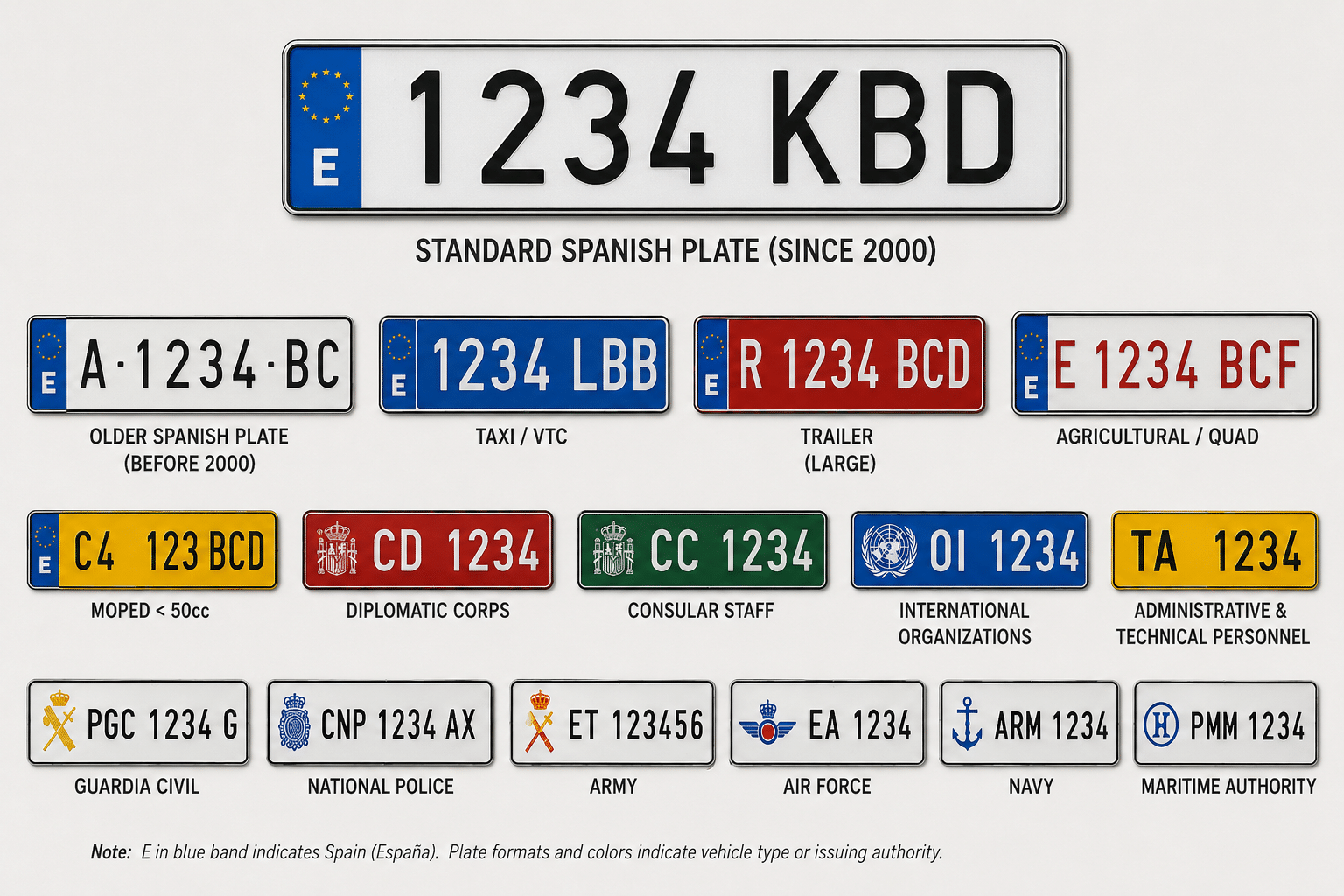
Since 2000, standard Spanish plates follow a four-digit-then-three-letter format and the letters are limited to a set of consonants. Vowels and a few specific consonants are deliberately excluded to avoid accidentally spelling something offensive. If you ever see a Spanish-style plate with a vowel in the letter sequence, it’s either an older plate, a replica, or not actually Spanish.
Older plates are still legally on the road too. Before 2000, Spanish plates included a province code — so a car registered decades ago in Alicante might still carry letters tied to its original province.
What About Vanity Plates In Spain?
If you’re used to picking your own combination back home, this is one area where Spain works very differently. Spain does not offer personalized or vanity plates in the way the US or UK do. Every standard plate is issued sequentially by the DGT, with no option to request a specific combination of letters or numbers.
There’s a narrow exception. Spain’s General Vehicle Regulation includes a small allowance for plate customization: drivers can add geometric designs without recognizable meaning to the plate background, as long as the design doesn’t interfere with reflectivity or legibility. Customized plates have technically been legal since 2013, but they must be approved by the DGT and can only be produced by a select group of authorized companies — and crucially, the registration number itself still has to follow the standard format and remain fully legible; what’s customizable is shape and background design, not the actual letters and numbers.
While you might occasionally see a Spanish plate with a decorative background or a slightly different plate shape, the registration sequence itself is never personalized the way a US vanity plate might spell out a name or phrase. Spain is actually grouped with countries like France, Italy and the Netherlands that simply don’t allow personalized plates, which puts it in the majority among EU countries rather than the exception.
Color-Coded Plates with a Purpose
Taxis and Uber-style ride services have used white characters on a blue background for their rear plate since 2018, specifically so passengers and police can quickly distinguish licensed operators from unlicensed ones. If you’re ever unsure whether a ride is legitimate, the blue plate is the tell.
Black letters on a red background mark large trailers, while red letters on white are used for quad bikes and agricultural vehicles, which explains some of what you’ll see on rural roads inland from the coast. Mopeds and other small vehicles under 50cc carry black letters on a yellow background.
Diplomatic and Government Plates
This is the category most people notice but few understand. Spain has four distinct types of diplomatic-style plates:
Vehicles carrying CD plates belong to members of foreign diplomatic corps and come with real legal weight — diplomatic immunity from certain local laws, exemption from some Spanish taxes and the ability to move freely even in restricted or low-emission zones. It’s not just a different paint job; it reflects an entirely different legal relationship with the host country.
Government and security vehicles have their own letter-coded series too. The Guardia Civil, National Police, Army, Air Force, Navy and Maritime Authority all carry distinct prefix codes on their plates rather than the standard four-digit format, which is part of why an official-looking car with letters instead of numbers up front often turns out to be exactly that.
Make sure to check out more on the subject of cars in Spain.