
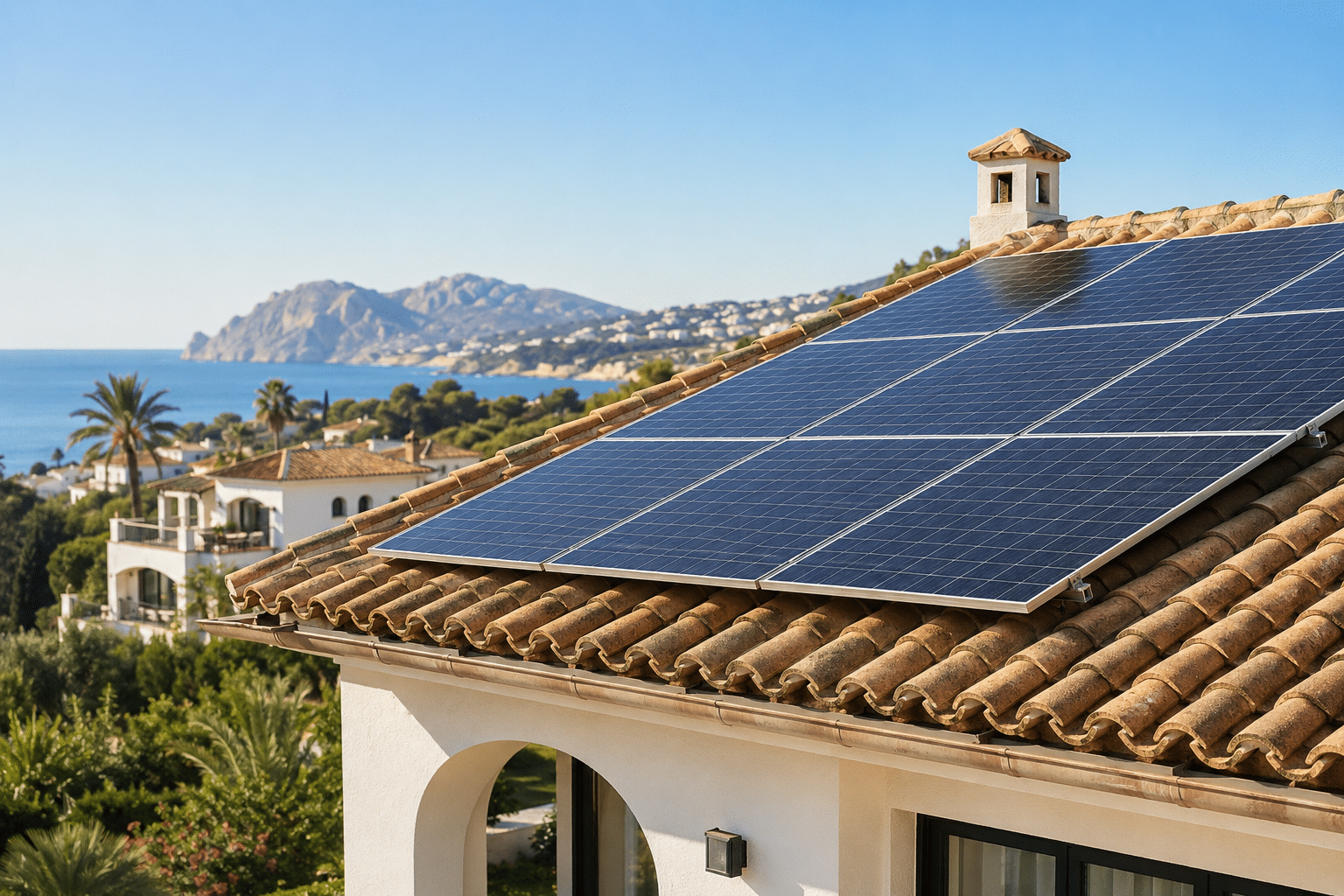
Solar power for a home in Spain is one of the first topics that comes up when you start seriously evaluating properties and for good reason. The sun hours here are among the highest in Europe, electricity prices have climbed steadily, and a well-sized system can cover the majority of a typical household’s needs year-round.
What hasn’t existed until now is one place that actually walks through the practical questions: how many panels you need, what it costs, what it costs to maintain, how long it lasts and what to look for whether you’re buying a home that already has solar or adding it after the fact.
While we’ve mentioned solar in our property checklists, our buying process pages, and our home services sections, here’s the full picture.
How Many Panels Should A Typical Home Have?
The honest answer is “it depends on your consumption,” but there are useful starting points.
The average Spanish household consumes around 5,300 kWh annually, which typically requires 7 to 9 high-efficiency panels at modern wattages. That’s a national average, though — actual need depends heavily on your specific consumption, roof orientation and location.
Spain’s solar output varies meaningfully by province: a home in Málaga produces around 1,700 kWh per square meter annually, while a home in Lugo in the north produces closer to 1,270 kWh — so a property on the Costa Blanca, which sits well within the sunnier southern band, will generally need fewer panels than the same consumption profile further north. Alicante, for example, gets over 2,850 sun hours a year, among the highest in the country, which works strongly in your favor if you’re sizing a system here.
For a typical Costa Blanca villa with a pool, AC throughout and standard household consumption, you’re usually looking at a system somewhere in the 5–8 kW range, which works out to roughly 12–18 panels at current high-efficiency wattages. A 5 kW system in southern Spain — including Valencia — typically produces 7,500 to 8,500 kWh per year, which covers a substantial share of typical household demand.
Does Having An Electric Vehicle Change the Sizing?
Yes. An EV driven a typical annual mileage uses 3,000–4,500 kWh of electricity a year, which on its own usually requires 6–10 additional solar panels beyond what you’d install to cover the house alone. A Tesla Model 3 or Model Y might need 5–7 panels just for its charging needs, while a larger EV or SUV with a bigger battery could need 7–9.
If you’re planning to add an EV — or already have one — tell your installer upfront rather than sizing the system for the house only and bolting on panels later. Most installers recommend adding 5 to 10 extra panels to a standard home system specifically to account for the added load of an EV.
It’s considerably cheaper to design that capacity in from the start than to expand the system in a second phase. If you’re considering two EVs down the line, mention that too — it roughly doubles the dedicated charging allowance, even though you won’t usually need to double the whole system since home and EV loads rarely peak at exactly the same time.
What Does Solar Actually Cost In Spain?
A typical 5 kW system installation for a standard Spanish home runs €6,500 to €8,500, including equipment, installation, permits and grid connection. A small 3 kW system suited to an apartment or low-consumption property runs roughly €4,000 to €5,500.
If you want battery storage to extend self-sufficiency into the evening, expect to add €4,000 to €8,000 depending on capacity, with a 5 kWh battery typically costing €4,000 to €5,000. You don’t need a battery to benefit from solar. Spain will credit you for surplus electricity you send back to the grid. The catch is that those credits you receive pay out at €0.05–0.08 per kWh — a fraction of what retail electricity costs. So the more of your own solar production you can use directly, the lower your costs. That’s what a battery makes possible.
It’s also worth knowing that incentives genuinely move the math.
An income tax deduction (IRPF) covers 40% of installation costs up to a maximum of €7,500 for systems that improve home energy efficiency by 30% or more. Many municipalities offer IBI property tax reductions of 25–50% for three to five years after installation. These programs vary by year and by town hall, so always confirm current eligibility with your gestor before assuming a discount applies — but they’re real enough to meaningfully shorten your payback period.
The Cost Of Maintenance Of Solar Panels
This is the part people tend to overestimate in terms of effort. Solar panels are genuinely low-maintenance.
Modern Tier 1 panels degrade at approximately 0.3–0.5% per year, meaning after 25 years they’re still producing over 90% of their original output in most cases. Most panels continue producing electricity at 85–90% capacity and can operate for 30 to 40 years total, well beyond the standard 25-year warranty period.
In most cases rain handles the cleaning naturally, since panels are installed at an angle and rainfall washes away dust, pollen and light debris. Costa Blanca’s dry summers mean you may want an occasional manual clean, though, since dirty panels can lose up to 30% of their efficiency in extreme cases. It’s worth a rinse a couple of times a year if you go long stretches without rain.
The component in a solar electric system that actually wears out is the inverter, not the panels. The average inverter lasts 10–12 years, so you’ll likely replace it at least once over the lifespan of your panels. Microinverters, like those from Enphase, are attached to each individual panel and typically carry 25-year warranties, which eliminates the mid-life inverter replacement cost that string inverters usually require.
When you’re comparing quotes, ask specifically what inverter type is being proposed and what its warranty and expected lifespan actually are — this affects your long-term cost more than panel brand does.
Battery Backup During Power Outages
One thing worth knowing upfront: solar panels alone don’t keep your lights on during a grid outage. Most residential solar systems shut off during a grid outage for safety unless they include a battery and an inverter properly configured to isolate from the grid and supply selected loads. If outage protection matters to you — and on parts of the Costa Blanca where summer storms occasionally knock out local grid sections, it’s a reasonable thing to plan for.
How long a battery lasts during an outage comes down to capacity versus what you’re running.
A 10 kWh battery can power the critical systems in an average house for at least 24 hours if you turn off AC and electric heating. It would cover things like the refrigerator, WiFi, lighting and device charging.
A 13.5 kWh battery — roughly the size of a Tesla Powerwall — can keep a fridge, lights, WiFi and a few small appliances running for close to 24 hours in real-world use. Step up to running air conditioning or a pool pump, though and that runtime drops sharply.
For whole-home backup (including AC and heavier appliances) you’ll need 20–30 kWh of total battery capacity rather than a single small unit. The good news for Costa Blanca homeowners specifically: solar panels can recharge the battery during daylight outages, since excess solar energy not immediately used by the home gets redirected to recharge the battery, effectively extending backup availability.
Given how much sun this region gets, a daytime outage is far less of a concern than an overnight one. Your panels are quietly refilling the battery while the grid is down, as long as it’s not raining.
Panel Size and Mounting on Spanish Tile Roofs
A practical question that comes up once people start picturing this on their own roof: how big are these things and do they actually work with the curved clay tiles so common on Spanish homes? A typical modern residential panel measures roughly 66–82 inches long and 40–45 inches wide — in metric terms, somewhere around 1.7 to 2.1 meters by 1 to 1.1 meters, weighing 40 to 55 pounds. That’s a meaningful piece of equipment, but it’s manageable for two installers to carry and mount.
As for the tiles themselves it takes the right technique and an installer who’s actually done it before. Installing solar on Spanish tile roofs requires specialized knowledge to avoid damaging the tiles, and installers need to be familiar with clay-specific mounting methods to avoid cracked tiles and water intrusion. Clay tiles have a unique curved shape that makes standard mounting hardware a poor fit, so custom mounts or tile-specific hooks are typically needed rather than whatever generic bracket an installer might use on a flat composite roof.
The standard approach is for installers to remove the clay tiles at each mounting point, drill and flash hooks directly into the roof structure, and then slide the original tiles back into place over the mounting feet. From the ground, a well-done installation is barely visible against the rest of the roof. An alternative method, sometimes called a comp-out or inset installation, replaces a section of tile entirely with composite shingles underneath the panels. Some installers prefer that method for a cleaner mounting surface, though it changes the look of that section of roof slightly. This is exactly why local installer experience matters more here than almost anywhere else in the process.
Most general solar installers won’t go near a clay tile roof and the ones who do need real, specific experience with it — ask directly how many tile-roof installations they’ve completed and what method they use. A wrong approach here is what leads to roof leaks years down the line rather than a problem you’ll notice immediately.
Buying a House That Already Has Solar
If you’re touring a property with an existing solar panel system, the questions worth asking go well beyond what’s covered here. Installation date, ownership status, inverter history, maintenance records, transferability of warranties and battery details all matter. We’ve built a dedicated Solar Panel Evaluation Checklist for exactly this situation, available in our Resources section.
The short version: get the installation date, ask whether the system is fully paid off, and find out whether there’s a transferable maintenance contract. A system that’s eight years into a 25-year panel life with a recently replaced inverter is a very different proposition than one that’s about to need its first inverter swap.
Installing Solar After You’ve Purchased A Villa
If you’re adding solar to a property after purchase, the process in most of Spain has gotten simpler in recent years. Most regions have simplified the process and no longer require formal planning permission for residential solar, with fast-track installation available. If your property is part of a community or urbanización, though, you may still need approval from the comunidad de propietarios, so check before committing to a design.
Sizing, vendor vetting, EV planning, battery goals and tile-roof mounting all factor into a new installation decision, which is why we’ve also put together a New Solar Evaluation Checklist covering exactly what to ask installers and how to think through sizing before you sign a contract.
What to Look For In An Solar Energy Installer
Rather than naming a single “best” installer — since reputations shift and the right fit depends on your specific roof, budget and goals — here’s what’s actually worth checking before you sign anything:
Ask how long the company has operated in your specific area, not just in Spain generally.
Costa Blanca has a meaningfully developed local installer base, with companies based in Jávea, Pedreguer and along the Marina Alta who specifically understand tile roof types common to the region, local permitting, and orientation considerations unique to the area — that local track record matters more than a national brand name.
Ask what panel and inverter brands they install and why.
“Tier 1” is a financial classification — not a quality certification — that simply indicates a manufacturer has supplied panels to multiple non-recourse-financed projects, a sign of bankability rather than superior performance.
Brands like LONGi, Jinko, Trina, JA Solar and Canadian Solar are all reputable Tier 1 manufacturers producing genuinely reliable panels at accessible prices, while premium brands like REC and SunPower Maxeon offer higher efficiency and lower degradation at a 15–25% price premium — worth it mainly if your roof space is limited.
For inverters, Huawei, Solis, GoodWe and Fox ESS are widely regarded as reliable, competitively priced options for straightforward residential installs.
Ask for the actual warranty documents, not just a verbal summary.
Product warranty (manufacturing defects) and performance warranty (guaranteed output over time) are different things, and you want both in writing.
Ask whether the company handles the permit and grant paperwork for you.
This is one of the more tedious parts of the process and a good local installer should take it off your plate entirely.
Solar in this part of Spain is about as close to a sure financial bet as home improvements get — strong sun hours, high electricity prices, and meaningful tax incentives stack in your favor. The work that’s actually worth doing is sizing the system correctly to your real consumption (including any EVs in your plans), understanding what you’re buying if a house already has one installed, and choosing an installer based on local tile-roof experience and clear warranty terms rather than the lowest quote you receive.