
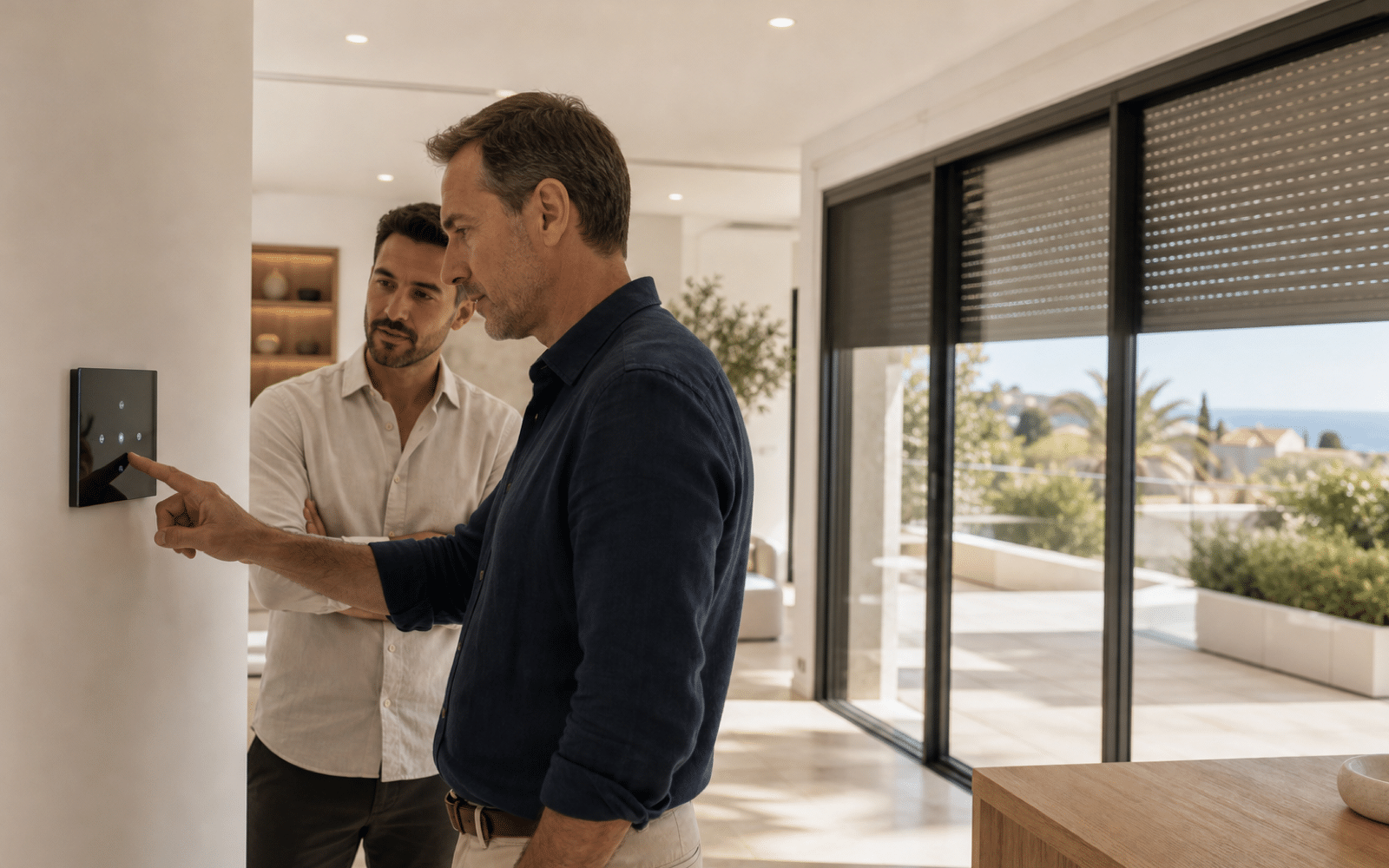
Domotica, (home automation), has gone from a luxury feature to something you’ll see in most new-build properties across the Costa Blanca. When you’re property shopping, it’s worth understanding what’s typically included, what’s worth adding yourself and what matters when comparing one automated home to another.
This isn’t the same conversation as security cameras and data privacy, which we cover in a separate post or persianas specifically, which get their own dedicated post. This one covers the broader picture: what’s controllable, what’s worth having, and what to check before you buy.
What A Modern Spanish Home Automates
Lighting.
Scheduling, dimming, and motion-based lighting are common in new builds. Beyond convenience, this is a genuine energy saver, and it’s usually one of the cheapest pieces of a system to add or expand later.
Heating and cooling.
Most Spanish homes use split-unit AC, one unit per room or zone, rather than the ducted central air common in the US. That’s already a form of zoning, since each unit runs independently. Smart control adds scheduling and remote start on top, so you can trigger heating or cooling before you arrive instead of coming home to a cold house in winter or a hot one in summer.
Underfloor heating is increasingly common in new builds, especially paired with a heat pump (aerotermia) system, and can be zoned room by room the same way. Ceiling fans are common, too (mostly as a low-cost supplement to AC) and smart-controlled models fold into the same app as everything else. If a resale property only has old-style radiators or window units, moving to split AC and a smart thermostat is one of the more worthwhile upgrades to budget for.
Gates and access control.
Automated driveway gates are common on villas and larger properties. Smart door locks are worth having on their own, even outside a full system, since they let you unlock remotely for a cleaner, contractor or property manager without handing out a physical key. Most systems log who came and went. If you’ll be away for stretches, this kind of remote access is worth having for practicality and peace of mind alike.
Video doorbells and intercoms.
A step beyond a traditional buzzer, a video intercom lets you see and speak to whoever’s at the gate or door from your phone, whether you’re in the house or out of the country. It’s one of the more commonly retrofitted features, since it rarely needs major rewiring.
Persianas and blinds.
Motorized persianas are common in new builds and increasingly added to resales. We cover this in detail in our persianas post, including cost, retrofit considerations, and how it ties into a broader system. Worth checking during a walkthrough whether persiana automation is already wired in or would need to be added.
Toldos (retractable awnings).
Different from persianas, a toldo is an exterior sun shade over a terrace or patio not a window shutter. They’re commonly motorized the same way, often from the same app or remote, but it’s worth knowing the two are separate features with separate installations.
Irrigation.
For any property with garden or landscaping, automated irrigation on a schedule or tied to a rain sensor is a practical addition, especially if you’re not living there full time yet.
Energy monitoring.
A whole-home energy monitor or smart plugs that track usage in real time help you actually manage your potencia contratada (contracted power limit), rather than guess at it and trip the breaker. This matters more in Spain than the US, since going over your limit cuts power to the whole house rather than just one circuit. See our [Utilities page] for more on how potencia contratada works.
Safety sensors.
Smart smoke and CO detectors that push a phone alert, rather than just sounding an alarm no one’s there to hear, are a real upgrade for a home you’re not in full time. The same goes for water leak sensors with automatic shutoff, which cut water to the house the moment a leak is detected. A slow leak in an empty property can run for weeks before anyone notices otherwise, making this one of the more genuinely valuable additions for anyone splitting time between the US and Spain.
Security integration.
Exterior cameras, motion sensors, and alarm systems increasingly tie into the same app-based control as everything else. We’ve covered the privacy and legal side of exterior cameras (AEPD rules, what you can and can’t record) in a [separate post], so this one focuses on how security fits into a broader automated home. Interior cameras are a different story. Pointed entirely at private space, they don’t carry the same legal considerations, and they’re mostly used for a simpler reason: checking on the house while you’re away, whether that’s confirming a delivery arrived, keeping an eye on pets, or just general peace of mind.
Solar and pool heating.
Neither is traditionally filed under “home automation,” but both increasingly connect to the same app-based control. Many modern solar installations let you monitor generation and consumption from an app, and some integrate directly with smart thermostats or a pool heat pump to run high-draw appliances when generation is highest. A pool heater doesn’t need to be automated on its own, but remote and scheduled control is genuinely useful, letting you start heating the pool a couple of days before you arrive rather than waiting once you’re there, since pools can take a day or two to reach temperature.
Choosing A System: What Actually Matters
Protocol matters more than brand.
Spanish home automation runs on a handful of underlying protocols, and this is the single most important thing to understand before buying into any system, new or existing. KNX is the professional standard for wired, whole-home systems and dominates new-build construction, since it’s straightforward to run the cabling during initial construction. Zigbee, Z-Wave, and the newer Matter standard are wireless protocols that work well for retrofits, since they don’t require opening walls. Proprietary app-based systems (Tuya-based products are common and inexpensive) work fine on their own but don’t always play well with other brands.
Open vs closed systems.
A KNX or Matter-based system is an open standard, meaning multiple manufacturers’ devices work together and you’re not locked into one company for parts, support, or future expansion. A fully proprietary system, common with budget WiFi products, can be cheaper upfront but leaves you stuck if the manufacturer stops supporting it or you want to expand with a different brand later.
Voice assistants and hub compatibility.
Most systems, whatever the underlying protocol, tie into a familiar voice assistant on top: Amazon Alexa, Google Home, or Apple HomeKit. This is usually what you’ll actually interact with day to day, even if KNX or Zigbee is doing the work behind the scenes. Worth confirming a system is compatible with whichever ecosystem you already use, rather than ending up with a separate app just for the house.
Installer and support continuity.
Ask who installed the system and whether that installer, or another one, is still operating locally and able to service it. KNX in particular requires a certified installer, and there are fewer of them than general electricians. A beautiful automation setup no one locally can maintain or expand is a liability, not a selling point.
Retrofit cost in older homes.
Adding automation to an existing home costs meaningfully more than including it during new construction, since wired systems require opening walls. As a rough guide, a full KNX installation in a new build typically runs €8,000 to €20,000 for a 100 m² home, while the same scope retrofitted into an existing home can run 40% to 80% more. Wireless systems (Zigbee, Z-Wave, Matter) are the more common and cost-effective retrofit choice for exactly this reason.
Concrete walls and wireless range.
Spanish homes are built almost entirely from concrete and block, not the wood-frame drywall common in the US, and this matters for a wireless retrofit. Higher-frequency protocols like Zigbee lose range fast through thick concrete, sometimes down to just a few meters depending on wall thickness. Z-Wave, running on a lower frequency, generally penetrates concrete better and is worth asking about if you’re retrofitting a solid-built older home. Either way, expect to need more hubs, repeaters, or mesh extenders than the same system would need in a similarly sized US house.
What “Included” Actually Means In A New Build
Not every new build with “smart home ready” in the listing means the same thing, and it’s worth clarifying before you assume anything. Developers generally fall into one of three camps:
Roughly a third of Spanish buyers say they consider domotica essential, so coverage varies a lot developer to developer, and it’s genuinely common to find only preinstalación even in an upscale new build. Ask directly which of these three you’re getting, and if it’s a preinstalación, ask to see the wiring plan so you know what’s there to build on.