
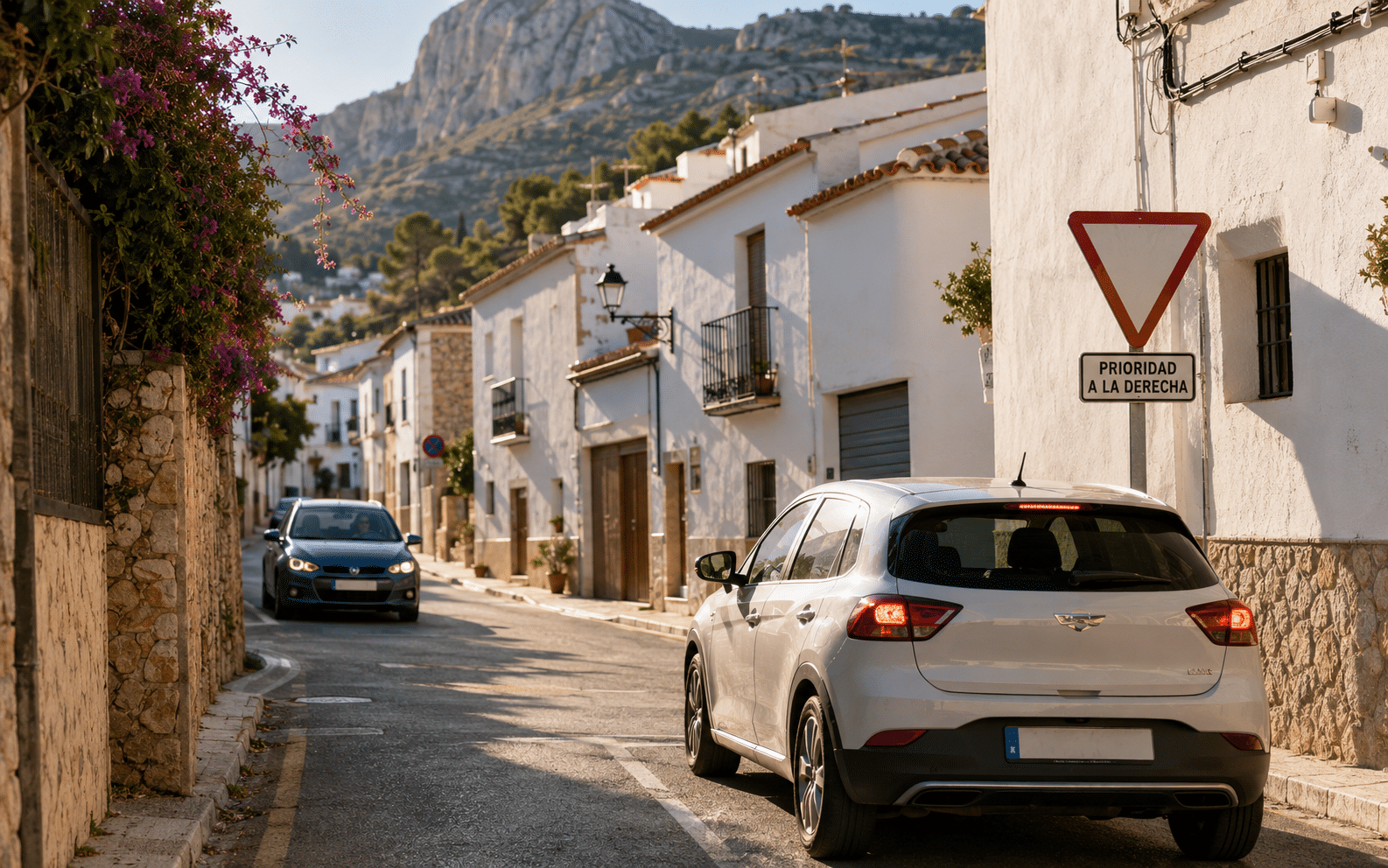
Spain drives on the right side of the road, just like the US. That’s one less thing you’ll have to worry about when driving in Spain. Everything else takes getting used to. A few US driving habits are worth erasing from your memory since holding onto them here, is a fast way to earn a ticket. The rules, the customs and even the road types work differently in Spain. A few of them may surprise you the first time you run into them.
Priority To The Right
At any intersection with no signs, no lights and no markings, the car approaching from your right has priority. Not who got there first. Not whoever’s on the bigger road. It’s whoever is to your right. This is the default rule across Spain.
This one catches Americans off guard constantly since the US doesn’t really have an equivalent. Most intersections have signs that override this rule, but in small towns and residential streets, an unmarked junction is common enough that it’s worth knowing, remembering and putting into practice.
One Lane Streets Or Roads On A Hill: Uphill Always Wins
On a narrow one lane road or street with a steep grade (7% incline or steeper) the vehicle going uphill has priority. The car heading downhill has to back up or pull aside to let it pass.
The logic is starting and steering while pointed uphill is harder and riskier than backing up while pointed downhill. There’s one exception. If the uphill driver is closer to a pull-out spot than the downhill driver is to open road, the uphill driver should use it instead of making the other car reverse. On a narrow stretch with no real slope, the rule flips. Whoever entered the narrow section first gets to keep going.
Many towns along the Costa Blanca are built on hillsides that have many residential streets that are steep, narrow and short on turnouts. This rule applies even to streets in your own neighborhood. Many of these streets already have one-way signs, mirrors at blind corners or an obvious wide spot built in for passing, so it rarely turns into a real standoff. But on the stretches that don’t, the rule holds: if you’re headed downhill and meet someone coming up it, you back up so they can pass by
Roundabouts: The Rule Is Simple
Spain uses roundabouts far more than the US does, especially outside city centers. The rule is simple. Cars already inside the roundabout have priority. You yield before entering and wait for a gap. Once you’re in, stay in the outer lane if you’re taking one of the first couple exits. Move to the inner lane if you’re going further around. Signal before you exit. Most confusion comes from lane etiquette, not the yielding itself.
Never Turn Right On Red, Ever
This is one of the biggest habits US drivers need to break. Turning right on red is not allowed in Spain unless a specific sign or arrow specifically permits it and that’s rare. A red light means stop, a full complete stop, no exceptions.
Pedestrians Have Priority
At a marked crosswalk, pedestrians always go first. Drivers are expected to actually stop, not just slow down. This applies even at unmarked crossings when a vehicle is turning through an intersection. In pedestrian zones and residential areas, cars are expected to move at a crawl and yield constantly. Jaywalking is treated more casually in Spain than the driver’s obligation to stop. That can feel contrary to the assumption in the US that pedestrians stay out of the way.
Spanish Law Gives Cyclists Get A Full 1.5 Meters Clearance
When passing a cyclist, Spanish law requires at least 1.5 meters (about 5 feet) of clearance. You’re required to drop your speed to at least 20 km/h (about 12 mph) below the road’s normal limit when passing them. Cyclists riding in a group also have priority at some intersections and roundabouts once the lead rider has entered. Rural roads here often have more cyclists than American drivers expect, especially on weekend mornings so give them room and patience.
Delivery Vehicles Do Double-Park
In town centers and older neighborhoods, streets are often too narrow for a proper loading zone, so delivery vehicles double-park with hazards on while making a drop. It’s not always technically legal, but it’s the cultural norm and tolerated. Don’t expect anyone to move quickly. Don’t be surprised when traffic backs up behind a parked delivery van on a one-lane street. Patience goes a lot further than honking.
Spanish Road Types And All About Tolls
Spain’s road network breaks down into a few main types.
Major roads in Spain are generally well maintained, often better than the average US interstate. Secondary and rural roads can be narrower, curvier and slower than what you’re used to, especially in mountainous areas. Budget more time than the map suggests for anything off the main highways.
Spain charges tolls directly at booths rather than using the sticker-based system other EU countries use, so you pay per stretch of road as you go instead of buying a pass upfront.
Tolled roads have actually been shrinking, not growing. Between 2018 and 2021 over 1,000 kilometers of Spanish toll motorways went free as their original concessions expired. That included the AP-7 stretch between Alicante and Tarragona, the road that runs right along the Costa Blanca which dropped its toll on January 1, 2020. The road we’re most likely to be driving locally has gotten cheaper over the last several years, not more expensive.
City Driving In Spain Comes With Its Own Rules
Historic town centers were built centuries before cars existed. Expect narrow streets, tight turns and very little room for error.
Many Spanish cities now run a low emission zone (ZBE), restricting which vehicles can enter based on an environmental sticker called the distintivo ambiental. Every Spanish city over 50,000 people is required to have one.
If your car is registered in Spain, getting the sticker is simple and cheap. It’s available at any Correos post office. Once you have it, it’s valid nationwide not just in your home city. It’s a national DGT classification not a city-specific pass. Fines for not have a sticker run between €100 to €200 and they’re camera-enforced.
Paid parking zones, marked zona azul (blue zone) or zona verde (green zone) depending on the city, are common in town centers and require a ticket from a nearby machine or app. Ignore one and you’ll likely find a ticket on your windshield within the hour.
Speed Limits And Alcohol Limits Are Stricter Than The US
Speed limits in Spain run:
The blood alcohol limit is 0.05% and a stricter 0.03% for a “conductor novel,” which is anyone within their first two years of holding a license or for professional drivers. Both numbers are noticeably tighter than the American standard of 0.08%. Novel status (conductor novel) is based on how long you’ve held a license not your age. A 45-year-old who just got licensed counts the same as an 18-year-old.
Fines scale with how far over the limit you are. Between 0.05% and 0.08% expect fines of around €500 and the loss of 4 points on your license. Above that, up to the criminal threshold, it’s closer to €1,000 and 6 points.
Past roughly 1.2% or on a second offense within a year, it stops being a fine and becomes a criminal matter with possible jail time and a mandatory license suspension of 1 to 4 years.
Refusing a breathalyzer test entirely is treated as its own offense and carries the same €1,000 fine, 6-point loss and potential criminal exposure.
Radar Cameras Are Everywhere
Spain runs one of the more extensive speed camera networks in Europe.
It mixes fixed cameras, mobile units and stretches that measure your average speed over a distance rather than catching you at a single point. Apps like Google Maps and Waze that warn you about known fixed camera locations are completely legal since they’re just relaying public information. True radar detectors are illegal in Spain. Having one that’s switched on in your vehicle can cost you a fine and points off your license, even if you never get caught speeding.
Spain’s Drivers License Point System
Every Spanish drivers license runs on a points system.
Standard drivers start with 12 points. New drivers start with 8, moving up to 12 once they’ve gone 2 to 3 years without a point-losing infraction. Serious violations, like the higher alcohol tier or speeding by more than 50 km/h (about 31 mph) over the limit, cost 6 points at once. Lesser ones, like using your phone at the wheel or running a red light, cost 4.
Lost points come back automatically either 2 years after a clean record or 3 years if the infraction that cost you points was classified as especially serious. There’s also a faster option: a 12-hour DGT awareness course can recover up to 6 points. You can take the course once every 2 years.
Stay completely clean for 3 straight years and your cap actually rises to 14, then 15 after another 3. Hit zero points and you lose your license entirely. The system is worth taking seriously even if a single ticket doesn’t feel like much.
Spanish Road Signs
Spanish road signs follow the same general system you’ll see across the EU.
Red circles means prohibited, triangles mean warning and blue circles mean something is mandatory. Speed limits and distances are all in kilometers not miles. Stop signs are the same as you’d recognize in the US.
One sign worth learning early is the priority road marker. It’s a yellow diamond with a white border, officially called R-3. Once you pass one, you have the right of way at every intersection along that road, not just the next one you pass. Cars joining from side streets are legally required to yield to you. The default priority-to-the-right rule doesn’t apply in this instance.
This protection continues until you hit a junction controlled by lights, a stop sign or a yield sig, or you see the matching sign with a black diagonal line through it, R-4, which marks the end of the priority road. Once you pass an R-4, normal rules, including priority-to-the-right are back in effect. It’s common on roads that connect towns or run through a busy stretch where stopping for every side street would be impractical.
Other Things Worth Knowing
None of this is complicated once you’ve driven in Spain a few times. Most of it just takes replacing habits you never had to think about back home with a new, slightly different set. Give yourself a little extra patience for the first few weeks and it becomes second nature faster than you’d expect.