
After The Move
Home Services

Setting up home services in Spain feels familiar at first — you may need a cleaner, someone for the garden, maybe a pool person. But the way these services work, what they cover, and how you find reliable people is different enough from the US that it’s worth understanding before you start making calls. This page covers the main recurring services most expats in Spain end up hiring, organized by category, with rough costs and the things that tend to surprise people.
What To Know Before You Start
In Spain — and particularly in expat communities on the Costa Blanca — personal recommendation is far and away the best way to find anyone. Ask neighbors, ask people in your urbanización, ask in the local expat Facebook groups for your specific town. Almost everyone knows “a guy” for cleaning, gardening, pool maintenance and the trades, and they’re usually good.
There’s a cultural reason for this that goes beyond convenience. In Spain, recommending someone who does a bad job reflects poorly on the person who made the recommendation. People take that seriously. When a trusted neighbor gives you a name, they’re putting their own reputation on the line — which means the referral carries real weight, and the person being referred knows it. That dynamic produces a different quality of recommendation than a Google review or an online directory.
The flip side: if someone gives you a name and it doesn’t work out, say so. The feedback loop matters and your neighbors will appreciate knowing.
Formal agencies and online platforms exist and can be useful when you’re new and don’t yet have a network. But as soon as you have neighbors you trust, start asking them first.
Cash Vs Invoice
Spain has a large informal economy, and many individual service providers — particularly cleaners and gardeners — work cash in hand without issuing invoices. This is common and widely accepted. If you need receipts for tax purposes, you’ll want to find someone operating as an autónomo (self-employed) who can invoice you. Agencies always invoice.
Language
Many service providers in expat-heavy coastal areas speak at least functional English. In more Spanish areas or with specialist trades, you may need help communicating. Your gestoría, a bilingual neighbor, or a WhatsApp translation can usually bridge the gap.
Autónomo Vs Informal
If you hire someone directly and regularly — particularly a cleaner — technically they may need to be registered as an employee or autónomo for it to be fully above board. In practice most expats hire informally. If this matters to you legally or for tax purposes, discuss it with your gestoría.
Liability Concerns For Informal Hires
This is worth understanding, because it’s one of the bigger blind spots for Americans used to a system where workers’ comp largely shields homeowners from this. Civil liability coverage (responsabilidad civil) is a standard part of Spanish home insurance and protects you if someone is injured or their property is damaged while on your premises. If your cleaner slips on a wet floor or your gardener is injured by a falling branch, this is the coverage that’s meant to respond.
Here’s the catch worth knowing about: some policies specifically exclude damage or injury caused “in the pursuit of a profession or service within your home.” In other words, the same policy that covers your visiting in-laws tripping on a rug may not automatically cover your gardener falling off a ladder while working for you — because they’re not a guest, they’re someone providing a service on your property. Whether that exclusion applies, and how it’s worded, varies by insurer and policy.
This is a good thing to raise directly with your home insurance provider when you set up your policy — ask specifically whether civil liability covers injuries to people you’ve hired informally to work on the property, and if not, what would need to change for it to. It’s also worth a conversation with your gestoría, since it ties into the broader question of whether someone you hire regularly should be registered. We’re not insurance professionals, so treat this as a prompt to ask the right question rather than a definitive answer — but it’s a question worth asking before, not after, someone gets hurt.

The Full Rundown
With those general points in mind, here’s the full rundown — organized by category, with what each service typically covers, roughly what to expect to pay on the Costa Blanca, and the things that are different enough from the US to catch you off guard. Some of these you’ll need from day one; others you won’t think about until the first time something breaks, or until your first August rolls around and half the country seems to disappear. Either way, it’s easier to know what’s coming than to figure it out in the moment.
Regular Home Maintenance
Cleaning (Limpieza)
A cleaning person is usually the first hire and often the most important one. Rates on the Costa Blanca typically run €14–€25 per hour, with most expat households paying toward the lower end for a regular weekly or biweekly cleaner hired directly. Agency rates are higher.
Most people hire a cleaner for a set number of hours per week or biweekly rather than paying by the job. A typical arrangement for a 3-bedroom villa is 3–4 hours per visit. Deep cleans — moving in, moving out, post-renovation — are quoted separately and cost more.
What’s different from the US: labor costs are significantly lower than you’re used to, and it’s common for the same person to clean for you for years. The relationship tends to be more personal than transactional. Tips are not expected but are appreciated at Christmas.
Garden And Landscaping (Jardinería)
This is where American expectations get recalibrated almost immediately. In the US, a landscaping service typically means someone comes to mow the lawn. In Spain — particularly on the Costa Blanca — a garden service is genuinely full-service. A good gardener handles lawn mowing, hedge trimming, tree pruning, palm maintenance, irrigation system checks, seasonal planting and general garden health. You hire one person or company and they take care of everything. It’s a different and frankly better model.
Garden and pool services are often offered together by the same company, which is convenient and usually more cost-effective than hiring separately. Combined garden and pool maintenance for a typical villa runs roughly €100–€200 per month depending on garden size, visit frequency and whether it’s bundled.
A few things worth knowing for the Costa Blanca specifically: the climate is hard on gardens. Summer heat, pests, low rainfall and very hard water mean irrigation systems are essential, and drought-tolerant planting is the norm rather than the exception. A good local gardener will know what thrives in the microclimate and will advise accordingly. Lush green lawns are possible but expensive to maintain — many expats transition to low-water Mediterranean planting after a season or two.
Palm trees need specific attention — they’re susceptible to the red palm weevil, a destructive pest that has devastated palms across the region. A gardener experienced with palms will know what to watch for.
Pool Maintenance (Mantenimiento de Piscina)
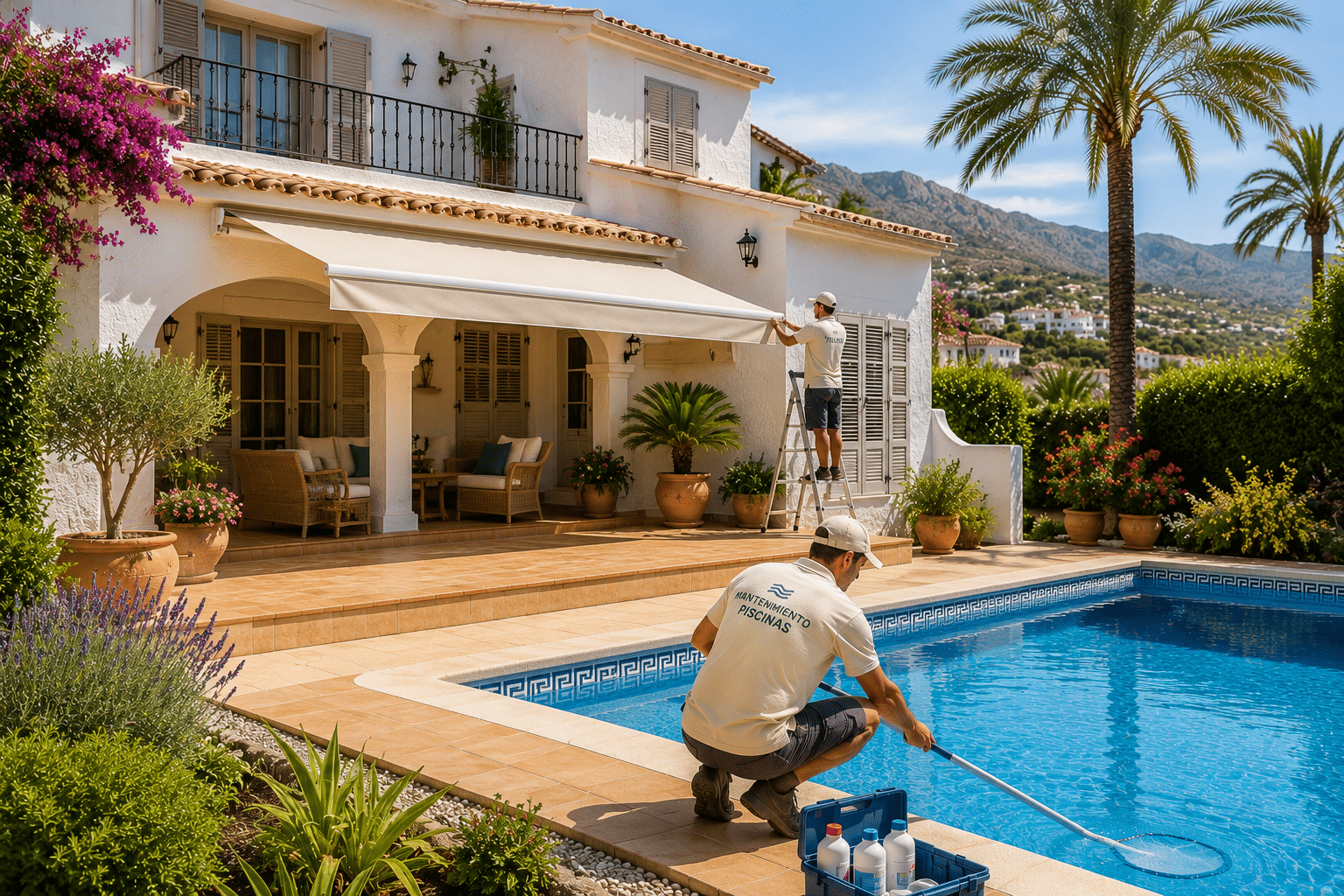
If your property has a pool — and most detached villas on the Costa Blanca do — professional maintenance is essentially non-negotiable unless you’re living there full-time and genuinely willing to manage it yourself. A pool can turn green within 3–5 days of neglect in Spanish summer heat, and recovery treatment costs €200–€500 on top of the embarrassment.
Professional pool maintenance on the Costa Blanca runs approximately €80–€150 per month for weekly service, which typically includes chemical balancing, cleaning the waterline, backwashing the filter and checking equipment — though some providers bill chemicals separately, so it’s worth confirming what’s covered before you sign up. Annual running costs including chemicals, electricity, water and occasional repairs average €1,500–€3,000 for a typical 8x4m pool.
What surprises many newcomers: on the Costa Blanca you can often use the pool well into November and again from April — there’s no full winterizing needed the way there would be in a colder climate. But the pool still needs off-season attention, just less of it.
As noted above, garden and pool services are frequently offered together. If you’re getting quotes, ask about combined packages.
AC Servicing
Air conditioning is standard in most Spanish properties, and it needs annual servicing — something a lot of new arrivals discover the hard way when the unit quits in the middle of August. A standard service covers cleaning filters, checking refrigerant levels and inspecting the unit. It typically costs €50–€100 per unit and takes about an hour. Do it in spring before you actually need the thing.
Spanish AC units are almost always split systems — wall-mounted indoor unit, outdoor compressor. They’re efficient and reliable, but skip the annual service and you’re gambling with your summer.
Water Softener Servicing
Hard water is a significant issue in the Alicante province — among the hardest in Spain. Most expat homes on the Costa Blanca have or eventually install a water softener or descaler. These need periodic salt refills and an annual service check. Salt bags are available from most hardware stores (ferreterías) and supermarkets; servicing is typically done by the installer or a local water treatment company. Annual servicing costs roughly €80–€150.
If your property doesn’t have a softener and you’re seeing white scale on taps, showerheads and appliances, it’s worth looking into. Unchecked hard water shortens the life of washing machines, dishwashers and water heaters considerably.
Window Cleaning
Not a service most people think about until they’ve lived through a few weeks of Saharan dust or post-storm grime coating every surface. Most expat households use a window cleaner every one to three months. Costs depend on property size but a typical villa runs €30–€60 per visit for external and internal windows.
On-Call Trades
Handyman (Manitas)
Manitas literally means “little hands” and is the Spanish equivalent of a handyman — someone who handles the small jobs that don’t warrant calling a specialist: fixing a door handle, patching a wall, hanging things, assembling furniture, minor tile repairs. In expat areas there are plenty of English-speaking manitas available. Rates are typically €20–€40 per hour. For anything structural, electrical or plumbing, you’ll want a specialist.
Plumber (Fontanero) and Electrician (Electricista)
The time to find a plumber and electrician is before you need one at 7pm on a Friday. Ask your neighbors now, save the numbers, and you’ll be grateful later. Rates run €40–€70 per hour plus parts, with emergency call-out fees on top of that.
Resale properties on the Costa Blanca can have some interesting plumbing and wiring decisions baked in from previous owners and previous decades. A good local tradesperson who knows the building stock in your area is worth their weight. For electrical work, make sure whoever you hire is certificado — licensed — it matters for insurance purposes and your own peace of mind.
Pest Control (Control de Plagas)
Pest control in Spain is more of a routine matter than it is in the US — the warm climate means mosquitoes, cockroaches, ants, processionary caterpillars, wasps and other pests are a fact of life rather than an occasional problem. Most pest professionals recommend treating in May before summer activity peaks, and again in September before pests seek winter shelter indoors.
A basic annual treatment contract typically runs €100–€200 per year for a standard villa, covering preventive visits and call-out for specific problems. One-off treatments for a specific infestation cost more depending on the pest and severity.
Make sure whoever you hire is registered — licensed pest control companies in Spain must be registered with the ROESBA (Spain’s Official Pest Control Registry). Your gestoría or a quick search of the official registry can verify this. See our Wildlife and Pests page for more on what you’re likely to encounter on the Costa Blanca.
Family and Pet Services
Babysitter / Nanny (Canguro / Niñera)
Canguro — literally “kangaroo” — is the Spanish word for babysitter, which tells you something about the culture’s sense of humor. For occasional babysitting expect to pay €10–€15 per hour. For a regular nanny arrangement, rates depend on hours and whether the person is hired formally or informally. As with cleaners, expat Facebook groups are the most common way to find someone, and personal recommendations matter.
What’s different: Spanish childcare culture centers on family, and formal childcare infrastructure outside of school hours is less developed than in the US. Many Spanish families rely on grandparents; expats without that network often find a trusted canguro indispensable.
Pet Sitter and Pet Boarding
For short trips, a pet sitter who visits your home once or twice a day is common and typically costs €15–€25 per visit. For longer absences, pet boarding at a registered facility (residencia canina for dogs, residencia felina for cats) runs roughly €15–€30 per day depending on the facility and animal. Some pet sitters also offer in-home boarding where your pet stays at their house, which tends to be less stressful for the animal.
Finding a good pet sitter is very much a word-of-mouth exercise. Given the importance of Leishmania prevention (see our Leishmania post), make sure any boarding facility or sitter is aware of your dog’s prevention protocol and can maintain it while you’re away.
Property and Admin Management
House Check / Key-Holding Service
Essential for anyone who splits time between Spain and the US, or who travels frequently. A key-holding service gives a trusted local contact access to your property to check on it periodically — typically once or twice a week. At a basic level they can air the rooms, check the pool, water plants and have fresh essentials ready for your arrival. More comprehensive services include paying utility bills, liaising with tradespeople and dealing with any issues that arise while you’re away.
Empty properties in Spanish summer heat can develop pest infestations within two to three weeks, and water damage from an undetected leak can get expensive fast. Having someone check the property regularly isn’t a luxury — it’s basic protection for a significant asset.
Costs vary widely — a basic key-holding and check service might run €50–€100 per month; full concierge-style management is priced accordingly. Many garden and pool companies offer key-holding as an add-on, which makes it easy to bundle.
Full Property Management Company
For owners who are away for extended periods, rent their property, or simply want everything handled, a property management company takes care of the full picture — maintenance coordination, bill payment, cleaning, pool and garden oversight and tenant or guest management if applicable. Fees are typically a percentage of rental income for rental properties, or a flat monthly fee for management-only arrangements.
Worth knowing: property management quality varies enormously on the Costa Blanca. Get references from other expats, not just the company’s own testimonials. The expat Facebook groups for your specific area are the best place to ask.
Gestoría
Not a home service in the traditional sense, but most expats end up using a gestoría on a recurring basis — for annual tax filings, car registration, NIE renewals, dealing with bureaucratic correspondence and anything else that involves Spanish paperwork. A good gestoría is one of the most valuable ongoing relationships you’ll have in Spain. See our Legal Guide for more on what they do and how to find one.
Alarm / Security Monitoring
Alarm systems are common on Costa Blanca villas, and most can be connected to a monitoring company (empresa de seguridad) that responds to activations. Monthly monitoring contracts typically run €30–€60 per month. Some companies also offer remote camera access, which pairs well with a key-holding service for peace of mind when you’re abroad.
Periodic But Recurring
Chimney Sweeping
If your property has a wood burner or fireplace — common in inland and rural homes where winters are genuinely cold — get it swept annually before the burning season starts. It’s not glamorous but a blocked flue is a real hazard. Costs typically run €80–€150. Your gardener or handyman can usually point you to someone local.
Awning And Shutter Servicing (Toldos y Persianas)
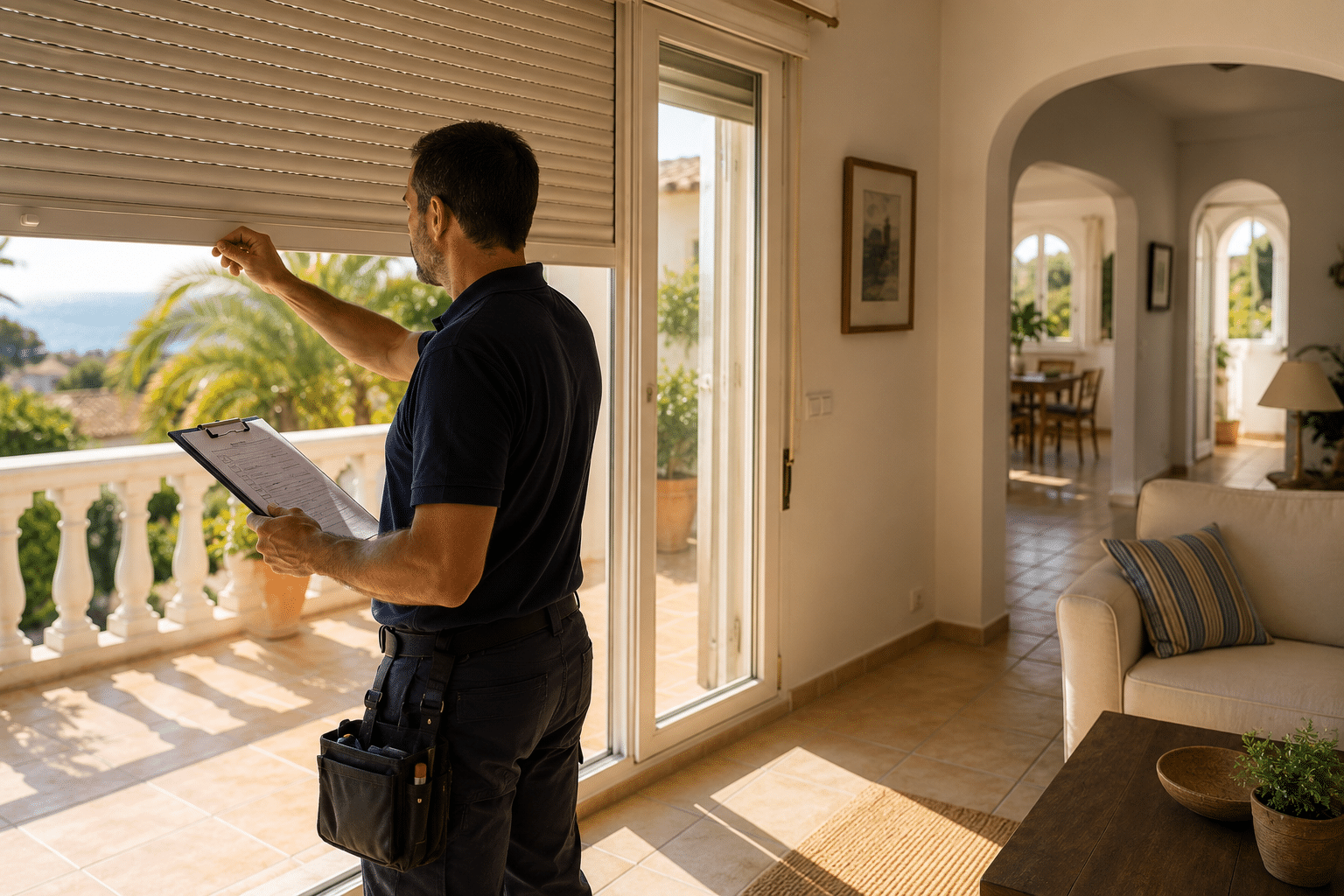
Motorized awnings and exterior shutters (persianas) are a feature of almost every Spanish home — they’re essential for managing heat and light. Motors wear out, slats break and tracks need lubricating. Annual servicing keeps them working and avoids the misery of a stuck shutter in August. Most towns have a local toldos/persianas specialist; a service visit typically runs €50–€100.
Boiler And Water Heater Servicing
Annual servicing of your gas boiler or water heater is recommended and sometimes required for insurance. Budget €80–€150 for a standard visit. If your property runs on gas cylinders (bombonas) rather than mains gas, keep an eye on the level — they run out faster than you’d expect and suppliers don’t always come quickly. Worth keeping a spare on hand once you’ve figured out the local delivery situation.
Septic Tank Emptying (Fosa Séptica)
Not every property on the Costa Blanca is connected to mains drainage — plenty of rural and semi-rural homes run on a septic tank (fosa séptica) that needs pumping out every one to three years. It’s one of those things you want to know about before you buy rather than after. A pump-out runs €150–€300. Ask your lawyer or the previous owner before you complete — it’s an easy question that saves a surprise.
Solar Panel Maintenance
Solar is increasingly common on Costa Blanca properties, and for good reason — the sunshine here is not in short supply. Panels need cleaning a couple of times a year; Saharan dust and general grime accumulate faster than you’d think and dirty panels lose efficiency quickly. An annual electrical check is also worth doing. Most installers offer a maintenance contract — if yours did the installation, ask what they offer before shopping around.

Quick Reference: Approximate Monthly and Annual Costs*
*All costs are approximate and reflect typical rates on the Northern Costa Blanca as of 2025–2026. Prices vary by property size, provider and whether you hire directly or through an agency. Use these as a planning guide rather than a quote. USD figures are based on an approximate exchange rate of $1.16 to the euro and will drift as rates change — treat them as a rough gut-check, not a conversion you can rely on.
FAQs
Should I provide cleaning supplies, or does the cleaner bring their own?
Both arrangements are common. Some cleaners bring their own products and equipment and charge slightly more; others expect you to supply everything. This is one of the first things to clarify when you hire someone — it’s a normal question to ask upfront and avoids an awkward first visit.
Is it normal to give service providers a key to my property?
Yes, and it’s standard practice — especially for cleaners, gardeners and pool technicians who often need access whether or not you’re home. This is exactly why the word-of-mouth approach matters so much: you’re handing someone a key based largely on trust built through your network, not a background check.
Do home services in Spain slow down in August?
Significantly, yes. August is when much of Spain takes its main summer holiday, including many trades, gardeners and even some pest control and maintenance companies. If you need work done, plan around it — book well in advance for July or wait until September. Don’t expect a quick response to anything non-urgent during August.
What if I’m not happy with a service provider — how do I end the arrangement?
Directly and politely, ideally in person or by a warm message rather than just stopping contact. Spain’s word-of-mouth culture means the same person may come up again through a different neighbor and a clean ending matters more here than it might elsewhere. Give reasonable notice if there’s a regular arrangement.
How far in advance should I line up these services before moving in?
As early as you can, particularly for cleaning, gardening and pool maintenance — good providers are often at capacity and word-of-mouth recommendations take time to gather. If you’re working with a property manager or key-holder before you arrive, ask them to start making introductions before your move date.

Before Moving
Everything you need to sort before you leave — visas, NIEs, finances and the hundred other things on your pre-move list.

After The Move
What you need to get sorted once you arrive — utilities, healthcare, paperwork and all the practicalities of your new life in Spain.

Property Guide
Here’s what to know about buying property in Spain as an American — from your first search to signing at the notary.

Resources
Checklists, glossaries and vetted websites to help you plan, prepare and hit the ground running in Spain.

Our Journey
Follow along as we document our move from Portland, Oregon to Jávea, Spain — the highs, the headaches and everything in between.
This page last updated: