
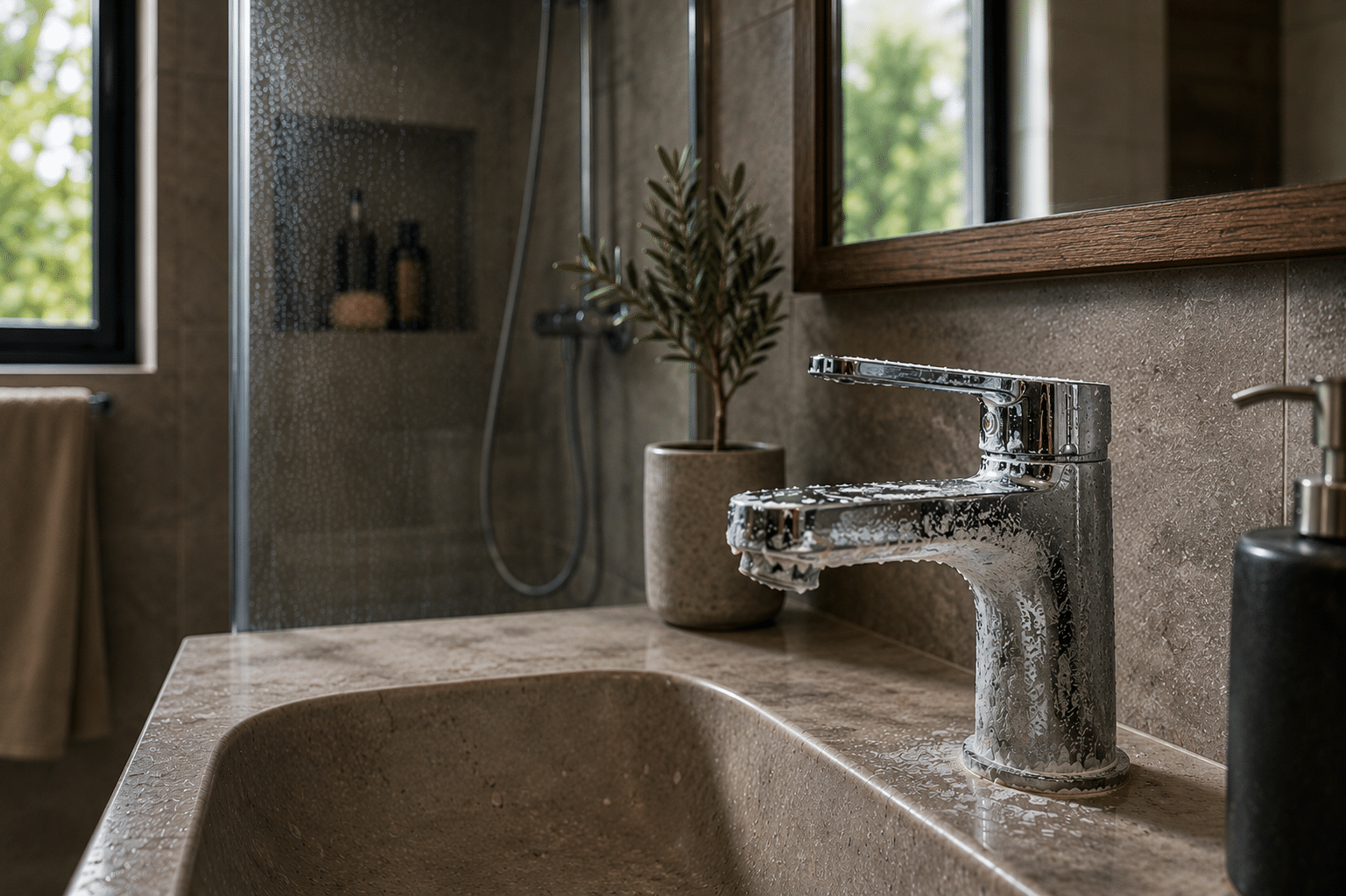
If you’ve never given a second thought to the water coming out of your tap, the Costa Blanca will change that. Hard water in the Costa Blanca region is a given since a large part of it sits on limestone bedrock. As water travels through it, it picks up dissolved calcium and magnesium along the way. The result is what’s called hard water. It’s one of those small daily-life differences that catches a lot of newcomers off guard.
You’ll find more about the basics of what hard water is and how it shows up on your utility bill on our Utilities page. Here we talk about what it means in day to day life and what to check before you buy a home.
Why Is The Water So Hard?
Hard water simply means water with a high mineral content, mainly dissolved calcium and magnesium, picked up as the water passes through rock and soil on its way to the tap. The more of those minerals it carries, the “harder” it’s considered and the more noticeable the effects around the house.
The region’s limestone geology is the short answer for why the water here carries so much of it. As groundwater filters through limestone rock, it dissolves calcium carbonate and carries it into the water supply. By the time it reaches the tap, it’s carrying a much higher mineral load than most people are used to if they’re coming from areas with softer water.
This isn’t unique. Most of the Mediterranean coast, including Jávea, deals with the same thing. It’s worth understanding and exploring solutions because it affects nearly everything that touches water in your home.
Is It Like This Everywhere in Spain?
No. Water hardness varies a lot by region. If your search takes you beyond the Costa Blanca this is key.
Broadly speaking, the north and northwest of the country tends to have soft water, while the eastern half and south lean hard. Galicia, the Pyrenees region and Madrid are known for some of the softest water in Spain, along with cities like Vigo, Burgos, San Sebastián and León.
The “water hardness belt” runs along the Mediterranean coast and into the interior, covering Valencia, Alicante, Murcia, Barcelona and inland areas like Aragón, Catalonia, Castilla-La Mancha and Castilla y León. Zaragoza and Palma de Mallorca are frequently cited with the hardest water in the country. If you’re comparing these areas to other places in Spain during your search, expect a noticeably different day-to-day experience with water, appliances and how much attention descaling needs.
What Hard Water Does To Your Home
The most visible sign is limescale, the chalky white buildup you’ll see around faucets, showerheads and anywhere water evaporates and leaves mineral deposits behind. Left unchecked, it builds up inside pipes and appliances too, not just on visible surfaces.
Appliances take the brunt of it over time. Coffee makers, kettles, washing machines and dishwashers all involve heating or moving water through narrow channels. Limescale narrows those channels further and reduces efficiency.
Regular descaling keeps things running properly. Most people here use a citric acid or vinegar-based descaling solution every month or two for kettles and coffee makers and dishwashers and washing machines typically have their own dedicated descaling cycle or product.
Skip that maintenance and the cost shows up later: a scaled-up washing machine or dishwasher heating element typically means a callout fee plus a parts and labor bill that’s a meaningful fraction of a new unit. Often it’s simpler and not much more expensive to just replace the appliance rather than repair it. A few minutes of descaling now is a lot cheaper than either option.
Your water heater/boiler is one of the appliances most worth protecting. The calentador or termo that supplies your hot water has heating elements that scale up just like a kettle does, and a scaled-up unit works harder, costs more to run and fails sooner. If you’re not installing a whole-house softener, this is one appliance worth descaling or servicing on its own on a regular schedule, since replacing a heating element or the unit itself is a far bigger expense than prevention. A full boiler replacement is one of the pricier single-appliance repairs you can face in a home.
Laundry and soap behave differently too. Hard water makes it harder for soap and detergent to lather, so you may need to adjust the amount you use or switch to detergents formulated for hard water. You’ll also notice towels and clothes can feel stiffer over time as mineral deposits build up in the fabric, a water softener or occasional vinegar rinse cycle helps with this too.
Underfloor heating systems are common in this region and particularly vulnerable to scale buildup. These systems circulate water through a network of narrow tubing embedded in the floor and limescale accumulation inside that tubing reduces heating efficiency over time. It is far more difficult and expensive to address since the tubing isn’t easily accessible.
A full flush or repair can mean pulling up flooring in the worst cases, which turns a routine maintenance item into one of the more expensive repairs a home can face. This applies whether you’re buying an existing home with underfloor heating already installed or having it put into new construction.
For an existing system, ask when it was last flushed or serviced. For new installations, ask your installer what water treatment or filtration is built into the system to protect it long term.
Hard water affects your pool, too. If your home has a pool, calcium from the water supply builds up in pool equipment and along tile lines over time. It also throws off the water balance you’re managing with chemicals, since calcium hardness is one of the core numbers in pool water testing alongside pH and chlorine.
Filters, heaters, and pumps all see the same kind of scale buildup as household appliances, just at a larger scale given the volume of water involved. Excess scale in a pool heater or pump generally means an earlier replacement than you’d otherwise expect. Make sure to factor pool equipment into the same descaling and water treatment thinking as the rest of the house.
Water Softener Systems
Water softener systems are worth considering for the whole house rather than fighting hard water appliance by appliance. Point-of-entry softeners treat all the water coming into your home before it reaches any tap or appliance. It’s a much more thorough approach. As a homeowner, it’s the kind of investment that pays off in a short amount of time.
Types Of Water Softeners
Salt-based ion exchange systems are the traditional and most effective option, and what most people mean when they say “water softener.”
They swap the calcium and magnesium in your water for sodium using a resin bed, and periodically regenerate that resin using salt. This is the only type that actually removes hardness rather than just managing its effects. It’s the standard choice for whole-house protection in hard water areas like the Costa Blanca.
The tradeoff is ongoing salt costs and periodic maintenance, though this is lighter than it sounds. Loading salt yourself is a five-minute task done every month or so and if you’d rather not deal with it, local technicians offer maintenance plans that include salt supply and system checks on a scheduled visit. Typically those visits are every 6 to 12 months for around €130 to €190 a year all in.
Salt-free or electronic descalers condition the water rather than removing the minerals from it, using a technology that changes how calcium behaves so it’s less likely to stick to surfaces. They’re cheaper to buy, need no salt or chemicals, and require little to no maintenance. They are generally considered less effective than salt-based systems for genuinely hard water and results are more mixed. These tend to appeal to people who want a lighter-touch, lower-maintenance option and are willing to accept a smaller improvement.
Dual-tank systems solve one annoyance of single-tank salt-based softeners: during the regeneration cycle, a single-tank system briefly supplies unsoftened water. A dual-tank setup keeps one tank online while the other regenerates, so you always have softened water, useful for a household that doesn’t want to time showers and laundry around a regeneration cycle.
Brands Of Water Softener Systems
For brands, two names are worth knowing, though they work a little differently.
Fleck isn’t a retail brand you buy directly, it’s the valve technology, manufactured by Pentair that controls the regeneration cycle inside many softener units. It has a strong reputation for durability and is widely used inside units sold by installers and retailers across Spain, so look for “Fleck” or “Fleck 5600” in a unit’s spec sheet as a mark of reliable internals rather than searching for a Fleck-branded storefront.
The best approach in Spain is to buy through an established local installer or a marketplace like Amazon.es, where you can see current buyer reviews for the specific model and brand you’re considering before committing and where a local installer can also stand behind the install and any service needs after the sale.
For independent research beyond what we cover here, OCU (Organización de Consumidores y Usuarios), Spain’s leading consumer organization, is worth checking for general water hardness data by region and their past coverage of what does and doesn’t actually work against limescale. They don’t run a dedicated comparative test of individual softener brands the way they do for some other appliance categories.
Reverse Osmosis
Tap water in the Costa Blanca and across Spain meets EU drinking water standards and is safe to drink, so hardness here is a mineral content issue, not a safety issue. That said, plenty of residents, both Spanish and expat, aren’t fans of the taste since the heavy mineral content affects flavor. That’s where reverse osmosis comes in.
You’ll see reverse osmosis systems (osmosis inversa) advertised heavily by local installers and for good reason. They’re the most thorough answer to Costa Blanca’s hard water at the tap. Rather than just improving taste like a basic filter pitcher, they push water through a membrane that strips out most dissolved minerals entirely, giving you noticeably softer-tasting drinking and cooking water from a dedicated tap.
It’s a common add-on here specifically because the water is so mineral-heavy and worth asking about if you’re already getting quotes for a whole-house softener since many installers will bundle the two.
On brands, Bbagua is a Spanish company that’s specialized in water treatment since 2007, offering both reverse osmosis systems and softeners with national installation support. It’s well regarded for reliable, straightforward home systems at a reasonable price. As always, it’s worth comparing a couple of quotes and checking recent reviews for whichever specific model you’re considering before buying.
If reverse osmosis feels like more than you need, a simple filter pitcher or basic under-sink filtration unit is a lighter alternative that improves taste without the cost or installation of a full RO system, though it won’t reduce mineral content the way RO does.
Combining Water Softeners And Reverse Osmosis Systems
The two systems solve different problems, so combining them is common rather than redundant.
A whole-house softener protects your pipes, appliances, boiler, and everything else water touches, while reverse osmosis is specifically for what comes out of one dedicated tap for drinking and cooking. Softened water can still run through an RO system without issue and doing both means the whole house is protected from scale while your drinking water gets the extra step of mineral removal for taste. It’s worth asking any installer you get a quote from about a combined setup rather than pricing the two out separately, since bundling installation is usually more efficient than treating them as two unrelated projects.
Budget-wise, a whole-house softener installation typically runs €750-€1250 or more since system type and household size both affect the price. If you combine the whole-house softener with reverse osmosis for drinking water at the kitchen, packages can move toward roughly €1,900–€3,700.
Before deciding how far to go with any of this, it’s worth finding out your actual water hardness (dureza del agua) rather than going on regional reputation alone. Your local water supplier’s website or the national SINAC database will usually list the hardness for your specific municipality. You can also use a cheap TDS meter (Amazon is a good source) that will give you an instant reading straight from your own tap.
For reference, water is generally considered:
For example, SINAC lists Jávea’s water hardness at around 262 mg/L where we’ll be living as squarely in the very hard range.
If You Are Purchasing An Existing Home
If you’re evaluating a resale property rather than new construction, hard water history is worth asking about directly.
Decades of mineral buildup inside old pipework can narrow interior diameters and reduce water pressure. In extreme cases it can contribute to corrosion or leaks at joints. This is part of what we recommend checking during a property inspection, and it’s covered in our Property Evaluation Checklist under plumbing systems.