
Property In Spain
Foreign
Exchange Rates

When we started preparing for our move to Jávea, we focused on what the actual price of homes in Spain were in US dollars. Just a small fluctuation in the exchange rate can change what a home costs us by tens of thousands of dollars, even when the seller’s price in Euros never moves.
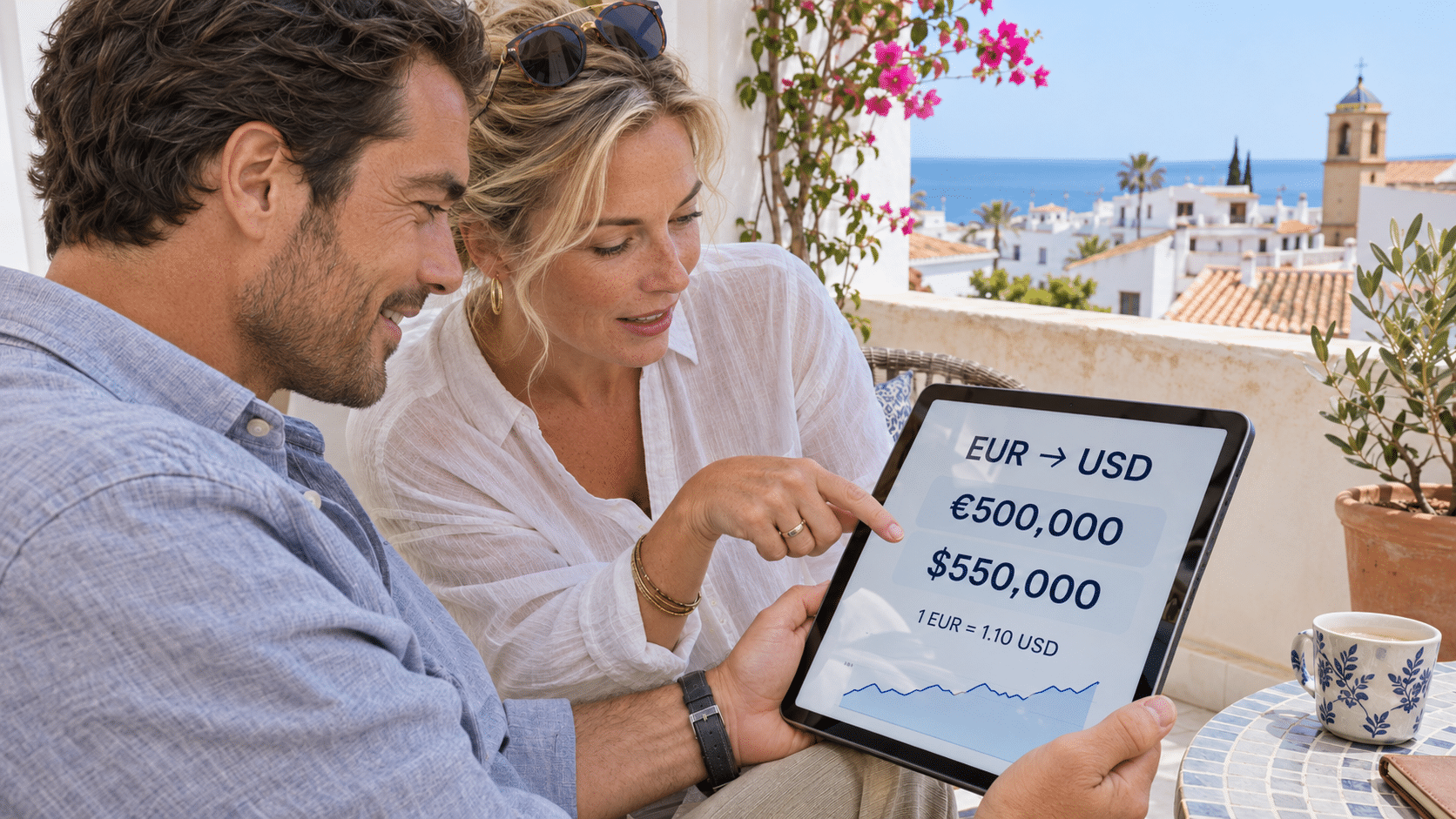
While we knew there was definitely going to be things to think about converting US dollars into euros, we didn’t realize all the ins and outs of the process, plus all of the careful thought you have to put into it to avoid paying a significant amount of extra money.
The exchange rate matters at two different points:
The same move in the exchange rate can help you one year and hurt you later. This page walks through both sides with simple examples, explains what moves the rate and gives you two calculators to try with your own numbers.
The EUR/USD Exchange Rate
For this article, the exchange rate always means how many US dollars it takes to buy 1 euro.
When the number falls, the euro is cheaper and your dollars buy more euros. When it rises, your dollars buy fewer euros. Watch the direction over time. Some apps and banks show the reverse: how many euros you get for $1 (for example, 0.91 instead of 1.10). Check the label before you enter a rate into any of our helpful calculators below.
What Impacts The Exchange Rate
A currency is like anything else people buy: when more people want dollars, the dollar costs more. A few things drive that demand:
Where things stand now (November 2026): US interest rates are higher than Europe’s. The Fed’s target rate tops out at 4.00%, while the ECB’s deposit rate is 2.50%. That gap has helped the dollar. The euro has slipped from about $1.17 earlier this year to around $1.11.
Exchange Rate Impact On Daily Life
Say you’re converting $10,000. Here’s how many euros you’d receive at different rates (before exchange fees):
| Exchange Rate For USD Per €1 | Euros Received For $10,000 |
|---|---|
| 1.20 | €8,333 |
| 1.10 | €9,091 |
| 1.00 | €10,000 |
| 0.90 | €11,111 |
Going from 1.10 to 1.00 gives you about €909 more from the same $10,000. Your dollar balance didn’t change. What that dollar buys in euros, did.
The same applies to any income that arrives in dollars, such as wages, investment distributions, Social Security or a pension. A fixed €2,000 monthly budget costs $2,400 at 1.20, $2,200 at 1.10 and $2,000 at parity.
Exchange Rate Impact On Buying A Spanish Home
Suppose the home you want costs €500,000 and the euro price never changes.
| Exchange Rate For USD Per €1 | Cost Of The €500,000 Home In US Dollars |
|---|---|
| 1.20 | $600,000 |
| 1.10 | $550,000 |
| 1.00 | $500,000 |
| 0.90 | $450,000 |
A useful rule of thumb: for a €500,000 home, every one-cent move in the euro changes your dollar cost by $5,000.
This works in both directions. In Spain when purchasing a house you usually sign a deposit contract (the arras) and complete the purchase weeks or months later. Completion is the Spanish equivalent of closing. If the euro gets more expensive in between, you need more dollars, even though the seller’s price hasn’t changed.
Also remember that the “published exchange rate” isn’t necessarily the exchange rate you’ll end up getting. Many currency exchange firms and financial institutions pad their exchange rate to make more income. Plus you’ll have any transaction fees to move the money from US dollars into euros. Those fees can also vary widely by financial institution and on how much money you wish to convert.
Calculator: What Will Your Spanish Home Cost In Dollars?
This calculator keeps the home’s price in euros fixed and compares how its cost in US dollars changes between two exchange rates.
What Will Your Spanish Home Cost in U.S. Dollars?
How to use it:
The results show the dollar cost at each exchange rate and the difference between them. The difference is labeled “Dollar Savings” when the comparison rate is cheaper and “Additional Dollar Cost” when it’s more expensive. It’s a great way to see what will happen to the actual amount you’ll pay in dollars if the exchange rate changes over time.
The Impact Of Exchange Rates After A Spanish Home Purchase
After you buy a home in Spain, it has a value in two currencies. Your home in Spain has its market value in euros. Its corresponding value in dollars depends on the exchange rate on the day you check or the day you sell.
Say you buy a €500,000 home at 1.10, so it costs $550,000. Ten years later it has appreciated 30% in value to €650,000.
Here’s what that same home is worth in dollars at different future rates.
| Future USD Value Per €1 | Value In US Dollars | Gain Or Loss Vs $550,000 |
|---|---|---|
| 1.20 | $780,000 | +$230,000 |
| 1.10 | $715,000 | +$165,000 |
| 1.00 | $650,000 | +$100,000 |
| 0.85 | $552,500 | +$2,500 |
| 0.80 | $520,000 | −$30,000 |
The home’s current value in euros stays the same. Only the exchange rate changed. At 0.80 the home is worth less in dollars than what you paid.
The key point: a cheaper euro helps you buy, but once you own, it lowers the dollar value of your home. A stronger euro increases the value of your home in US dollars.
Calculator: Estimating The Future US Dollar Value Of Your Spanish Home
This calculator compares what you originally paid in US dollars compared to what a future sale could be worth. It assumes an all-cash purchase.
Future Value of Your Spanish Home
How to use it:
Which Currency Matters Most?
It depends on where you expect the money to end up.
Both effects can happen at the same time. A weaker euro can make your dollar-funded daily life in Spain cheaper while lowering the dollar value of the home you own.
The Impact On Taxes Of Selling Your Spanish Home
If you’re a US citizen, the IRS taxes you on worldwide income, including the sale of a home in Spain. It calculates your gain in US dollars. Your purchase cost (plus costs such as improvements and closing fees) is converted at the exchange rate on the day you paid it. Your sale price is converted at the rate on the day you sell.
So the exchange rate itself can create or wipe out a taxable gain.
In the 1.20 row of our table above, the home gained €150,000 in euros but $230,000 in dollars as the IRS would measure it before costs or exclusions.
A few points to raise with a tax professional:
These rules are complex and depend on your situation. Talk to a tax professional who works with both US and Spanish taxes before you buy, not just when you sell. Our expat taxes guides cover more.
Moving Money For A House Purchase In Spain
There’s no perfect day to convert US dollars to euros. But there are a few things worth weighing, especially when your purchase stretches over months or years, depending on whether you construct a house from the ground up, buy a house already under construction or an existing Spanish home.
Know When You’ll Actually Owe Euros
| Buying Stage | Payment In Euros | Timing |
|---|---|---|
| Still searching | Not yet | If you’re confident you’ll buy, you might start moving money in stages if you feel the exchange rate will be better now. |
| Existing home, arras signed | A deposit (often around 10%) at signing, the rest at completion weeks or months later | Your euro amount and date are now known. This could be the time to lock in an exchange rate or convert. |
| New build or under construction | Stage payments during construction, which can take up to two years | Your exposure is long, but the payment schedule is known in advance. You can plan each payment separately. |
The Future Exchange Rate Outlook Is Just One Input
Banks and currency providers publish forecasts for where the euro is heading. Check them against your forecasted timeline. If the outlook suggests the euro could get more expensive and you’re confident about the purchase, converting part of your money earlier may be worth considering.
Treat forecasts as one input, not a prediction. Remember forecasts are what professionals think could happen not what will happen. It does, however, give you a range of rates to test various scenarios in the calculator.
Consider The Costs Of Converting Early
Managing Exchange Rate Risk
You can’t control the exchange rate, but you can control how exposed you are to it. Once you know your timeline, these are the main tools:
The European Central Bank publishes daily euro reference rates, but it describes them as information rates, not rates for transactions. The quote from your provider is what you’ll actually get. And whenever you’re moving large sums, confirm the receiving bank details by phone first. Our wire fraud guide explains why.
Our Experience So Far
We’ve been trying to be as forward-looking as possible when we’ve been moving money into euros from US dollars.
When we engaged a lawyer to help us not just the house purchase, but also immigration needs, we had them invoice us for all of the services at once. The fees are usually less the more money you exchange at one time.
For the deposit on our Spanish house, including the payments due prior to finishing construction and closing, we’re trying to move as much money into euros as we can, when the rates are advantageous. It’s hard to tell exactly what the markets are going to do, but when we started preparing for our move to Spain in August of 2025, the exchange rate has declined from around 1.20 to 1.10.
As of this update (November 2026), the current forecast is for the euro to decline another .01 to .03, so we’re waiting just a bit before transferring more. When we feel the time is right, we’ll probably transfer as much as possible to take advantage of the lower rate.
We’ve been using Wise so far, because the exchange rate they offer has been the lowest as have the fees. However, each time we move money we get quotes from XE and OFX as well, just in case they may have better rates. You can get reduced fees if you have multiple transfers within a short window of time.
We’ll keep this updated as we go through the house purchase process.
FAQs
Why is the rate I’m quoted worse than the rate I see on Google?
Google and most news sites show the mid-market rate, the midpoint between what banks pay to buy and sell euros. Transfer providers add a markup on top, which is how most of them make their money. Banks often mark up a few percent, while specialist transfer services are usually well under 1%. On a €500,000 purchase at 1.10, a 2% difference is about $11,000.
Do I need to prove where the money for my home came from?
Expect to. Spain’s anti-money-laundering rules require banks and notaries to check where purchase funds come from and how they’re paid. Keep a clear paper trail: statements showing the money leaving your US account, the transfer confirmation and the funds arriving in Spain. Money that bounces through several accounts can cause delays..
If I have a Spanish bank account do I have to report it to the IRS?
Usually, yes. If the combined value of your foreign accounts goes over $10,000 at any point in the year, you must file an FBAR (FinCEN Form 114). Holding euros for a home purchase can easily cross that line. Larger balances may also require IRS Form 8938. Once you’re a Spanish tax resident, Spain has a similar rule in reverse: Modelo 720 for assets abroad worth more than €50,000 in a category.
What happens if my completion (closing) date moves after I lock in a rate?
A forward contract is binding, so you still have to buy the euros. Many providers let you settle early or extend the date, usually for a fee or a small rate adjustment. Ask about this before you book, since Spanish completion dates do slip.
Is it safe to use a currency transfer company instead of my bank?
It can be, if the company is properly regulated. In the U.S., check that it’s registered with FinCEN as a money transmitter and licensed in your state. Before a large transfer, confirm the receiving account details by phone and consider sending a small test payment first.

Before Moving
Everything you need to sort before you leave — visas, NIEs, finances and the hundred other things on your pre-move list.

After The Move
What you need to get sorted once you arrive — utilities, healthcare, paperwork and all the practicalities of your new life in Spain.

Property Guide
Here’s what to know about buying property in Spain as an American — from your first search to signing at the notary.

Resources
Checklists, glossaries and vetted websites to help you plan, prepare and hit the ground running in Spain.

Our Journey
Follow along as we document our move from Portland, Oregon to Jávea, Spain — the highs, the headaches and everything in between.
This page last updated: