
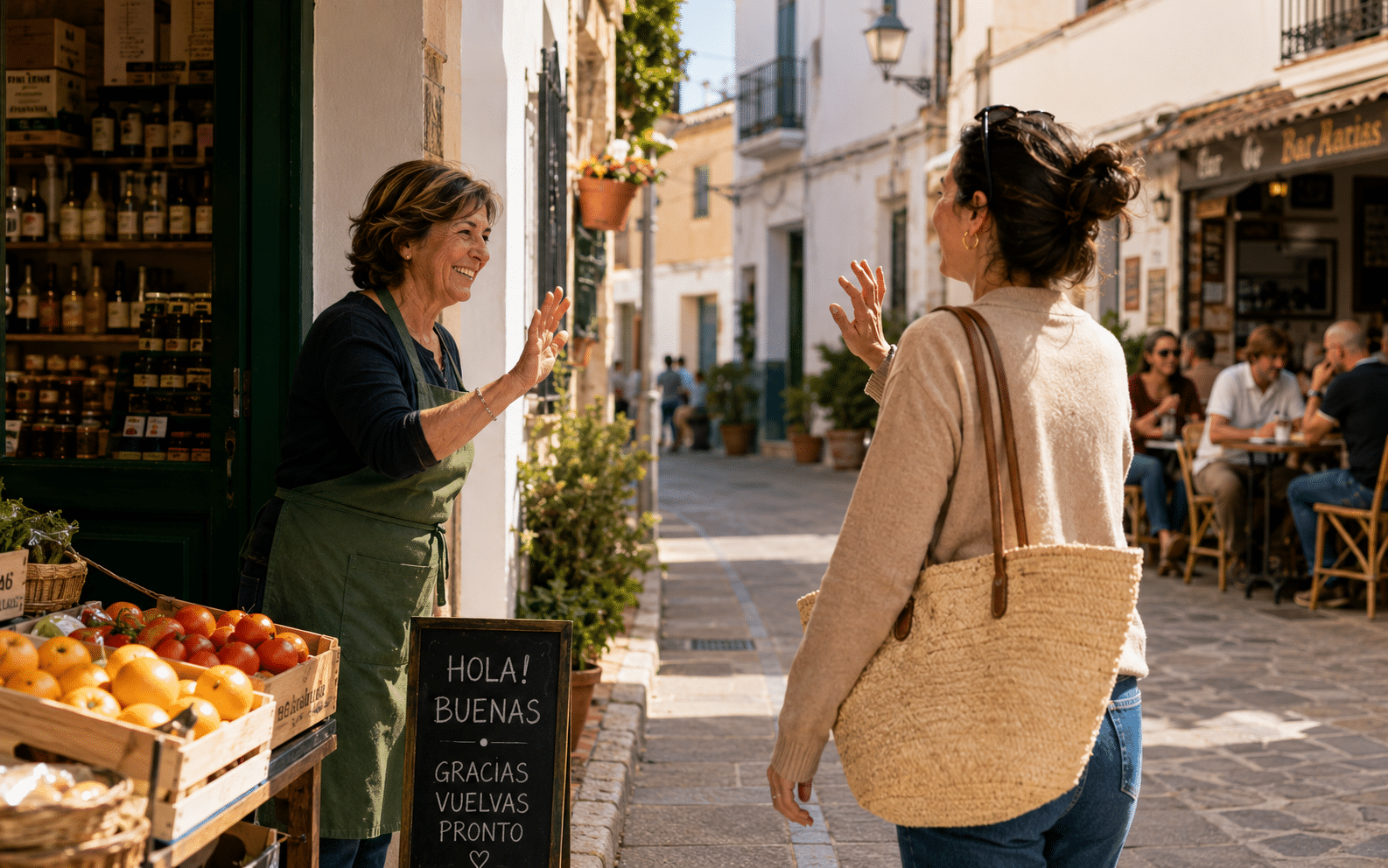
Most of daily life in Spain will feel familiar. People are polite, helpful and generally happy to see a new face around. But a layer of everyday habits works differently here. Social customs in Spain can be different. They won’t cause real problems if you get them wrong, but they make life smoother once you know them.
What Social Customs In Spain Are The Same?
Basic courtesy. Please and thank you is just as important here as it is in the US. Business interactions are just as professional once you’re past the greeting. Personal space is a little closer than a lot of Americans are used to. Punctuality still matters for anything formal: a doctor’s appointment, a meeting with a gestor or a scheduled service call.
Say Hello And Good Bye, Every Single Time
In Spain, you greet people when you walk into a small shop, step into an elevator or sit down at a bar, even if you don’t know a single person there.
A simple “hola” or “buenas” on the way in and “adiós” or “hasta luego” on the way out is expected. Skipping it doesn’t usually get called out, but it gives a cold or standoffish vibe. That’s the opposite of how you’d want to be perceived.
At Restaurants, The Pace Is The Whole Point
Meal times run later than most Americans expect. Lunch typically starts between 2 and 3pm and dinner rarely gets going before 9. Show up at 7 looking for dinner and you may find the kitchen isn’t even open yet.
In Spain, it’s not about “turning tables” like it is in the US. Once you’re seated, nobody rushes you. The bill won’t appear until you ask for it, since bringing it earlier is considered pushy rather than helpful.
Tipping isn’t the built-in expectation in Spain. Rounding up or leaving a small amount of change for good service is normal and appreciated, but nothing close to the 15, 20 or 25 percent baked into American dining.
Among friends, it’s common to take turns picking up the whole check across different outings rather than splitting every bill down the middle. And don’t expect a to-go box for leftovers at most sit-down restaurants. Taking food home isn’t really part of the culture here.
Spain Is About Slowing Down And Enjoying Life
Sobremesa deserves its own mention beyond just “don’t rush the check.” It’s the stretch of time after a meal is finished where the plates get cleared but nobody leaves. Conversation just keeps going, sometimes for another hour or more. It’s considered part of the meal itself. Treating it that way, rather than checking your phone or angling for the exit goes a long way toward being welcomed back.
A few other food and drink rituals are worth knowing, since they show up constantly in daily life.
El aperitivo or tomar el vermú, is the custom of a pre-lunch drink and a small bite, often vermouth, especially on Sunday around midday. It’s less about the drink and more about the excuse to be out and social before the main meal.
Ir de tapas, going out for tapas, usually means moving between two or three different bars over the course of an evening, having a small plate and a drink at each rather than settling in at one place.
Tomar un café, having a coffee, works the same way a lot of American “let’s grab a coffee” invitations do, except it tends to run longer and matter more.
Running Errands
The same greet-the-room habit applies the moment you walk in anywhere, a quick “buenos días” to the clerk before you launch into whatever you actually need. Lines aren’t always physically organized the way they are in the US. In a lot of small shops, pharmacies and market stalls, people track their own place informally. It’s completely normal to ask “¿quién es el último?”, who’s last in line when you walk in, then just remember who that was.
Plan around the siesta if you’re running errands in a smaller town. Many shops and offices still close for a few hours in the early afternoon, roughly 2 to 5pm. Showing up then just means trying again later. You may want to consider dressing a notch above typical American errand-casual. Smart-casual is closer to the local norm in parts of Spain, even for something as simple as a trip to the pharmacy.
Out And About
In smaller towns it’s common to greet someone you pass on a quiet street, even a total stranger. That’s especially true outside the busiest tourist areas. It’s a habit worth adopting rather than resisting. It’s one of the fastest ways to start feeling like a local rather than a visitor.
Evenings often bring people out for a paseo, an unhurried walk through town or along the promenade. It doubles as informal socializing, running into people you know and generally being out and visible rather than staying home behind closed doors.
Related to the paseo is a custom called tomar el fresco, taking in the cool evening air. Once the heat of the day recedes, especially in summer, it’s common to see neighbors bring chairs out onto the sidewalk, a balcony or a spot outside their front door and simply sit, chat, and cool off together as the evening settles in.
Knowing these cultural norms in Spain gets you through the everyday moments smoothly. It helps get you past being a polite, familiar face and into something more which are being real neighbors and building real friendships.