

Our guide on Moving Goods to Spain covers the logistics end to end. Things like the traslado de residencia customs exemption, required paperwork, choosing a moving company, shipping timelines and insurance.
This post zeroes in on one specific decision inside that process: what’s worth moving to Spain and what’s cheaper to leave behind and buy again when you get there. It also covers the short list of things Spain won’t let you bring at all, no matter how much you want to keep them.
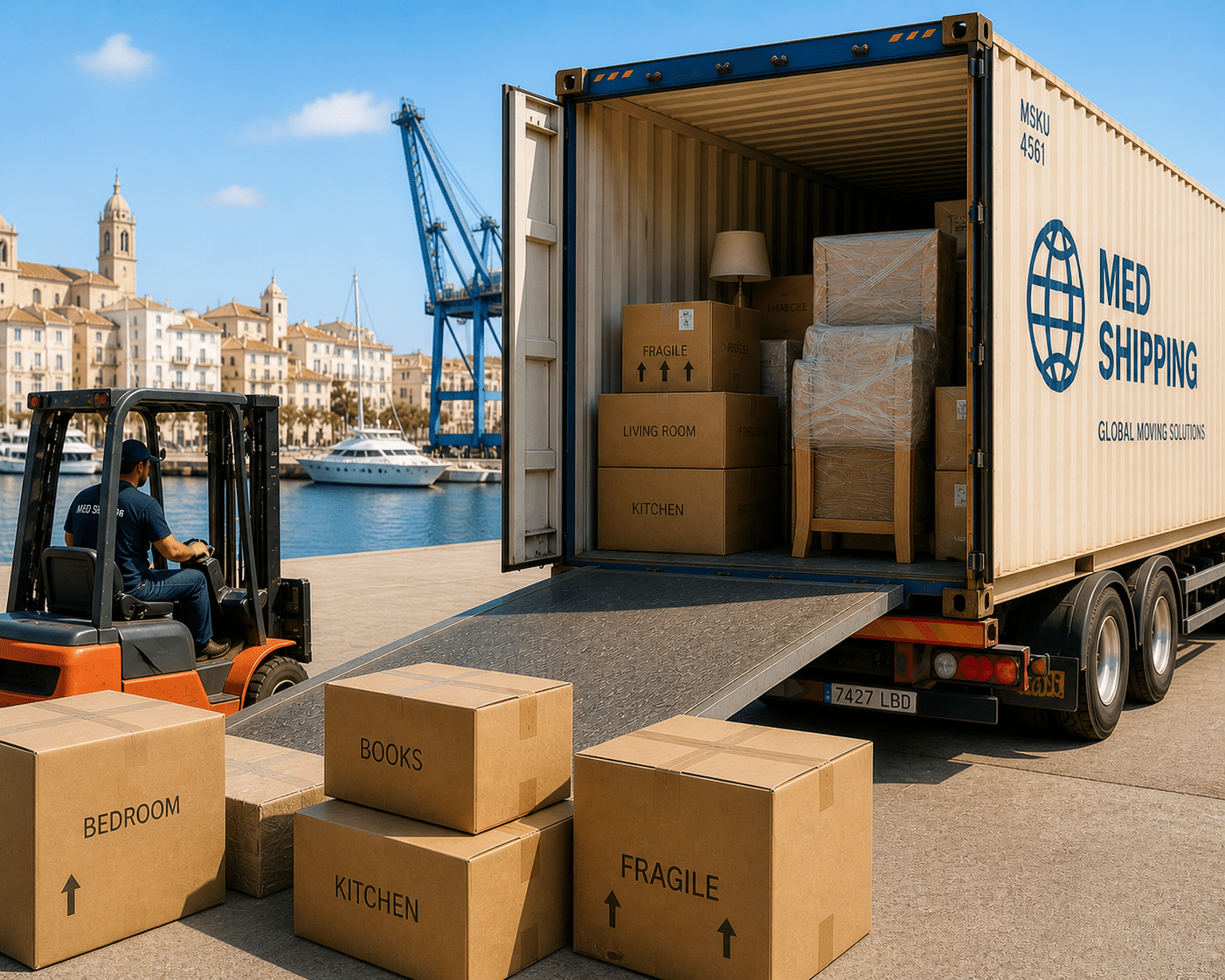
Ship It Or Replace It: A Practical Framework
Even with the duty-free exemption covered in our moving guide, shipping still costs real money and container space is limited. Before you pack something, weigh it against what the same item costs to simply buy in Spain.
As a starting point, furniture and household goods in general tend to run cheaper in Spain than in the US. Between IKEA, Leroy Merlin and other affordable retailers covered in our furnishing a Spanish home post, and generally lower prices on everyday household goods is genuinely cheaper to rebuy locally than to ship. This surprises people who assume Europe means paying more for everything. For big-ticket furniture specifically, it’s often the opposite.
The math is often more one-sided than people expect once you look at the actual shipping cost per item. Ocean freight is typically priced by volume, roughly $150 to $300 per cubic meter depending on the shipping company and route. A single large item can eat a meaningful chunk of your container budget before you even count the cost of the item itself.
A large sectional sofa or a solid wood dining set can easily take up 3 to 5 cubic meters once it’s crated and padded for the journey, putting the shipping cost of that one item alone in the $450 to $1,500 range, on top of whatever you originally paid for it. Compare that to buying a comparable piece new in Spain and for most mid-range furniture the replace option clearly wins once you do the actual math.
This math shifts for smaller, denser items. A box of books or kitchenware takes up little volume relative to its value, so shipping cost per item stays low even at the same per-cubic-meter rate. The rule of thumb: the bulkier and heavier an item is relative to what it would cost to replace the more likely it is that shipping doesn’t make financial sense.
Ship it if:
Replace it if:
There’s no universal rule here. A well-loved leather sofa might be worth shipping for one person and not worth the container space for another. The honest test is: would you pay to ship this today, at these prices, if you were starting from scratch? If the answer is no, sell it or donate it before you move rather than shipping it out of habit.
What Spain Won’t Let You Bring At All
Regardless of the ship-or-replace calculation, a short list of items simply can’t come with you or need documentation you likely won’t have as a normal household mover:
110V-only appliances without a real plan.
Not prohibited, but functionally pointless to bring without a voltage converter, and most people find it’s not worth the hassle for anything beyond a small item. See our [voltage post] for what’s actually worth converting versus replacing.
Houseplants and seeds.
Living plants, seeds, and some fresh flowers face real restrictions, and many require an official phytosanitary certificate from the country of origin to even be considered. For most people moving a normal household, it’s simpler to leave plants behind and buy new ones locally.
Most fresh, frozen, and perishable food.
Fresh produce, meat, and dairy from outside the EU face strict restrictions, largely due to agricultural pest and disease rules. Don’t plan to ship or bring your pantry.
Alcohol beyond personal-use quantities.
A modest personal collection generally isn’t an issue, but larger wine or spirits collections can trigger customs duties and additional scrutiny once they exceed personal-use thresholds, and may need to be declared separately from your general household goods. Our [Moving Your Belongings To Spain guide] covers this in more detail under specialty items, since wine collections in particular are common enough among our readers to be worth planning for ahead of time.
Medications without proper documentation.
Personal-use medication is generally fine, but bring it in original packaging with your name on it, along with a prescription or doctor’s note, especially for anything beyond about a 30-day supply.
Firearms, ammunition and weapons.
Heavily restricted and generally not something a normal household move should attempt without separate, specific licensing. This includes some items you might not expect like air guns, gun replicas and even certain tools like axes or harpoons.
Non-functional or deactivated firearms, like a family heirloom or a decorative trophy gun that can’t fire are not automatically exempt. They fall under their own EU regulatory category. They require a proper deactivation certificate confirming the weapon was deactivated to an official standard, correct markings and a formal customs declaration even though the actual security risk is obviously lower.
Spain also has a dedicated collector’s license (License L) for historical and artistic firearms. It is a separate, more involved track from simply packing an old rifle into a moving box. If you have anything in this category, plan on getting real guidance from a licensed importer or the Guardia Civil’s Intervención de Armas well before your move, rather than assuming a non-firing piece is automatically fine.
CITES-restricted animal products.
Items made from protected or endangered species, including some antiques or décor with ivory, tortoiseshell or certain exotic woods and skins can be seized without the correct permit.
Undeclared cash over €10,000.
Not prohibited, but must be declared. Failing to declare cash over this threshold can mean seizure and a fine ranging from 50% to 100% of the amount regardless of intent.
Wood items with pest concerns.
Untreated wood furniture or items with visible pest damage can be flagged and held for inspection or treatment, adding delay to your shipment.